


Following more than a decade of legislative proposals, the Cabinet yesterday approved a draft law on nonprofit foundations to place government-funded foundations under strict supervision and prevent them from misappropriating national assets.
The draft act divides foundations into two categories — private and government-funded — each with their own regulatory criteria, Deputy Minister of Justice Chen Ming-tang (陳明堂) said.
Stricter regulations are to be imposed on government-sponsored foundations, such as the Chiang Ching-kuo Foundation for International Scholarly Exchange, and those funded with public properties taken over from the Japanese colonial government, including the Taiwan Telecommunication Industry Development Association, the Postal Association and the Taiwan Sugar Association, which control billions of New Taiwan dollars in assets, but operate outside government control.

Photo: Chien Jung-fong, Taipei Times
Foundations are to be required to disclose their financial and operational data, as well as establish accounting and auditing systems, and would be subject to financial penalties if they fail to comply with government inspections or supervision.
The draft act authorizes the government to merge or dissolve foundations that can no longer meet their founding purpose, with property to be returned to the state.
The bill stipulates that a certain number of board members of government-funded foundations would have to be appointed by the government, with the number to be decided by the state’s stake in an organization’s assets.
Under the proposed act, in a bid to eliminate “fat cats,” government-appointed positions are to generally be unpaid, while holders of salaried positions would be required to give up any pension benefits while in office.
More lenient criteria would be applied to private foundations to ensure their autonomy, Chen said.
There are 165 government-sponsored foundations, 43 of which receive less than 50 percent of their funding from the state, while there are more than 600 private foundations.
“Nonprofit foundations are often criticized as being tools for tax evasion. The existing legal framework is not quite sufficient for regulation, so the draft act was proposed to ensure government supervision,” Chen said.
Transparency in the financial and personnel management of nonprofit organizations is key to ensuring their proper operation, but many organizations have shed government control, Premier Lin Chuan (林全) said.
“The draft act is progressive and will improve the legal environment of nonprofit foundations and their operations,” Lin said.
At present there are no regulations governing nonprofit foundations except for a set of general provisions in the Civil Code.
In September 2000, the Ministry of Justice began drafting legislation to regulate nonprofit foundations, with the Executive Yuan submitting four drafts since 2007 to the Legislative Yuan, none of which passed.
The Ministry of the Interior is to draft a special bill on religious and medical foundations, which have considerable real-estate holdings and are often criticized for a lack of financial transparency.
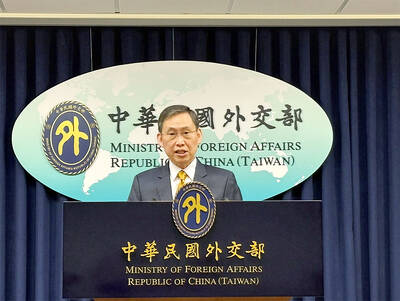
A Ministry of Foreign Affairs official yesterday said that a delegation that visited China for an APEC meeting did not receive any kind of treatment that downgraded Taiwan’s sovereignty. Department of International Organizations Director-General Jonathan Sun (孫儉元) said that he and a group of ministry officials visited Shenzhen, China, to attend the APEC Informal Senior Officials’ Meeting last month. The trip went “smoothly and safely” for all Taiwanese delegates, as the Chinese side arranged the trip in accordance with long-standing practices, Sun said at the ministry’s weekly briefing. The Taiwanese group did not encounter any political suppression, he said. Sun made the remarks when

PREPAREDNESS: Given the difficulty of importing ammunition during wartime, the Ministry of National Defense said it would prioritize ‘coproduction’ partnerships A newly formed unit of the Marine Corps tasked with land-based security operations has recently replaced its aging, domestically produced rifles with more advanced, US-made M4A1 rifles, a source said yesterday. The unnamed source familiar with the matter said the First Security Battalion of the Marine Corps’ Air Defense and Base Guard Group has replaced its older T65K2 rifles, which have been in service since the late 1980s, with the newly received M4A1s. The source did not say exactly when the upgrade took place or how many M4A1s were issued to the battalion. The confirmation came after Chinese-language media reported
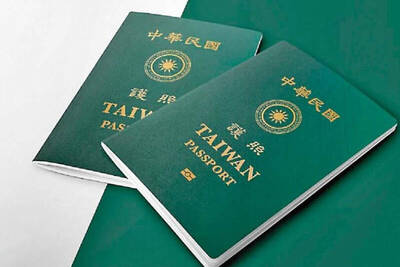
The Taiwanese passport ranked 33rd in a global listing of passports by convenience this month, rising three places from last month’s ranking, but matching its position in January last year. The Henley Passport Index, an international ranking of passports by the number of designations its holder can travel to without a visa, showed that the Taiwan passport enables holders to travel to 139 countries and territories without a visa. Singapore’s passport was ranked the most powerful with visa-free access to 192 destinations out of 227, according to the index published on Tuesday by UK-based migration investment consultancy firm Henley and Partners. Japan’s and
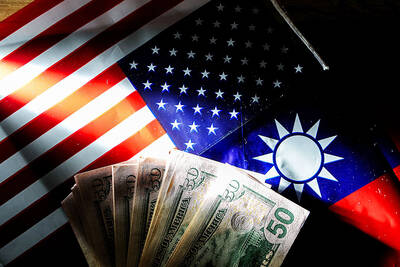
BROAD AGREEMENT: The two are nearing a trade deal to reduce Taiwan’s tariff to 15% and a commitment for TSMC to build five more fabs, a ‘New York Times’ report said Taiwan and the US have reached a broad consensus on a trade deal, the Executive Yuan’s Office of Trade Negotiations said yesterday, after a report said that Washington is set to reduce Taiwan’s tariff rate to 15 percent. The New York Times on Monday reported that the two nations are nearing a trade deal to reduce Taiwan’s tariff rate to 15 percent and commit Taiwan Semiconductor Manufacturing Co (TSMC, 台積電) to building at least five more facilities in the US. “The agreement, which has been under negotiation for months, is being legally scrubbed and could be announced this month,” the paper said,


 RSS
RSS