


An initial review of supervisory articles to govern negotiations with China stalled in the Legislative Yuan yesterday, as lawmakers clashed over procedural questions.
Chinese Nationalist Party (KMT) Legislator William Tseng (曾銘宗), a coconvener of the Internal Administration Committee, adjourned the meeting after Democratic Progressive Party (DPP) lawmakers moved to send the draft legislation back to the general assembly for reassignment.
“No party caucuses or individual legislators raised objections when the bills were originally assigned,” Tseng said, adding that he was willing to allow lawmakers from other committees to speak and raise motions during the review.
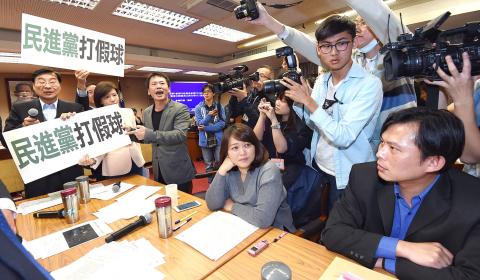
Photo: Liu Hsin-de, Taipei Times
“There are too many variables if the draft bill is sent back to the general assembly or the Procedure Committee [for reassignment] — it could end up being frozen completely,” he said, adding that he would continue to push for a review today.
Under legislative rules, only committee coconveners can call for joint hearings after legislation is assigned to their committees, allowing him to ignore the DPP motion, he said.
Other KMT legislators accused the DPP of boycotting the review of the bill aimed at guaranteeing legislative oversight and civic participation in cross-strait negotiations.
“This motion is just a stalling tactic to win a respite,” KMT Legislator Alicia Wang (王育敏) said. “DPP legislators are afraid to address the issue.”
KMT Legislator Lin Wei-chou (林為洲) accused the DPP of engaging in a legislative maneuver to ensure that the draft bill would be reassigned to a committee where it has control over the agenda.
While the DPP enjoys a strong majority in all legislative committees, voting rules have still enabled the KMT to win coconvenerships on several committees, splitting control over agenda-setting.
DPP caucus whip Ker Chien-ming (柯建銘) joined New Power Party (NPP) lawmakers in calling for the review to be handed to a joint committee.
“We should manage the review because we were the caucus that proposed the official draft version,” he said, criticizing the KMT caucus for failing to propose its own version.
He denied that the DPP was unwilling to initiate a review, while adding that the bill was not the “most important or urgent.”
“Tseng is trying to create conflict within the pan-green camp, while totally ignoring the strategy and stance of the central government,” he said, questioning whether the review should begin before a reported meeting between US President Donald Trump and Chinese President Xi Jinping (習近平) next month.
“Holding a review exclusively within the Internal Administration Committee would be a pretense that Taiwan is part of China, and that is inconsistent with the real state of affairs,” said New Power Party (NPP) Legislator Freddy Lim (林昶佐), who serves on the Foreign and National Defense Committee.
“Does not every version of the supervisory articles mention influence on national security as part of what should be included in mandatory impact assessments for future agreements? Is that not exactly what we in the Foreign and National Defense Committee are responsible for reviewing?” Lim said.
People First Party (PFP) Legislator Chen Yi-chieh (陳怡潔) said that the Foreign and National Defense Committee should be included in a joint committee review only if versions of the legislation referring to Taiwan and China as separate nations are withdrawn.
“Those versions would turn cross-strait relations upside-down, and that is totally unworkable,” she said.
Minister of Foreign Affairs David Lee (李大維) said that holding a joint committee review of the supervisory articles was unnecessary “because cross-strait relations are not foreign relations.”
Mainland Affairs Council Minister Katharine Chang (張小月) said she had “reservations” about versions of the articles referring to Taiwan and China as separate nations.
“Our definition of ‘cross-strait relations’ is ‘cross-strait relations,’” she said.
Additional reporting by CNA
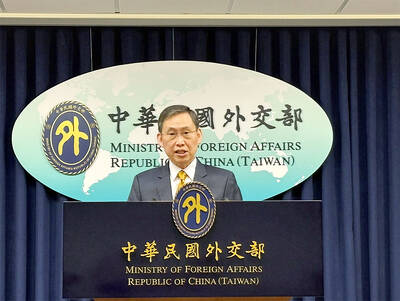
A Ministry of Foreign Affairs official yesterday said that a delegation that visited China for an APEC meeting did not receive any kind of treatment that downgraded Taiwan’s sovereignty. Department of International Organizations Director-General Jonathan Sun (孫儉元) said that he and a group of ministry officials visited Shenzhen, China, to attend the APEC Informal Senior Officials’ Meeting last month. The trip went “smoothly and safely” for all Taiwanese delegates, as the Chinese side arranged the trip in accordance with long-standing practices, Sun said at the ministry’s weekly briefing. The Taiwanese group did not encounter any political suppression, he said. Sun made the remarks when

PREPAREDNESS: Given the difficulty of importing ammunition during wartime, the Ministry of National Defense said it would prioritize ‘coproduction’ partnerships A newly formed unit of the Marine Corps tasked with land-based security operations has recently replaced its aging, domestically produced rifles with more advanced, US-made M4A1 rifles, a source said yesterday. The unnamed source familiar with the matter said the First Security Battalion of the Marine Corps’ Air Defense and Base Guard Group has replaced its older T65K2 rifles, which have been in service since the late 1980s, with the newly received M4A1s. The source did not say exactly when the upgrade took place or how many M4A1s were issued to the battalion. The confirmation came after Chinese-language media reported
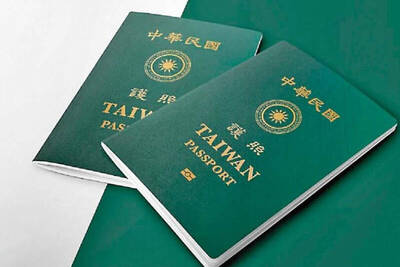
The Taiwanese passport ranked 33rd in a global listing of passports by convenience this month, rising three places from last month’s ranking, but matching its position in January last year. The Henley Passport Index, an international ranking of passports by the number of designations its holder can travel to without a visa, showed that the Taiwan passport enables holders to travel to 139 countries and territories without a visa. Singapore’s passport was ranked the most powerful with visa-free access to 192 destinations out of 227, according to the index published on Tuesday by UK-based migration investment consultancy firm Henley and Partners. Japan’s and

BROAD AGREEMENT: The two are nearing a trade deal to reduce Taiwan’s tariff to 15% and a commitment for TSMC to build five more fabs, a ‘New York Times’ report said Taiwan and the US have reached a broad consensus on a trade deal, the Executive Yuan’s Office of Trade Negotiations said yesterday, after a report said that Washington is set to reduce Taiwan’s tariff rate to 15 percent. The New York Times on Monday reported that the two nations are nearing a trade deal to reduce Taiwan’s tariff rate to 15 percent and commit Taiwan Semiconductor Manufacturing Co (TSMC, 台積電) to building at least five more facilities in the US. “The agreement, which has been under negotiation for months, is being legally scrubbed and could be announced this month,” the paper said,


 RSS
RSS