


The Presidential Office’s committee for Aboriginal historic and transitional justice issues, which is due to hold its first meeting today, has not sufficiently researched the issues it is to discuss, an Aboriginal rights campaigners said yesterday.
There cannot be justice if the committee does not truly understand all of the facts, they said, adding that they are concerned the meeting will lead to little more than the chanting of slogans.
Criticizing the government’s failure to include private land within the scope of the legal definition of traditional Aboriginal territory, a group of campaigners has been staging a “sleepout” on Ketagalan Boulevard in front of the Presidential Office Building since Feb. 23.
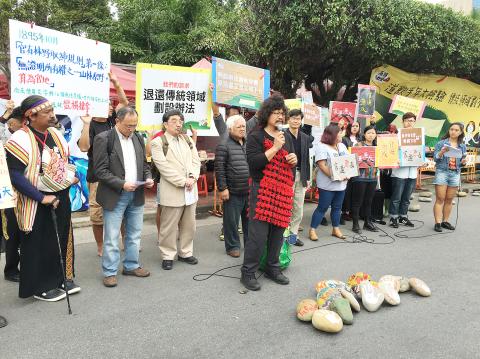
Photo: CNA
They yesterday reiterated their demands that the government retract the proposed Aboriginal land guidelines announced on Feb. 14 and called for the resignation of Council of Indigenous Peoples Minister Icyang Parod.
Documentary filmmaker Mayaw Biho, an Amis, said the government should recognize that transitional justice is about reconciliation, adding that such reconciliation is impossible if the government has not properly investigated the issues.
The government has been idle in addressing Aboriginal issues, he said, noting that today’s meeting comes seven months after President Tsai Ing-wen (蔡英文) made an apology to the nation’s Aborigines.
“Twelve very brave committee members initially submitted proposals for discussion related to traditional Aboriginal land, but all 12 later withdrew their proposals,” Indigenous Youth Front member Savungaz Valincinan said.
Tsai emphasized her support for Aboriginal land rights while she was campaigning for the presidency, National Dong Hwa University professor Shih Cheng-feng (施正鋒) said, adding that the private land excluded by the guidelines accounts for half of traditional Aboriginal land in the nation.
“The guidelines leave no room for Aborigines to even voice an opinion,” Shih said.
Biho concurred, adding: “Traditional land is very important to Aboriginal communities and with the guidelines they are going to lose a million hectares of land.”
He called on Tsai to review the issue carefully, adding that the protesters would continue their sleepout until the committee produces a more just proposal on Aboriginal land guidelines.
The committee spent four months waiting for each Aboriginal community to appoint their representatives to the committee meeting, Presidential Office Deputy Secretary-General Yao Jen-to (姚人多) said.
It is unfair to the committee for it to be judged as illegitimate or unrepresentative before it has the chance to meet, as well as not helpful in terms of establishing lines of communication, Yao said.
Transitional justice measures take time, Yao said.
While many have criticized the committee as being a “toothless tiger,” citing its lack of legal authority to conduct investigations, Democratic Progressive Party Legislator Kolas Yotaka, an Amis, yesterday said the committee’s investigation report would nevertheless have a great impact on transitional justice measures and history education.
Even though the committee does not have investigative authority that the police have, it can conduct research based on academic materials, government records and the oral history of Aboriginal communities.
Such research efforts have helped uncover 400 years of history of the Aborigines in Taiwan and would help carry out transitional justice measures related to Aboriginal communities, she said.
The results of the research should be collated and included in textbooks to tell a more inclusive history of the peoples of the nation, the lawmaker said.

Japan has deployed long-range missiles in a southwestern region near China, the Japanese defense minister said yesterday, at a time when ties with Beijing are at their lowest in recent years. The missiles were installed in Kumamoto in the southern region of Kyushu, as Japan is attempting to shore up its military capacity as China steps up naval activity in the East China Sea. “Standoff defense capabilities enable us to counter the threat of enemy forces attempting to invade our country ... while ensuring the safety of our personnel,” Japanese Minister of Defense Shinjiro Koizumi said. “This is an extremely important initiative for

MORE POPULAR: Taiwan Pass sales increased by 59 percent during the first quarter compared with the same period last year, the Tourism Administration said The Tourism Administration yesterday said that it has streamlined the Taiwan Pass, with two versions available for purchase beginning today. The tourism agency has made the pass available to international tourists since 2024, allowing them to access the high-speed rail, Taiwan Railway Corp services, four MRT systems and four Taiwan Tourist Shuttles. Previously, five types of Taiwan Pass were available, but some tourists have said that the offerings were too complicated. The agency said only two types of Taiwan Pass would be available, starting from a three-day pass with the high-speed rail and a three-day pass with Taiwan Railway Corp. The former costs NT$2,800

POLLS CONCERNS: There are concerns within the KMT that a Cheng Li-wun-Xi Jinping meeting could trigger a voter backlash in elections in November Chinese Nationalist Party (KMT) Chairwoman Cheng Li-wun (鄭麗文) accepted an invitation from Chinese President Xi Jinping (習近平) to visit next month, her party and Chinese state media reported yesterday. Cheng, who took up her role in November last year, “gladly accepted” the invitation to lead a delegation to China, the KMT said in a statement, confirming a Xinhua news agency report. Cheng “looks forward to joint efforts by both parties to advance the peaceful development of cross-strait relations, promote cross-strait exchanges and cooperation, and work for peace in the Taiwan Strait and greater well-being for people on both sides,” the statement said. Chinese
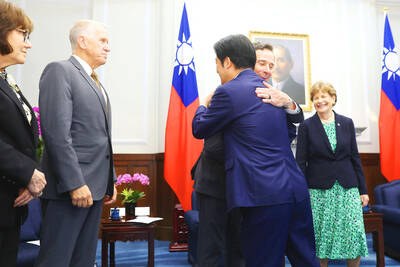
SIGNIFICANT TO THE WORLD: The delegation’s visit aims to send a clear message that bipartisan support for Taiwan is consistent, US Senator Jeanne Shaheen said The US Senate’s bipartisan support for Taiwan remains strong and Taiwan-US ties would continue for decades to come, a US Senate delegation said in Taipei yesterday, while calling on the legislature to swiftly pass a special defense budget bill. A US delegation led by Democratic US Senator Jeanne Shaheen and Republican US Senator John Curtis — both members of the US Senate Committee on Foreign Relations — arrived in Taiwan yesterday for a two-day visit. The other senators of the delegation included Senate Taiwan Caucus cochair Thom Tillis and Senate Committee on Armed Services senior member Jacky Rosen. Shaheen told a news


 RSS
RSS