

Minister of National Defense Feng Shih-kuan (馮世寬) has apologized to Premier Lin Chuan (林全) and other members of the Cabinet for his ministry dragging other agencies into a snowballing drug abuse scandal.
The Ministry of National Defense made a formal report to the Foreign Affairs and National Defense Committee on Thursday about the discovery of suspected amphetamines and drug paraphernalia at the Ching Chuan Kang Air Base in Taichung on Feb. 20 and drug screening that found eight base personnel testing positive for Category 1 drugs.
The report did not say much about the investigation into the case, but stressed the military’s drug abuse prevention efforts, highlighting the relatively low percentage of military personnel with addiction problems (0.08 percent) compared with groups of citizens regulated by other Cabinet agencies such as the Ministry of Education, which has said there is a 4.66 percent suspected drug abuse rate among students.
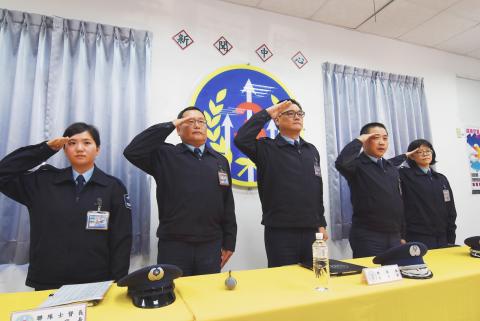
Photo: Lee Chung-hui, Taipei Times
The defense ministry’s disclosure of inter-ministerial records on drug test results triggered public criticism of the Cabinet for failing to enforce drug policies.
Feng apologized to Lin and his fellow ministers for the disclosure in a text message, including Minister of Education Pan Wen-chung (潘文忠) and Minister of Justice Chiu Tai-san (邱太三).
“The indiscreet citation of the National Audit Office’s [sic; it was the Ministry of Justice’s] drug test records during the legislative report today caused criticism from legislators and the media. The defense ministry apologizes [for the indiscretion],” Feng wrote in the text message.
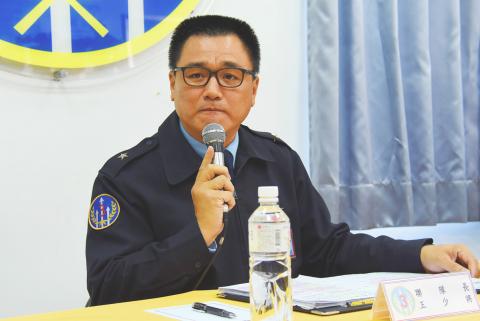
Photo: Lee Chung-hui, Taipei Times
The citation was an “unintentional mistake” and the ministry was sorry for causing a negative perception of the Cabinet, ministry spokesman Major General Chen Chung-chi (陳中吉) said.
In related news, base director Major General Wang Te-yang (王德揚) yesterday said that he has asked his superiors to take disciplinary measures against him for the effect the case has had on the armed forces’ reputation.
“The incident has caused public concern and damaged the reputation of the armed forces. As the base commander, I have examined my [mistakes] thoroughly and feel responsible for the incident. I promise that I will ask the Air Force Command Headquarters to take disciplinary action against me,” Wang yesterday told a news conference at the base.
There are 2,330 enlisted personnel and officers assigned to the base, and all but 225 have undergone drug screening, Wang said, adding that those who have not are either on leave or undergoing off-base training, but their testing would be completed by Wednesday, except for one officer who is in South America.
Asked why the 225 were not immediately recalled to the base to have a drug test, as any possible drugs in their bodies might have already metabolized over the past two weeks, Wang said he did not order them back because “troops have human rights too.”
The base has not withheld any information from the public, he said.
The ministry has said that the case has been transferred to prosecutors, so it could not reveal details of the ongoing investigation.
Sergeant Major Huang Yen-yuan (黃彥淵), who was rumored to have placed packages of drugs on the base to frame Huang because of a dispute with him, has denied the allegations.

‘GLOBAL WARNING’: The infiltration is not just a local problem, as Beijing has been deploying the same tactics worldwide against Western democracies, a report said Between 50,000 and 100,000 Chinese spies are operating in Taiwan, far more than the National Security Bureau’s previous estimate of 5,000, German journalist and author Jurgen Kremb said on Monday. Kremb presented his research, titled “The War of Spies: How China’s Intelligence Services Are Infiltrating Taiwan — and What Europe Must Learn from It,” at a joint event held by the Taiwan offices of the Friedrich Naumann Foundation and the European Values Center for Security Policy. The report was published in June in the Ministry of Justice Investigation Bureau’s Prospect & Exploration Monthly (展望與探索月刊). By spies, he said he was referring to informants,

PRICE STABILIZATION: The Ministry of Economic Affairs has urged the legislature to support the Cabinet’s supplementary budget for state-owned energy companies State-owned oil supplier CPC Corp, Taiwan (CPC, 台灣中油) on Saturday announced that it would raise domestic gasoline prices by NT$0.7 (US$0.02) per liter and diesel prices by NT$0.6 per liter this week after international crude oil prices rose above US$100 per barrel last week. Formosa Petrochemical Corp (台塑石化) yesterday said that it matched CPC’s price adjustments for this week. The decisions end a six-week period during which CPC and Formosa kept fuel prices in Taiwan unchanged. Retail gasoline prices this week would rise to NT$31.2, NT$32.7 and NT$34.7 per liter for 92, 95 and 98-octane unleaded gasoline respectively at CPC
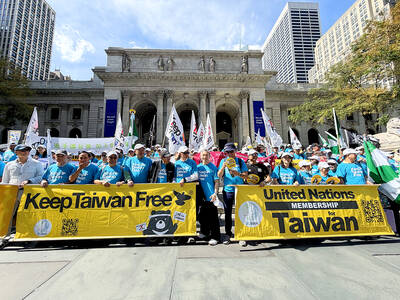
More than 100 Taiwanese-Americans, Taiwanese lawmakers and members of civic groups on Saturday marched through New York City to call for Taiwan’s participation in the UN, with Marshall Island Permanent Representative to the UN John Silk joining the event to show support. Participants chanted: “UN for Taiwan” and “Keep Taiwan Free” as they marched through central Manhattan, passing Times Square and Bryant Park before ending near the New York Public Library. The annual march brought together Taiwanese community groups from across the US East Coast. Silk expressed hope that Taiwan would one day be able to participate in UN meetings

Two aides at independent Legislator May Chin’s (高金素梅) office were ordered detained incommunicado yesterday in a broadening probe into alleged Chinese espionage by Chin’s former chief of staff, Chang Chun-chieh (張俊傑). The move to hold Lin I-chun (林怡君) and current chief of staff Chen Chih-huang (陳智葟) in custody came four days after Chang, indicted on corruption charges, cut off his electronic monitoring wristband and jumped bail. The High Prosecutors’ Office said that it believes Chang had developed a Chinese spy ring, which might have operated for more than a decade, with funding from China, and that Lin and Chen were suspected of


 RSS
RSS