


Dozens of packages of suspected amphetamines and regulated substances were found on the Chingchuankang (清泉崗) Air Base in Taichung, but an ongoing base-wide drug test has not identified any drug users.
Base patrol officers on Monday found 27 packages containing powdery and crystalline substances and drug paraphernalia, the Ministry of National Defense said.
A preliminary analysis showed that the substances might be amphetamines and ketamine.
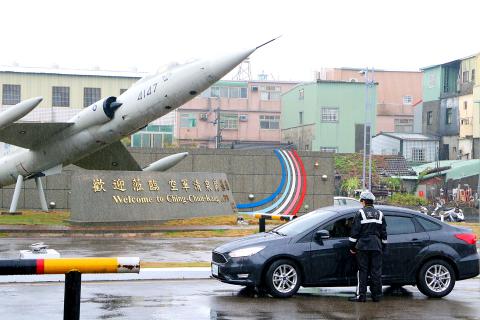
Photo: CNA
There are about 3,000 enlisted personnel and officers on the base, and 1,200 had taken urine tests as of yesterday, with 10 people initially testing positive, the base’s Political Warfare Office director Colonel Shih Sheng-te (施勝德) said yesterday.
However, a further analysis of their urine samples showed that they had not taken any prohibited substances, Shih said, adding that they might have tested positive because they had been taking cold medications.
It would take another few days to screen all personnel and those who test positive will have to undergo a secondary test at Tri-Services General Hospital, Shih said.
The packages were reportedly found on the pavement near the military airport’s runway and traffic control tower.
The case was handed over to the Taichung District Prosecutors’ Office, which is to interview base personnel who test positive for drugs and those with drug-use records.
The office will also review surveillance footage to try to determine who left the packages and whether they were left deliberately or accidentally.
Base personnel undergo drug testing on a regular basis, and those who test positive are placed on a watch list and given more frequent tests, Shih said, adding that security would be increased to prevent drugs from entering the base.
Minister of National Defense Feng Shih-kuan (馮世寬) said he was deeply concerned about the matter and asked the ministry’s medical, legal and investigative branches to form a task force to handle the case.
“Any officer found committing drug violations will face severe disciplinary action, regardless of their rank,” the ministry said.
Democratic Progressive Party Legislator Wang Ding-yu (王定宇) said the incident was not just a case of military misconduct, but an indicator of the severity of drug abuse in society at large.
“The armed forces are part of society and if drug abuse is a pervasive problem in society, it could become an issue in the military. It is like two sides of the same coin,” Wang said.
Ketamine use is also a growing issue on school campuses, and the Cabinet and the National Police Agency have to adopt immediate measures to crack down on drugs and drug dealing activities, he said.
Chinese Nationalist Party (KMT) Legislator Johnny Chiang (江啟臣) said that there would be no need for China to use missiles and aircraft carriers or for Taiwan to buy expensive arms if Taiwan’s military could be easily defeated by drugs.
“How does a soldier dogged by drugs fight?” Chiang asked, demanding that the ministry not only investigate this case, but undertake an across-the-board check on all troops for possible drug use and dealing.
KMT Legislator Alicia Wang (王育敏) called for a discussion over whether to amend the Narcotics Hazard Prevention Act (毒品危害防制條例) to mete out heavier punishment to convicted military personnel and asked President Tsai Ing-wen (蔡英文) to come up with concrete measures to deal with ketamine users, such as upgrading the drug to a Category 2 substance that would carry heavier punishment for illegal use.
Additional reporting by Alison Hsiao

A signaling system malfunction disrupted high-speed rail (HSR) services beginning at 8am today, with trains temporarily reduced to three northbound and three southbound trains per hour as authorities conduct inspections. The malfunction occurred on a section of track in Miaoli County during pre-operation checks early this morning, forcing northbound and southbound trains to use a single track, the HSR operator said. The regular schedule has been replaced with three hourly trains offering only nonreserved seating in each direction, stopping at every station, it said, adding that business class cars would still have reserved seating. Departures from terminal stations are scheduled at the top
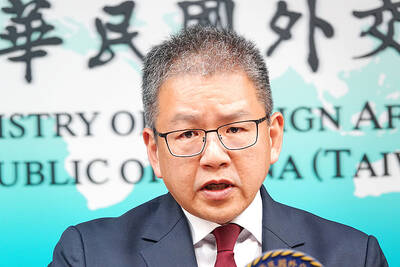
Taiwan is still in the process of assessing the possibility of recruiting workers from Eswatini, the Ministry of Foreign Affairs said yesterday, adding that its goal is to help Eswatini upgrade its vocational training centers. If there are plans to recruit workers from Eswatini, safeguarding national security, protecting public health and ensuring the employment rights of Taiwanese would be prerequisites, Department of West Asian and African Affairs Director-General Yen Chia-liang (顏嘉良) told a news conference. Key considerations would also include filling labor shortages in specific industries, and fostering bilateral professional and technical exchanges, he said. Yen was asked about the progress of labor

A US uncrewed surface vessel (USV) encountered multiple Chinese warships during an autonomous transit of the Taiwan Strait, US defense company Seasats said in a statement on Wednesday. Seasats announced that a Lightfish USV had completed the first autonomous transit of the Taiwan Strait. Over five days, the USV traversed the entire length of the Strait while constantly monitoring surface vessel traffic, the company said. The Lightfish encountered multiple Chinese warships, one of which was a Chinese People’s Liberation Army Navy (PLAN) Type 056 corvette, it said. The Chinese vessels were operating “well within Taiwan’s exclusive economic zone without transmitting their identity via the

VERBOSE VESSELS: A CGA cutter and a China Coast Guard exchanged verbal barbs for more than a day in Taiwanese-controlled waters before the Chinese vessel left The Taiwanese and Chinese coast guards had a standoff near the strategically located Pratas Islands (Dongsha Islands, 東沙群島) in the north of the South China Sea, the Coast Guard Administration (CGA) said yesterday. The two sides engaged in intense radio exchanges over sovereignty claims during the 33-hour standoff. China Coast Guard vessel 3501 eventually left the restricted waters, 26.6 nautical miles (49.2km) west of the Pratas Islands, at 5pm yesterday, the CGA said. Lying approximately between southern Taiwan and Hong Kong, the Taiwan-controlled Pratas are seen by some security experts as vulnerable to Chinese attack due to their distance — more than


 RSS
RSS