


US green card holders from the predominantly Muslim Middle East countries covered by an executive order on travel will not be stopped from returning to the US, Secretary of Homeland Security John Kelly said, as criticism mounted over US President Donald Trump’s action.
Trump defended Friday’s order, which halted entry to the US from seven countries for 90 days, after judges blocked parts of the plan and companies, lawmakers and foreign leaders weighed in.
Senators from Trump’s own party, notably John McCain of Arizona and Lindsey Graham of South Carolina, in a sharply worded joint statement, suggested the action had been too broad and potentially damaging to the US.
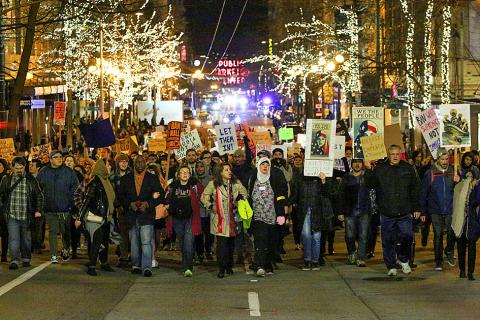
Photo: Reuters
“In applying the provisions of the president’s executive order, I hereby deem the entry of lawful permanent residents to be in the national interest,” Kelly said in a statement. “Absent the receipt of significant derogatory information indicating a serious threat to public safety and welfare, lawful permanent resident status will be a dispositive factor in our case-by-case determinations.”
The administration also moved to assure nervous counterparts in the UK and elsewhere about how their citizens would be affected.
Trump, who spent part of the afternoon at a staff screening of the animated movie Finding Dory at the White House, emerged to say on Twitter that McCain and Graham’s statement was “wrong — they are sadly weak on immigration.”
Senators should focus their energies on Islamic State, illegal immigration and border security, “instead of always looking to start World War III,” Trump said.
In a statement from the White House and on Facebook, Trump repeated that the move was “not a Muslim ban,” and said his policy was “similar to what [former US] President [Barack] Obama did in 2011 when he banned visas for refugees from Iraq for six months.”
“I have tremendous feeling for the people involved in this horrific humanitarian crisis in Syria,” Trump said in the statement.
World leaders — including Canadian Prime Minister Justin Trudeau and German Chancellor Angela Merkel — have denounced the move. Australia yesterday said it was asking the Trump administration to ensure its citizens are exempt from the ban, after US officials moved to reassure Canada and the UK.
A federal judge in Boston on Sunday became the latest to curb Trump’s immigration order, directing customs officials at the city’s Logan International Airport to let passengers from the seven countries with valid visas go on their way.
Protests were held at numerous airports and cities around the nation, including one outside the Trump International Hotel in Washington.
Signs at the Washington demonstration included “No Muslim Ban” and “The Pilgrims were undocumented.” Protesters led chants that included “No hate, no fear, refugees are welcome here.”
Judges temporarily blocked the administration from enforcing portions of his order to halt immigration and entry of citizens of Syria, Iraq, Iran, Sudan, Somalia, Yemen and Libya. Under the order, the admission of refugees would also be suspended for 120 days.
US Senate Majority Leader Mitch McConnell expressed opposition to “religious tests” for immigration restrictions.
“It’s hopefully going to be decided in the courts as to whether or not this has gone too far,” he said on ABC. “I don’t want to criticize them for improving vetting. I think we need to be careful. We don’t have religious tests in this country.”
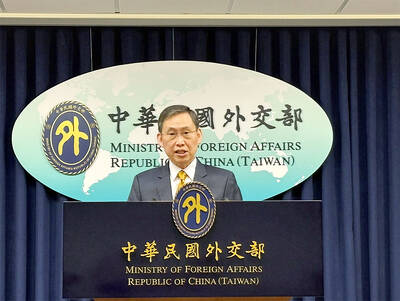
A Ministry of Foreign Affairs official yesterday said that a delegation that visited China for an APEC meeting did not receive any kind of treatment that downgraded Taiwan’s sovereignty. Department of International Organizations Director-General Jonathan Sun (孫儉元) said that he and a group of ministry officials visited Shenzhen, China, to attend the APEC Informal Senior Officials’ Meeting last month. The trip went “smoothly and safely” for all Taiwanese delegates, as the Chinese side arranged the trip in accordance with long-standing practices, Sun said at the ministry’s weekly briefing. The Taiwanese group did not encounter any political suppression, he said. Sun made the remarks when
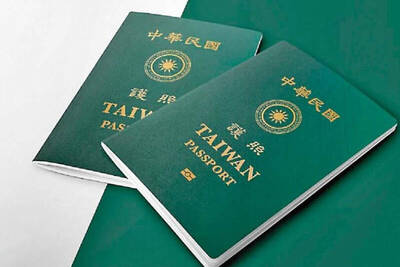
The Taiwanese passport ranked 33rd in a global listing of passports by convenience this month, rising three places from last month’s ranking, but matching its position in January last year. The Henley Passport Index, an international ranking of passports by the number of designations its holder can travel to without a visa, showed that the Taiwan passport enables holders to travel to 139 countries and territories without a visa. Singapore’s passport was ranked the most powerful with visa-free access to 192 destinations out of 227, according to the index published on Tuesday by UK-based migration investment consultancy firm Henley and Partners. Japan’s and
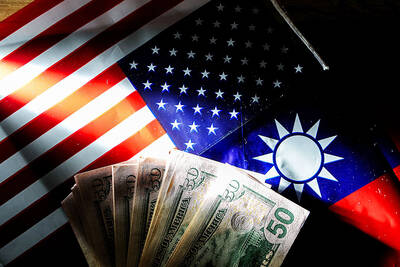
BROAD AGREEMENT: The two are nearing a trade deal to reduce Taiwan’s tariff to 15% and a commitment for TSMC to build five more fabs, a ‘New York Times’ report said Taiwan and the US have reached a broad consensus on a trade deal, the Executive Yuan’s Office of Trade Negotiations said yesterday, after a report said that Washington is set to reduce Taiwan’s tariff rate to 15 percent. The New York Times on Monday reported that the two nations are nearing a trade deal to reduce Taiwan’s tariff rate to 15 percent and commit Taiwan Semiconductor Manufacturing Co (TSMC, 台積電) to building at least five more facilities in the US. “The agreement, which has been under negotiation for months, is being legally scrubbed and could be announced this month,” the paper said,

MIXED SOURCING: While Taiwan is expanding domestic production, it also sources munitions overseas, as some, like M855 rounds, are cheaper than locally made ones Taiwan and the US plan to jointly produce 155mm artillery shells, as the munition is in high demand due to the Ukraine-Russia war and should be useful in Taiwan’s self-defense, Armaments Bureau Director-General Lieutenant General Lin Wen-hsiang (林文祥) told lawmakers in Taipei yesterday. Lin was responding to questions about Taiwan’s partnership with allies in producing munitions at a meeting of the legislature’s Foreign Affairs and National Defense Committee. Given the intense demand for 155mm artillery shells in Ukraine’s defense against the Russian invasion, and in light of Taiwan’s own defensive needs, Taipei and Washington plan to jointly produce 155mm shells, said Lin,


 RSS
RSS