


Lunar New Year messages from President Tsai Ing-wen (蔡英文) on Twitter yesterday sparked a war of words between Taiwanese and Chinese netizens.
“From the people of Taiwan, we wish everyone a bright and prosperous Year of the Rooster,” Tsai wrote in separate messages in English and Japanese to Internet and social media users.
Her messages drew a torrent of criticism from Chinese netizens, with some leaving vitriolic comments that accused Tsai of pandering to Japan and the US by favoring Japanese and English over Chinese.
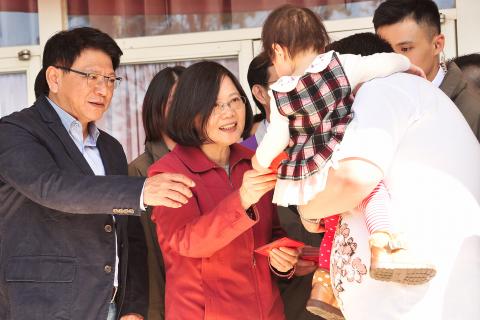
Photo: Tsai Tsung-hsien, Taipei Times
Saying that the Japanese do not celebrate the Lunar New Year, a number of the Chinese critics accused Tsai of “selling out to Japan,” while others referenced the oppression perpetrated by the Japanese government during the Japanese colonial era in Taiwan.
Tsai should have tweeted in Mandarin instead, as Chinese characters belong to China, several Chinese said.
However, Taiwanese were quick to argue the claim, with one saying that Hong Kong, Singapore and Malaysia all use Chinese characters.
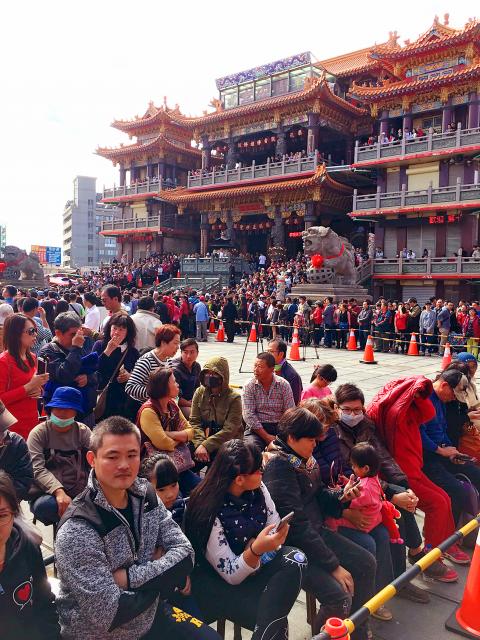
Photo: CNA
Chinese netizens should “stay out of other people’s business,” another said.
One Taiwanese netizen said that Tsai and Taipei Mayor Ko Wen-je (柯文哲) tweet in English as a means of diplomacy, while another said that most Taiwanese tend to use other social networking platforms more than Twitter.
The Presidential Office said Tsai’s tweet shows the president has a cosmopolitan world view, adding that it was meant to wish all Twitter users a happy Lunar New Year.
People should be magnanimous over the holiday, the office said.
Tsai spent the first day of the Year of the Rooster visiting temples around the nation to ask for blessings from the gods and distributing hongbao (紅包), or red envelopes, each with a NT$1 coin inside, to crowds of people hoping to receive an envelope from her personally.
The tradition of the president distributing hongbao on the first day of the new lunar year was begun by former president Lee Teng-hui (李登輝) in his hometown.
Tsai’s first stop was the Jue Siou Temple (覺修宮) in Taipei, where she made an offering of incense and prayed for the blessings of the temple god. She then proceeded to visit Fu-an Temple in Pingtung County’s Checheng Township (車城), where she handed out red envelopes to the throngs of people who had waited in long lines.
Many in the crowd shouted: “Welcome home, president.”
Tsai also visited Fenggang Village (楓港) in the county’s Fangshan Township (枋山), where her ancestral home is located and where she was warmly received by residents.
“We are glad that President Tsai has not forgotten about the support people in her hometown have shown her,” one resident said.
Tsai also visited temples in Tainan, Chiayi and Kaohsiung.
The outside of Tsai’s envelope featured a rooster along with wishes for a happy new year in Chinese and English and the signatures of Tsai and Vice President Chen Chien-jen (陳建仁).
Additional reporting by Tsai Tsung-hsien and CNA
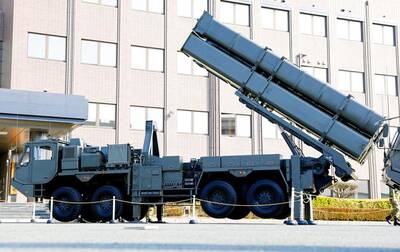
Japan has deployed long-range missiles in a southwestern region near China, the Japanese defense minister said yesterday, at a time when ties with Beijing are at their lowest in recent years. The missiles were installed in Kumamoto in the southern region of Kyushu, as Japan is attempting to shore up its military capacity as China steps up naval activity in the East China Sea. “Standoff defense capabilities enable us to counter the threat of enemy forces attempting to invade our country ... while ensuring the safety of our personnel,” Japanese Minister of Defense Shinjiro Koizumi said. “This is an extremely important initiative for
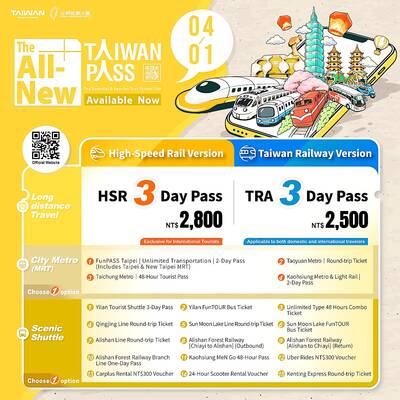
MORE POPULAR: Taiwan Pass sales increased by 59 percent during the first quarter compared with the same period last year, the Tourism Administration said The Tourism Administration yesterday said that it has streamlined the Taiwan Pass, with two versions available for purchase beginning today. The tourism agency has made the pass available to international tourists since 2024, allowing them to access the high-speed rail, Taiwan Railway Corp services, four MRT systems and four Taiwan Tourist Shuttles. Previously, five types of Taiwan Pass were available, but some tourists have said that the offerings were too complicated. The agency said only two types of Taiwan Pass would be available, starting from a three-day pass with the high-speed rail and a three-day pass with Taiwan Railway Corp. The former costs NT$2,800

POLLS CONCERNS: There are concerns within the KMT that a Cheng Li-wun-Xi Jinping meeting could trigger a voter backlash in elections in November Chinese Nationalist Party (KMT) Chairwoman Cheng Li-wun (鄭麗文) accepted an invitation from Chinese President Xi Jinping (習近平) to visit next month, her party and Chinese state media reported yesterday. Cheng, who took up her role in November last year, “gladly accepted” the invitation to lead a delegation to China, the KMT said in a statement, confirming a Xinhua news agency report. Cheng “looks forward to joint efforts by both parties to advance the peaceful development of cross-strait relations, promote cross-strait exchanges and cooperation, and work for peace in the Taiwan Strait and greater well-being for people on both sides,” the statement said. Chinese
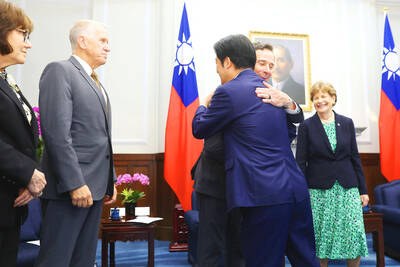
SIGNIFICANT TO THE WORLD: The delegation’s visit aims to send a clear message that bipartisan support for Taiwan is consistent, US Senator Jeanne Shaheen said The US Senate’s bipartisan support for Taiwan remains strong and Taiwan-US ties would continue for decades to come, a US Senate delegation said in Taipei yesterday, while calling on the legislature to swiftly pass a special defense budget bill. A US delegation led by Democratic US Senator Jeanne Shaheen and Republican US Senator John Curtis — both members of the US Senate Committee on Foreign Relations — arrived in Taiwan yesterday for a two-day visit. The other senators of the delegation included Senate Taiwan Caucus cochair Thom Tillis and Senate Committee on Armed Services senior member Jacky Rosen. Shaheen told a news


 RSS
RSS