


US president-elect Donald Trump said in an interview with the Wall Street Journal that he would not commit to the “one China” policy until he sees progress from Beijing in its currency and trade practices.
In excerpts from the hour-long interview published on Friday, Trump, when asked if he supported the “one China” policy toward Taiwan that has underpinned US relations with Beijing for decades, said: “Everything is under negotiation, including ‘one China.’”
“We sold them [Taiwan] US$2 billion of military equipment last year. We can sell them US$2 billion of the latest and greatest military equipment, but we’re not allowed to accept a phone call. First of all, it would have been very rude not to accept the phone call,” Trump said in the interview.
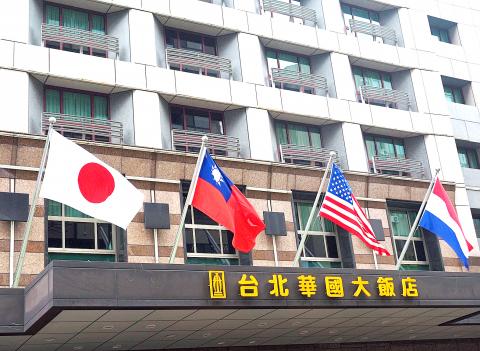
Photo: EPA
In a previous interview with Fox News Sunday with Chris Wallace last month, Trump questioned the need for Washington to stick to its “one China” policy.
“I fully understand the ‘one China’ policy, but I don’t know why we have to be bound by a ‘one China’ policy unless we make a deal with China having to do with other things, including trade,” he said at the time.
Presidential Office spokesman Alex Huang (黃重諺) at the time said that the office had no comment about Trump’s remarks on the Fox show.
While in El Salvador on Friday, President Tsai Ing-wen (蔡英文), in response to reporters’ questions on concerns that Taiwan might become a bargaining chip in the relationship between the US and China, said she had heard the view.
“I feel that we are able to deal with such things and will put Taiwan’s interests first,” she said.
Trump has said he would label China a currency manipulator after he takes office.
In Friday’s interview, he said he would not take that step on his first day in the White House.
“I would talk to them first,” he said. “Certainly they are manipulators, but I’m not looking to do that.”
However, the president-elect made plain his displeasure with China’s currency practices.
“Instead of saying, ‘We’re devaluating our currency,’ they say, ‘Oh, our currency is dropping.’ It’s not dropping. They’re doing it on purpose,” the Wall Street Journal quoted him as saying. “Our companies can’t compete with them now, because our currency is strong and it’s killing us.”
In other news, a personal e-mail of former US secretary of state Hillary Rodham Clinton recently leaked by WikiLeaks suggested an adviser, Jake Sullivan, once shared with her an article titled “To save our economy, ditch Taiwan” by Paul Kane, a former international security research fellow at Harvard’s John F. Kennedy School of Government.
In the article, Kane suggested that US President Barack Obama could bolster US economic security by ending its military assistance and arms sales to Taiwan, in exchange for a write-off of US$1.14 trillion in US debt held by China.
“I saw it and thought it was so clever. Let’s discuss,” said Clinton, who ran against Trump in the US presidential election last year, in the leaked e-mail.
Additional reporting by CNA and staff writer

SILENCING CRITICS: In addition to blocking Taiwan, China aimed to prevent rights activists from speaking out against authoritarian states, a Cabinet department said The Ministry of Foreign Affairs (MOFA) yesterday condemned transnational repression by Beijing after RightsCon, a major digital human rights conference scheduled to be held in Zambia this week, was abruptly canceled due to Chinese pressure over Taiwanese participation. This year’s RightsCon, the world’s largest conference discussing issues “at the intersection of human rights and technology,” was scheduled to take place from tomorrow to Friday in Lusaka, and expected to draw 2,600 in-person attendees from 150 countries, along with 1,100 online participants. However, organizers were forced to cancel the event due to behind-the-scenes pressure from China, the ministry said, expressing its “strongest condemnation”
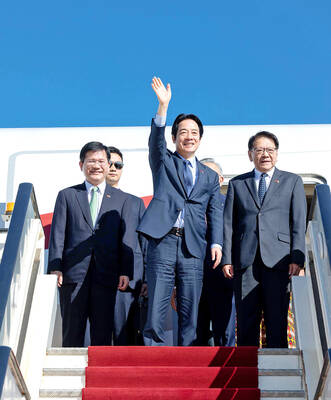
DELAYED BUT DETERMINED: The president’s visit highlights Taiwan’s right to international engagement amid regional pressure from China President Willaim Lai (賴清德) yesterday arrived in Eswatini, more than a week after his planned visit to Taiwan’s sole African ally was suspended because of revoked overflight permits. “The visit, originally scheduled for April 22, was postponed due to unforeseen external factors,” Lai wrote on social media. “After several days of careful arrangements by our diplomatic and national security teams, we successfully arrived today.” Lai said he looked forward to further deepening Taiwan-Eswatini relations through closer cooperation in the economy, agriculture, culture and education, as well as advancing the nation’s international partnerships. The president was initially scheduled to arrive in time to celebrate
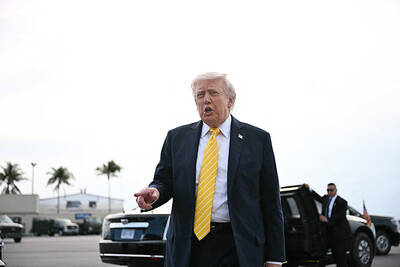
Iran’s Islamic Revolutionary Guard Corp (IRGC) yesterday said the US faced a choice between an “impossible” military operation or a “bad deal” with Tehran, after US President Donald Trump disparaged Iran’s latest peace proposal. Negotiations between the two countries have been deadlocked since a ceasefire came into effect on April 8, with only one round of direct peace talks held so far. Iran’s Tasnim and Fars news agencies reported that Tehran had submitted a 14-point proposal to mediator Pakistan, but Trump was quick to cast doubt on it. “I will soon be reviewing the plan that Iran has just sent to us, but

A group affiliated with indicted Chinese immigrant Xu Chunying (徐春鶯) is to be dissolved for monitoring Chinese immigrants in Taiwan, a source said yesterday. Xu, the secretary-general of the Cross-Strait Marriage and Family Service Alliance, was indicted on March 24 on charges of violating the Anti-Infiltration Act (反滲透法). The alliance “illegally monitored" Chinese immigrants living in Taiwan on behalf of the Chinese Communist Party (CCP) and the Ministry of the Interior is expected to dissolve the organization in the coming days under provisions of the Civil Associations Act (人民團體法), the source said. Xu, who married a Taiwanese in 1993 and became a Republic


 RSS
RSS