


The Shilin District Court yesterday indicted former Academia Sinica president Wong Chi-huey (翁啟惠) on corruption charges relating to biotech company OBI Pharma Inc (台灣浩鼎).
Wong denied the charges, accusing the court of abusing its authority.
Wong was appointed president of Academia Sinica in October 2007 and began work on developing cancer vaccine technologies in 2008, the indictment read.
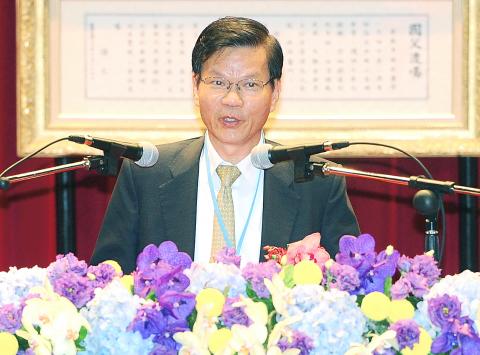
Photo: Chang Chia-ming, Taipei Times
He also started collaborating with OBI Pharma chairman Michael Chang (張念慈) — a friend from the time he was studying at the Massachusetts Institute of Technology — on public research, it said.
In October 2011, Chang offered Wong 1,500 new shares of OBI Pharma in a quid pro quo exchange for technologies developed by Wong, which Wong accepted, prosecutors said.
However, the two later abandoned the scheme in favor of an agreement to exchange the technology for a future payment, after the Ministry of Economic Affairs expressed misgivings about the new shares, prosecutors said.
In August 2012, Academia Sinica posted a public notice for a corporate partner to transfer its patented “next-generation synthetic oligosaccharides technology,” which was obtained by Amaran Biotechnology Inc (潤雅生技), a company that shared an office with OBI Pharma.
Prosecutors said that the technology transfer was made under Wong and Chang’s direction, following the completion of the transfer of 3,000 shares of OBI Pharma on Dec. 17 to Wong’s daughter Wong Yu-shioh (翁郁秀).
Although Wong Yu-shioh was the nominal owner of the 3,000 shares, estimated to be worth NT$93 million (US$2.9 million at current exchange rates), prosecutors said they believed Wong Chi-huey has de facto control of the shares.
As to other issues, prosecutors said that no indictment was issued on Wong Chi-huey’s acceptance of a US$300,000 contribution from US-based Optimer Pharmaceuticals Inc, because he was able to provide documentation proving that the sum was used for a legitimate cooperative project.
No indictment was also issued for Chang Sui-fen (張穗芬), the finance division manager of OBI Pharma who facilitated the stock transfer, because there was insufficient evidence that she knowingly participated in the act of bribery, prosecutors said.
Wong Chi-huey issued a press statement last night saying he was “shocked and angered” by the indictment, calling it “a far-fetched accusation and an abuse of prosecutorial authority.”
He denied having discussed stock options with Chang in a quid pro quo arrangement, and insisted that the 3,000 OBI Pharma shares he received were entirely self-funded and had no connection to his position then as president of Academia Sinica.
“This humiliation has done grievous injury to my academic reputation... I will strenuously defend my innocence through the legal process,” he said.
Meanwhile, OBI Pharma said that its operations and research would not be affected by the case, adding that it respected the court’s decision and would continue to stand by its management team.

CREDIT-GRABBER: China said its coast guard rescued the crew of a fishing vessel that caught fire, who were actually rescued by a nearby Taiwanese boat and the CGA Maritime search and rescue operations do not have borders, and China should not use a shipwreck to infringe upon Taiwanese sovereignty, the Coast Guard Administration (CGA) said yesterday. The coast guard made the statement in response to the China Coast Guard (CCG) saying it saved a Taiwanese fishing boat. The Chuan Yu No. 6 (全漁6號), a fishing vessel registered in Keelung, on Thursday caught fire and sank in waters northeast of Diaoyutai Islands (釣魚台). The vessel left Keelung’s Badouzih Fishing Harbor (八斗子漁港) at 3:35pm on Sunday last week, with seven people on board — a 62-year-old Taiwanese captain surnamed Chang (張) and six
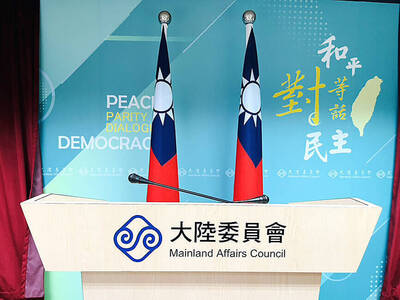
RISKY BUSINESS: The ‘incentives’ include initiatives that get suspended for no reason, creating uncertainty and resulting in considerable losses for Taiwanese, the MAC said China’s “incentives” failed to sway sentiment in Taiwan, as willingness to work in China hit a record low of 1.6 percent, a Ministry of Labor survey showed. The Directorate-General of Budget, Accounting and Statistics (DGBAS) also reported that the number of Taiwanese workers in China has nearly halved from a peak of 430,000 in 2012 to an estimated 231,000 in 2024. That marked a new low in the proportion of Taiwanese going abroad to work. The ministry’s annual survey on “Labor Life and Employment Status” includes questions respondents’ willingness to seek employment overseas. Willingness to work in China has steadily declined from

The Legislative Yuan’s Finance Committee yesterday approved proposed amendments to the Amusement Tax Act (娛樂稅法) that would abolish taxes on films, cultural activities and competitive sporting events, retaining the fee only for dance halls and golf courses. The proposed changes would set the maximum tax rate for dance halls and golf courses at 50 and 20 percent respectively, with local governments authorized to suspend the levies. Article 2 of the act says that “amusement tax shall be levied on tickets sold or fees charged by amusement places, facilities or activities” in six categories: “Cinema; professional singing, story-telling, dancing, circus, magic show, acrobatics
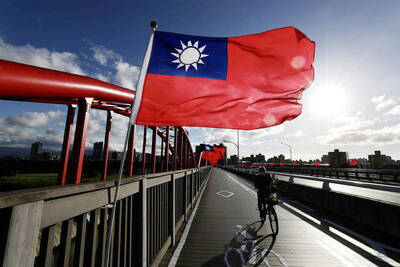
INFLATION UP? The IMF said CPI would increase to 1.5 percent this year, while the DGBAS projected it would rise to 1.68 percent, with GDP per capita of US$44,181 The IMF projected Taiwan’s real GDP would grow 5.2 percent this year, up from its 2.1 percent outlook in January, despite fears of global economic disruptions sparked by the US-Iran conflict. Taiwan’s consumer price index (CPI) is projected to increase to 1.5 percent, while unemployment would be 3.4 percent, roughly in line with estimates for Asia as a whole, the international body wrote in its Global Economic Outlook Report published in the US on Monday. The figures are comparatively better than the IMF outlook for the rest of the world, which pegged real GDP growth at 3.1 percent, down from 3.3 percent


 RSS
RSS