


Minister of Foreign Affairs David Lee (李大維) yesterday confirmed that President Tsai Ing-wen (蔡英文) and former US national security official Stephen Yates met on Wednesday and Yates urged Tsai to keep a low profile during her transit stops in the US on her way to Central America next month.
Speaking on the sidelines of a morning meeting of the legislature’s Foreign Affairs and National Defense Committee, Lee said Tsai and Yates had an in-depth conversation, but he did not know what they discussed because he was not there.
“Yates and I are old acquaintances. When I was stationed in Washington, Yates served as deputy national security adviser to then-US vice president Dick Cheney. We met once or twice every month,” Lee said.
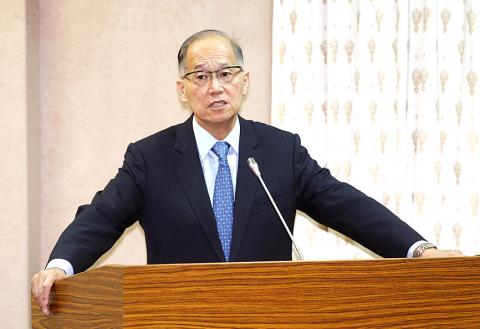
Photo: CNA
Yates is scheduled to visit him today to discuss Taiwan-US relations, he said.
The ministry is organizing the itinerary for Tsai’s state visit to four diplomatic allies and is still in talks with the US about her transit stops on her way to and from Central America, he said.
New York was never considered for a transit stop, he said, amid rumors that it would allow for the possibility of a meeting with US president-elect Donald Trump, whom she spoke with by telephone on Friday last week.
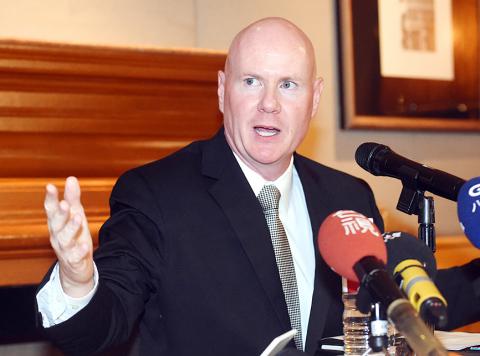
Photo: Liao Chen-Huei, Taipei Times
“The president’s itinerary will be made public by the Presidential Office once the details are finalized,” he said.
Regarding foreign news reports that the call was the result of the government’s orchestrated efforts with a lobbying firm affiliated with former US senator Bob Dole, Lee said it was Taiwanese diplomats who contacted a key aide on Trump’s transition team and no US consulting or lobbying firms that the government works with played a role.
“It was purely a congratulatory phone call, during which discussions of substantial bilateral issues were limited. As President Tsai told US reporters the other day, the call does not suggest a major change in Taiwan-US policy,” Lee said.
Democratic Progressive Party (DPP) Legislator Lo Chih-cheng (羅致政), who attended the meeting between Tsai and Yates, quoted Yates as saying that Taiwan should be prepared for a tougher stance on trade negotiations once Trump takes office.
The issue of imports of US pork containing ractopamine was not discussed, Lo said.
Yates also called for people-to-people interactions between Taipei and Washington at all levels, including in the areas of trade, investment and acquisitions, Lo said, so that Americans could feel the close ties they have with Taiwanese.
Yates felt that there was no need for Tsai to meet with Trump during a transit stop, but she might engage with ordinary US citizens, Lo said.
Regarding the possibility of changes in the US’ “one China” policy, Lo said regardless of the content of the policy, both sides agreed that there are still many areas of Taiwan-US relations that require effort.
DPP Legislator Hsiao Bi-khim (蕭美琴), who knows Yates, also attended the three-hour meeting, which was held at the president’s official residence, Lo said.

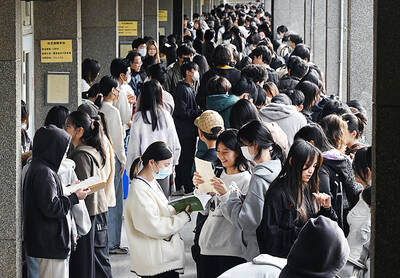
A global survey showed that 60 percent of Taiwanese had attained higher education, second only to Canada, the Ministry of the Interior said. Taiwan easily surpassed the global average of 43 percent and ranked ahead of major economies, including Japan, South Korea and the US, data from the Organisation for Economic Co-operation and Development (OECD) for 2024 showed. Taiwan has a high literacy rate, data released by the ministry showed. As of the end of last year, Taiwan had 20.617 million people aged 15 or older, accounting for 88.5 percent of the total population, with a literacy rate of 99.4 percent, the data

NEW LOW: The council in 2024 based predictions on a pessimistic estimate for the nation’s total fertility rate of 0.84, but last year that rate was 0.69, 17 percent lower An expected National Development Council (NDC) report expects the nation’s population to drop below 12 million by 2065, with the old-age dependency ratio to top 100 percent sooner than 2070, sources said yesterday. The council is slated to release its latest population projections in August, using an ultra-low fertility model, the sources said. The previous report projected that Taiwan’s population would fall to 14.37 million by 2070, but based on a new estimate of the total fertility rate (TFR) — the average number of children born to a woman over her lifetime — the population is expected to reach 12 million by

COUNTERING HOSTILITY: The draft bill would require the US to increase diplomatic pressure on China and would impose sanctions on those who sabotage undersea cable networks US lawmakers on Thursday introduced a bipartisan bill to bolster the resilience of Taiwan’s submarine cables to counter China’s hostile activities. The proposal, titled the critical undersea infrastructure resilience initiative act, was cosponsored by Republican representatives Mike Lawler and Greg Stanton, and Democratic Representative Dave Min. US Senators John Curtis and Jacky Rosen also introduced a companion bill in the US Senate, which has passed markup at the chamber’s Committee on Foreign Relations. The House’s version of the bill would prioritize the deployment of sensors to detect disruptions or potential sabotage in real-time and enhance early warning capabilities through global intelligence sharing frameworks,
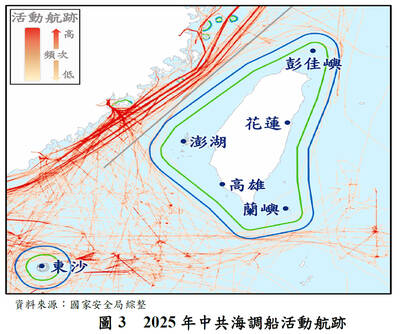
INTENSIFYING THREATS: Beijing’s tactics include massive attacks on the government service network, aircraft and naval vessel incursions and damaging undersea cables China is prepared to interfere in November’s nine-in-one local elections by launching massive attacks on the Taiwanese government’s service network (GSN), a report published by the National Security Bureau showed. The report was submitted to the Legislative Yuan ahead of the bureau’s scheduled briefing at the Foreign Affairs and National Defense Committee tomorrow. The national security team has identified about 13,000 suspicious Internet accounts and 860,000 disputed messages, the bureau said of China’s cognitive warfare against Taiwan. The disputed messages focus on major foreign affairs, national defense and economic issues, which were produced using generative artificial intelligence (AI) and distributed through Chinese


 RSS
RSS