


China is likely to conduct more flights over the Miyako Strait between Japan’s Miyako Islands on a regular basis following a flyover of the strategic waterway last month, the Ministry of National Defense said yesterday.
Six Chinese military aircraft flew over the strait as part of a long-distance training exercise on Nov. 25, which was also China’s first military flight around Taiwan, Deputy Minister of National Defense Admiral Lee Hsi-ming (李喜明) told a meeting of the legislature’s Foreign Affairs and National Defense Committee in Taipei.
The flight, which prompted the Japan Air Self-Defense Force to scramble fighter jets to conduct surveillance, might become a routine training exercise, Lee said.
“The flight did not come as a surprise. China has performed all possible exercises and if it has the ability [to conduct the flight], there is no reason that it will not continue to do so,” he added.
The Chinese aircraft flew around Taiwan’s air defense identification zone at a distance of 70km to 80km, the ministry said.
“Frequent Chinese military activity will definitely put pressure on us, but the military has reacted promptly so far and there is no need to change standard response procedures,” Lee said, adding that the armed forces reacted faster than Japan’s military in response to the politically sensitive flight.
Lee also rejected media reports that the ministry was mulling the early retirement of Dassault Mirage 2000 fighter jets due to maintenance difficulties and costs.
The Chinese-language Apple Daily reported that the air force was considering retiring its fleet of 56 Mirage 2000s, which has been in service for 19 years, because it failed to secure an affordable upgrade program to extend the fighters’ service life.
There is no plan to retire the Mirage 2000 fleet, Lee said, adding that the air force has no problems acquiring parts from France.
The Chungshan Institute of Science and Technology has been tasked with maintaining the Mirage 2000’s missile system since 2006, Lee said, reaffirming the combat readiness of the French fighter jets.
Democratic Progressive Party Legislator Chen Ting-fei (陳亭妃) asked Lee whether the telephone call between President Tsai Ing-wen (蔡英文) and US president-elect Donald Trump that took place on Friday could cause tensions between Taiwan and China to rise.
Lee said he did not think the call would result in a tenser cross-strait relationship, adding that it could have a positive impact on Taiwan-US military interactions.
However, the call did not affect US arms sales and the ministry is moving forward with existing arms deals, he said, adding that no new deals are being negotiated.
“The call marked an unprecedented change in Taiwan-US interactions since official diplomatic ties were severed. It is a good start for us,” National Security Bureau Deputy Director Chou Mei-wu (周美伍) said.
However, it is possible that China, in an angry response to the call, might intensify its efforts to lure away Taiwan’s diplomatic allies, although there is no intelligence pointing to such attempts, Chou said.
Separately yesterday, Mainland Affairs Council Minister Katharine Chang (張小月) said China should not view the congratulatory telephone call by Tsai to Trump as anything unusual.
“The Republic of China is a sovereign nation,” Chang said. “It has long been the government’s policy to expand its international presence and its relations with the US.”
Taipei also attaches importance to its relationship with China and the peaceful and stable development of ties across the Taiwan Strait, she said, adding that the two approaches do not conflict.
Additional reporting by CNA
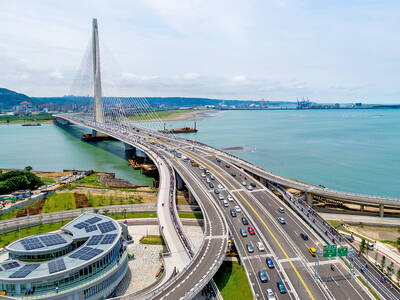
The Ministry of Transportation and Communications yesterday inaugurated the Danjiang Bridge across the Tamsui River in New Taipei City, saying that the structure would be an architectural icon and traffic artery for Taiwan. Feted as a major engineering achievement, the Danjiang Bridge is 920m long, 211m tall at the top of its pylon, and is the longest single-pylon asymmetric cable-stayed bridge in the world, the government’s Web site for the structure said. It was designed by late Iraqi-British architect Zaha Hadid. The structure, with a maximum deck of 70m, accommodates road and light rail traffic, and affords a 200m navigation channel for boats,
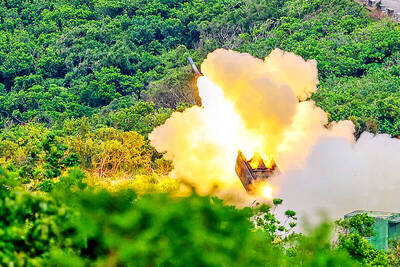
PRECISION STRIKES: The most significant reason to deploy HIMARS to outlying islands is to establish a ‘dead zone’ that the PLA would not dare enter, a source said A High Mobility Artillery Rocket System (HIMARS) would be deployed to Penghu County and Dongyin Island (東引) in Lienchiang County (Matsu) to force the Chinese military to retreat at least 100km from the coastline, a military source said yesterday. Taiwan has been procuring HIMARS and Army Tactical Missile Systems (ATACMS) from the US in batches. Once all batches have been delivered, Taiwan would possess 111 HIMARS units and 504 ATACMS, which have a range of 300km. Considering that “offense is the best defense,” the military plans to forward-deploy the systems to outlying islands such as Penghu and Dongyin so that
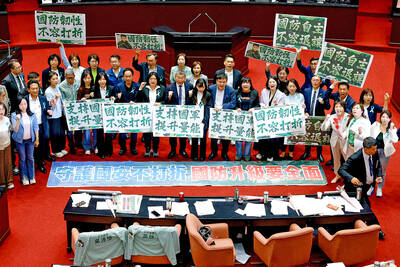
WHAT WAS ALL THAT FOR? Jaw Shaw-kong said that Cheng Li-wen had pushed for more drastic cuts and attacked him, just for the outcome to be nearly identical to his bill The legislature yesterday passed a supplementary budget bill to fund the purchase of separate packages of US military equipment, with the combined amount of spending capped at NT$780 billion (US$24.8 billion). The Chinese Nationalist Party (KMT) and Taiwan People’s Party (TPP) used their legislative majority to pass the bill, which runs until 2033 and has two main funding provisions. One was for NT$300 billion of arms sales already approved by the US for Taiwan on Dec. 17 last year, the other was for NT$480 billion for another arms package expected to be announced by Washington. The bill, which fell short of the NT$1.25
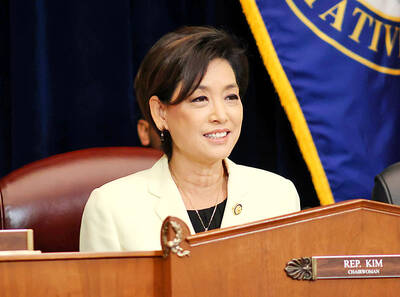
‘CLEAR MESSAGE’: The bill would set up an interagency ‘tiger team’ to review sanctions tools and other economic options to help deter any Chinese aggression toward Taiwan US Representative Young Kim has introduced a bill to deter Chinese aggression against Taiwan, calling for an interagency “tiger team” to preplan coordinated sanctions and economic measures in response to possible Chinese military or political action against Taiwan. “[Chinese President] Xi Jinping [習近平] has directed the People’s Liberation Army to be ready to invade Taiwan by 2027. China has a plan. America should have one too,” Kim said in a news release on Thursday last week. She introduced the “Deter PRC [People’s Republic of China] aggression against Taiwan act” to “ensure the US has a coordinated sanctions strategy ready should


 RSS
RSS