


Taiwan yesterday signed two memorandums of understanding (MOUs) with the Japanese government on boosting bilateral collaboration on improving the safety of electronic products and machinery, as well as foreign-language learning in high schools.
Association of East Asian Relations President Chiou I-jen (邱義仁) and Japan’s Interchange Association Chairman Mitsuo Ohashi signed the agreements at the Ambassador Hotel Taipei yesterday morning, following the conclusion of the Taiwan-Japan trade and economic talks, which have been held annually since 1976.
Bureau of Standards, Metrology and Inspection Director Liu Ming-chung (劉明忠) said the memorandum on the safety of electronic products and machinery would create a systematic model for bilateral collaboration with the bureau’s counterpart, the Japanese National Institute of Technology and Evaluation.
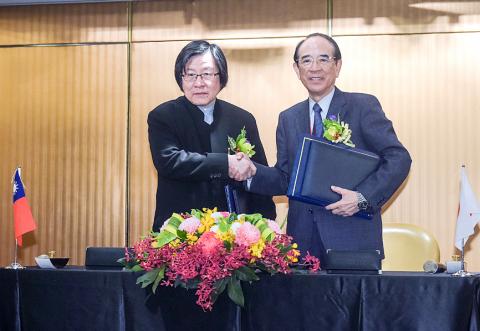
Photo: Huang Yao-cheng, Taipei Times
Ministry of Education official Huang Kuan-chao (黃冠超) said about 32,000 high-school students choose Japanese as their second foreign language when they sign up for elective courses, while more than 19,000 Japanese high-school students learn Chinese.
The memorandum on foreign-language learning is aimed at leveraging cultural exchanges, he said.
“The Japanese delegation raised the topic of the nation’s stance on relaxing the import ban and expressed concerns,” Association of East Asian Relations Deputy Secretary-General Tsai Wei-kan (蔡偉淦) said in response to media queries over whether the import ban on food products from five Japanese prefectures was discussed.
“Our delegation told them that Minister of Foreign Affairs David Lee (李大維) on Monday said in the legislature that this would not be a topic for discussion during the economics talks. We told the Japanese delegation that there is still internal dissent over the matter and ended the discussion,” Tsai said.
Prior to the signing ceremony, a group of demonstrators opposed to lifting the import ban rallied outside the hotel, which was heavily guarded by police.
Regarding the prospect of signing an Economic Partnership Agreement, Tsai said that Japan reiterated its unwavering stance on forging economic ties based on comprehensive trade and investment.
The chances of Taiwan signing an economic agreement are affected by political factors and international configurations, and the association would continue toward that aim, he said.
Tsai dismissed questions over why Japan has not lifted an import ban on five fruits — guava, tangerine, dragon fruit, Indian plum and the Aiwen mango — adding that the association would continue lobbying for the ban to be lifted.
Asked whether the two sides did not sign a memorandum on food safety due to public concerns, Tsai said it was due to insufficient time.
The association would continue negotiating with Japan on a food safety agreement, he said.
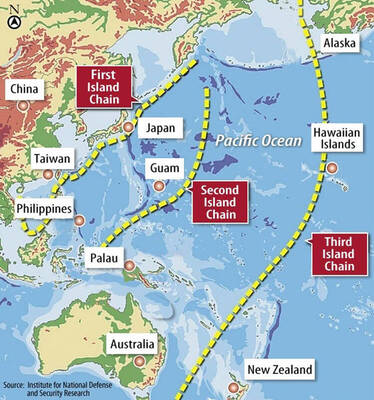
The US government has signed defense cooperation agreements with Japan and the Philippines to boost the deterrence capabilities of countries in the first island chain, a report by the National Security Bureau (NSB) showed. The main countries on the first island chain include the two nations and Taiwan. The bureau is to present the report at a meeting of the legislature’s Foreign Affairs and National Defense Committee tomorrow. The US military has deployed Typhon missile systems to Japan’s Yamaguchi Prefecture and Zambales province in the Philippines during their joint military exercises. It has also installed NMESIS anti-ship systems in Japan’s Okinawa

‘WIN-WIN’: The Philippines, and central and eastern European countries are important potential drone cooperation partners, Minister of Foreign Affairs Lin Chia-lung said Minister of Foreign Affairs Lin Chia-lung (林佳龍) in an interview published yesterday confirmed that there are joint ventures between Taiwan and Poland in the drone industry. Lin made the remark in an exclusive interview with the Chinese-language Liberty Times (the Taipei Times’ sister paper). The government-backed Taiwan Excellence Drone International Business Opportunities Alliance and the Polish Chamber of Unmanned Systems on Wednesday last week signed a memorandum of understanding in Poland to develop a “non-China” supply chain for drones and work together on key technologies. Asked if Taiwan prioritized Poland among central and eastern European countries in drone collaboration, Lin

TRAGEDY STRIKES TAIPEI: The suspect died after falling off a building after he threw smoke grenades into Taipei Main Station and went on a killing spree in Zhongshan A 27-year-old suspect allegedly threw smoke grenades in Taipei Main Station and then proceeded to Zhongshan MRT Station in a random killing spree that resulted in the death of the suspect and two other civilians, and seven injured, including one in critical condition, as of press time last night. The suspect, identified as a man surnamed Chang Wen (張文), allegedly began the attack at Taipei Main Station, the Taipei Fire Department said, adding that it received a report at 5:24pm that smoke grenades had been thrown in the station. One man in his 50s was rushed to hospital after a cardiac arrest
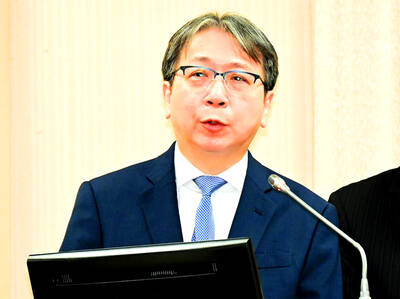
ON ALERT: Taiwan’s partners would issue warnings if China attempted to use Interpol to target Taiwanese, and the global body has mechanisms to prevent it, an official said China has stationed two to four people specializing in Taiwan affairs at its embassies in several democratic countries to monitor and harass Taiwanese, actions that the host nations would not tolerate, National Security Bureau (NSB) Director-General Tsai Ming-yen (蔡明彥) said yesterday. Tsai made the comments at a meeting of the legislature’s Foreign Affairs and National Defense Committee, which asked him and Minister of National Defense Wellington Koo (顧立雄) to report on potential conflicts in the Taiwan Strait and military preparedness. Democratic Progressive Party (DPP) Legislator Michelle Lin (林楚茵) expressed concern that Beijing has posted personnel from China’s Taiwan Affairs Office to its


 RSS
RSS