


US president-elect Donald Trump on Saturday said that his administration would “do all it can” once he takes office on Jan. 20 to help increase freedom and prosperity for Cuban people after the death of former Cuban president Fidel Castro.
However, his initial reaction to Castro’s death sidestepped whether Trump would make good on a threat made late in his White House campaign to reverse US President Barack Obama’s moves to open relations with the Cold War adversary.
Obama used his executive powers on a series of steps to ease trade, travel and financial restrictions against Cuba, arguing it was time to try diplomacy after the half-century-long economic embargo against Cuba had failed to shake the regime.
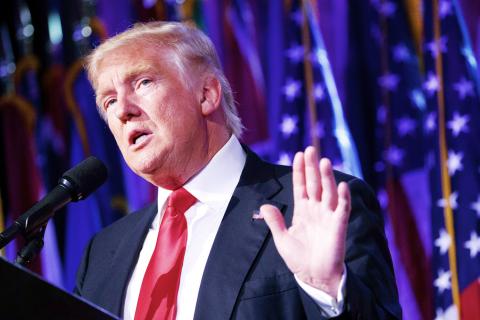
Photo: AP
Trump’s first statement on Cuba policy since the Nov. 8 election, issued from his Palm Beach, Florida, resort where he and his family were spending the weekend after the Thanksgiving holiday, did not address whether he would roll back Obama’s measures because of concerns about religious and political freedom in Cuba.
“Though the tragedies, deaths and pain caused by Fidel Castro cannot be erased, our administration will do all it can to ensure the Cuban people can finally begin their journey toward prosperity and liberty,” Trump said in the statement.
“While Cuba remains a totalitarian island, it is my hope that today marks a move away from the horrors endured for too long and toward a future in which the wonderful Cuban people finally live in the freedom they so richly deserve,” he said.
Trump has just begun to fill out the top ranks of his national security team, and has not yet named his top diplomat — the US secretary of state — who would play a major role in formulating policy on Cuba.
He last week named Mauricio Claver-Carone, a political lobbyist who has strongly criticized Obama’s efforts to normalize relations with Cuba and supports maintaining the US embargo against the island, to his transition team at the US Treasury Department.
The agency is responsible for enforcing US trade and travel restrictions on Cuba. Claver-Carone is director of the US-Cuba Democracy Political Action Committee.
Trump’s initial statement was viewed by some to mark a softening from his rhetoric on Cuba policy late in the campaign, one US intelligence official told reporters, speaking on the condition of anonymity.
“This may be one place where his business interests prod him to take a more pragmatic course, even if that angers the hardcore, anti-Castro elements of both parties,” the official said.
A second US official said that the foreign-policy advisers Trump has named thus far are not known to have any particular interest in Cuba.
That might mean Trump’s economic team will have more sway over Cuba policy, which could lead to a more pragmatic approach, the second official said.
An aggressive policy by Trump would close off lucrative opportunities to US businesses and hand them to European or Asian firms, and would hurt companies like American Airlines, due to start commercial flights to Havana on Monday for the first time in half a century.

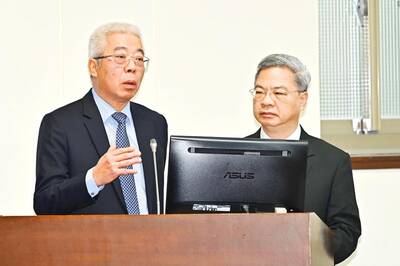
Taiwan has arranged for about 8 million barrels of crude oil, or about one-third of its monthly needs, to be shipped from the Red Sea this month to bypass the Strait of Hormuz and ease domestic supply pressures, CPC Corp, Taiwan (CPC, 台灣中油) said yesterday. The state-run oil company has worked with Middle Eastern suppliers to secure routes other than the Strait of Hormuz, through which about 20 percent of the world’s oil and liquefied natural gas typically passes, CPC chairman Fang Jeng-zen (方振仁) said at a meeting of the legislature’s Economics Committee in Taipei. Suppliers in Saudi Arabia have indicated they
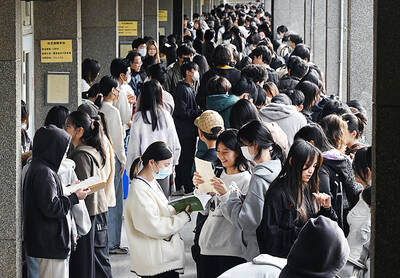
A global survey showed that 60 percent of Taiwanese had attained higher education, second only to Canada, the Ministry of the Interior said. Taiwan easily surpassed the global average of 43 percent and ranked ahead of major economies, including Japan, South Korea and the US, data from the Organisation for Economic Co-operation and Development (OECD) for 2024 showed. Taiwan has a high literacy rate, data released by the ministry showed. As of the end of last year, Taiwan had 20.617 million people aged 15 or older, accounting for 88.5 percent of the total population, with a literacy rate of 99.4 percent, the data
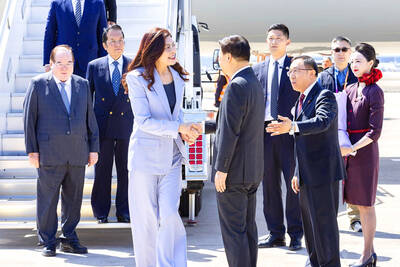
CCP ‘PAWN’? Beijing could use the KMT chairwoman’s visit to signal to the world that many people in Taiwan support the ‘one China’ principle, an academic said Chinese Nationalist Party (KMT) Chairwoman Cheng Li-wun (鄭麗文) yesterday arrived in China for a “peace” mission and potential meeting with Chinese President Xi Jinping (習近平), while a Taiwanese minister detailed the number of Chinese warships currently deployed around the nation. Cheng is visiting at a time of increased Chinese military pressure on Taiwan, as the opposition-dominated Legislative Yuan stalls a government plan for US$40 billion in extra defense spending. Speaking to reporters before going to the airport, Cheng said she was going on a “historic journey for peace,” but added that some people felt uneasy about her trip. “If you truly love Taiwan,

NEW LOW: The council in 2024 based predictions on a pessimistic estimate for the nation’s total fertility rate of 0.84, but last year that rate was 0.69, 17 percent lower An expected National Development Council (NDC) report expects the nation’s population to drop below 12 million by 2065, with the old-age dependency ratio to top 100 percent sooner than 2070, sources said yesterday. The council is slated to release its latest population projections in August, using an ultra-low fertility model, the sources said. The previous report projected that Taiwan’s population would fall to 14.37 million by 2070, but based on a new estimate of the total fertility rate (TFR) — the average number of children born to a woman over her lifetime — the population is expected to reach 12 million by


 RSS
RSS