


A “key consultant” of US president-elect Donald Trump’s campaign team met with President Tsai Ing-wen (蔡英文) in Taipei a few weeks ago, Minister of Foreign Affairs (MOFA) David Lee (李大維) said yesterday, stressing that the nation is an asset rather than a liability to Washington.
Lee made the remarks on the sidelines of a meeting of the legislature’s Foreign Affairs and National Defense Committee in the morning, which was held amid growing concern about the possible impact of Trump’s unexpected victory on Taipei-Washington ties.
“As a matter of fact, a few weeks ago, Trump sent a key consultant from his team to Taipei and we arranged for him to meet Tsai. I also spent some time catching up with the consultant, as he is an old acquaintance of more than 30 years,” said Lee, who served as the nation’s representative to Washington from July 2004 to April 2007.
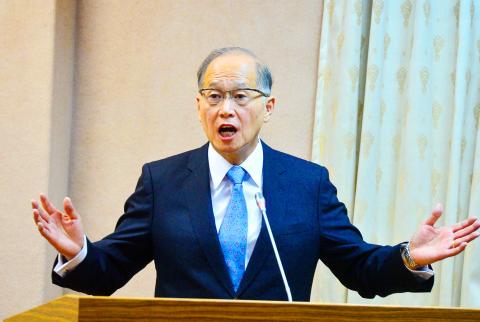
Photo: Wang Yi-sung, Taipei Times
Presidential Office spokesman Alex Huang (黃重諺) later disclosed the identity of the “consultant” — Edwin Feulner, founder of the Washington-based Heritage Foundation think tank — who met with Tsai on Oct. 13.
Representative to the US Stanley Kao (高碩泰) has met with a number of Trump’s counselors, Lee said, adding that, based on his understanding, Kao is set to meet key members of Trump’s transition team over the next few days.
Asked to comment on public concerns that Trump, given his business record, might seek to warm ties with China at the expense of Taiwan’s interests, Lee said Taipei is a vital asset to Washington rather than a liability.
“We will definitely endeavor to strengthen our cooperation with the US, and show Trump’s team that Taipei is an important asset to Washington and an indispensable part of the US’ strategy in the Asia-Pacific region,” Lee said.
He dismissed worries about cross-strait stability in light of Trump’s calls on US allies in Asia, particularly Japan and South Korea, to shoulder a larger share of the defense burden, saying it is still too early to talk about details of Trump’s future policies.
Representative to Japan and former premier Frank Hsieh (謝長廷), who attended a routine legislative meeting for the first time since assuming his diplomatic post in June, called for closer Taiwan-Japan cooperation, saying Trump’s election could pave the way for the return of protectionism and isolationism.
“A former Japanese prime minister once said that one of the three Asian crises would be the US pulling out of Asia... In the face of the new political landscape, Asian countries should unite and cooperate with each other,” Hsieh said.
However, as most Asian countries are not on good terms with each other, with the Taipei-Tokyo ties being one of the few exceptions, Hsieh said that Taiwan should build on its relationship with Japan.
Separately, Premier Lin Chuan (林全) reaffirmed the nation’s ties with the US after Trump takes office, saying Taiwan would not change its policies on building stronger political and economic relations with the US.
The government will not alter its policies and plans following the US presidential election, and Taiwan will continue to hold talks with the US under the Trade and Investment Framework Agreement, and push for a bilateral investment agreement and, eventually, a free-trade agreement, Executive Yuan spokesman Hsu Kuo-yung (徐國勇) quoted the premier as saying.
During the Cabinet meeting, Lin did not discuss the US-led Trans-Pacific Partnership amid uncertainties about Trump’s view on the proposal to form a regional trade bloc, Hsu said, adding that the Executive Yuan would initiate response measures when prospects become clearer.
The Cabinet held an interministerial meeting on Wednesday after the result of the US presidential election was declared, and decided not to activate the National Stabilization Fund as the local stock market’s fluctuation was milder compared with that of neighboring countries, Hsu said.
Additional reporting by Chen Wei-han

A signaling system malfunction disrupted high-speed rail (HSR) services beginning at 8am today, with trains temporarily reduced to three northbound and three southbound trains per hour as authorities conduct inspections. The malfunction occurred on a section of track in Miaoli County during pre-operation checks early this morning, forcing northbound and southbound trains to use a single track, the HSR operator said. The regular schedule has been replaced with three hourly trains offering only nonreserved seating in each direction, stopping at every station, it said, adding that business class cars would still have reserved seating. Departures from terminal stations are scheduled at the top

Taiwan is still in the process of assessing the possibility of recruiting workers from Eswatini, the Ministry of Foreign Affairs said yesterday, adding that its goal is to help Eswatini upgrade its vocational training centers. If there are plans to recruit workers from Eswatini, safeguarding national security, protecting public health and ensuring the employment rights of Taiwanese would be prerequisites, Department of West Asian and African Affairs Director-General Yen Chia-liang (顏嘉良) told a news conference. Key considerations would also include filling labor shortages in specific industries, and fostering bilateral professional and technical exchanges, he said. Yen was asked about the progress of labor

A US uncrewed surface vessel (USV) encountered multiple Chinese warships during an autonomous transit of the Taiwan Strait, US defense company Seasats said in a statement on Wednesday. Seasats announced that a Lightfish USV had completed the first autonomous transit of the Taiwan Strait. Over five days, the USV traversed the entire length of the Strait while constantly monitoring surface vessel traffic, the company said. The Lightfish encountered multiple Chinese warships, one of which was a Chinese People’s Liberation Army Navy (PLAN) Type 056 corvette, it said. The Chinese vessels were operating “well within Taiwan’s exclusive economic zone without transmitting their identity via the

VERBOSE VESSELS: A CGA cutter and a China Coast Guard exchanged verbal barbs for more than a day in Taiwanese-controlled waters before the Chinese vessel left The Taiwanese and Chinese coast guards had a standoff near the strategically located Pratas Islands (Dongsha Islands, 東沙群島) in the north of the South China Sea, the Coast Guard Administration (CGA) said yesterday. The two sides engaged in intense radio exchanges over sovereignty claims during the 33-hour standoff. China Coast Guard vessel 3501 eventually left the restricted waters, 26.6 nautical miles (49.2km) west of the Pratas Islands, at 5pm yesterday, the CGA said. Lying approximately between southern Taiwan and Hong Kong, the Taiwan-controlled Pratas are seen by some security experts as vulnerable to Chinese attack due to their distance — more than


 RSS
RSS