


Fighting broke out at a meeting of the Legislative Yuan’s Social Welfare and Environmental Hygiene Committee yesterday as the Democratic Progressive Party (DPP)-controlled committee approved a controversial amendment to the Labor Standards Act (勞動基準法).
Torn papers and signs littered the committee chamber’s floor and desks after a 20-minute fracas that saw Chinese Nationalist Party (KMT) legislators throw themselves against a cordon of Democratic Progressive Party (DPP) lawmakers.
“How can you bully us like this,” KMT Legislator Alicia Wang (王育敏) shouted, grappling at the arms of several DPP legislators as fellow KMT members yelled for the consideration of a motion to overturn a review conducted on Oct. 5.
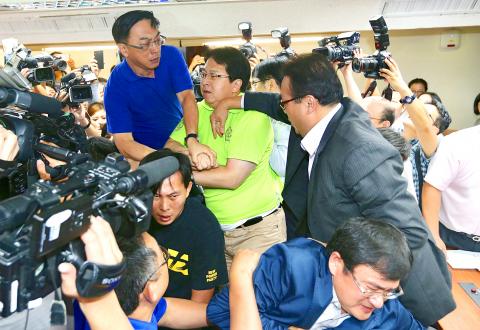
Photo: Chien Jung-feng, Taipei Times
KMT Legislator Arthur Chen (陳宜民) climbed onto the first row of desks in front of DPP Legislator Wu Yu-chin (吳玉琴), one of the committee co-conveners, and engaged in a tussle with DPP Legislator Chiu Chih-wei (邱志偉) before being pushed off by DPP Legislator Su Chen-ching (蘇震清).
The fracas erupted after Wu refused to take up a KMT motion following the official reading of minutes from the committee’s Oct. 5 meeting, instead relying on the DPP majority guarding her desk to confirm the minutes despite objections.
DPP members of the committee had moved to send the amendment directly to cross-caucus negotiations when the review began earlier this month, with the confirmation of the minutes being the final step before the amendment leaves the committee, following several weeks of break as the legislature held confirmation hearings for nominees for the Council of Grand Justices.
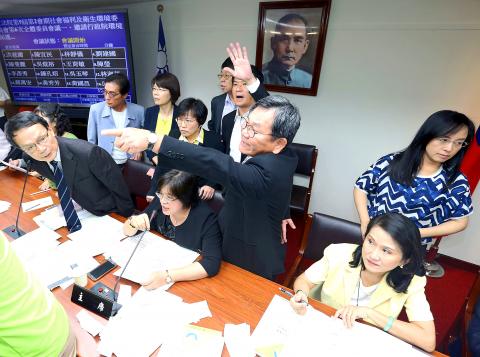
Photo: CNA
The amendment has stirred controversy, as it seeks to cut seven national holidays with the implementation of a five-day workweek with one mandatory day off and a “flexible rest day.”
After KMT legislators prevented the confirmation of the minutes by occupying the co-conveners’ desk on Wednesday, dozens of DPP legislators the same night locked themselves in the committee chamber and used their bodies to block the desks the moment the doors opened yesterday.
KMT legislators lined up in front of their DPP counterparts shortly after entering the committee chamber, claiming to be waiting to take their turn for “procedural remarks” and clamoring for Wu to yield the floor.
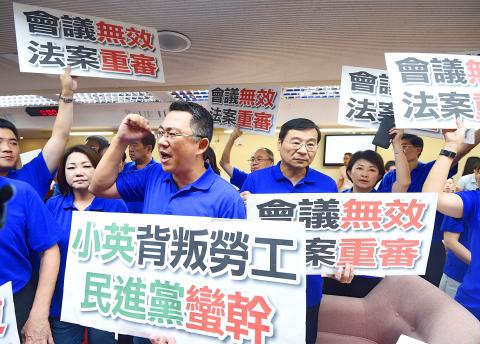
Photo: Chien Jung-fong, Taipei Times
“All we demand is that the recordings [of the earlier meeting] be brought forward to correct the minutes,” KMT caucus whip Sufin Siluko (廖國棟) said.
After the minutes were confirmed, Sufin Siluko led other KMT lawmakers to the Control Yuan and Taipei District Court to protest, saying that the DPP’s “railroading” of inaccurate minutes made the party liable for falsification of documents.
Meanwhile, Wu told a news conference that the meeting was conducted fully in accordance with legislative procedures.
She said she decided that the committee would not consider a proposal filed by the KMT caucus about the proceedings of the Oct. 5 meeting, because it did not address the proceedings, but merely raised procedural questions.
The committee would have considered a motion to review the proceedings only if there was a mistake or omission, she added.
She put her decision to a vote, and it was approved 7-0, because no KMT legislator voted during the commotion.
She also rejected a proposal raised by the New Power Party (NPP) caucus because a caucus could not raise a proposal in a committee where it has less than three legislators, and only NPP Legislator Hung Tzu-yung (洪慈庸) is a member of the committee.
The amendment is a responsible legislation to ensure a five-day workweek, unify the nation’s various leave schemes and increase paid annual leave for employees, DPP caucus chief executive Wu Ping-jui (吳秉叡) said.
“Whoever is against the legislation does not have to support the DPP in the elections,” he added.
Wu Ping-jui accused the KMT and the NPP of employing double standards, as both demanded that hearings about the amendment be held, but they made no such demands when Wang chaired a committee meeting in July and approved a KMT amendment to the act.

PROVOCATIVE: Chinese Deputy Ambassador to the UN Sun Lei accused Japan of sending military vessels to deliberately provoke tensions in the Taiwan Strait China denounced remarks by Japan and the EU about the South China Sea at a UN Security Council meeting on Monday, and accused Tokyo of provocative behavior in the Taiwan Strait and planning military expansion. Ayano Kunimitsu, a Japanese vice foreign minister, told the Council meeting on maritime security that Tokyo was seriously concerned about the situation in the East China and South China seas, and reiterated Japan’s opposition to any attempt to change the “status quo” by force, and obstruction of freedom of navigation and overflight. Stavros Lambrinidis, head of the EU delegation to the UN, also highlighted South China Sea
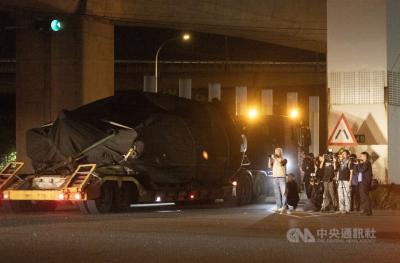
The final batch of 28 M1A2T Abrams tanks purchased from the US arrived at Taipei Port last night and were transported to the Armor Training Command in Hsinchu County’s Hukou Township (湖口), completing the military’s multi-year procurement of 108 of the tanks. Starting at 12:10am today, reporters observed more than a dozen civilian flatbed trailers departing from Taipei Port, each carrying an M1A2T tank covered with black waterproof tarps. Escorted by military vehicles, the convoy traveled via the West Coast Expressway to the Armor Training Command, with police implementing traffic control. The army operates about 1,000 tanks, including CM-11 Brave Tiger
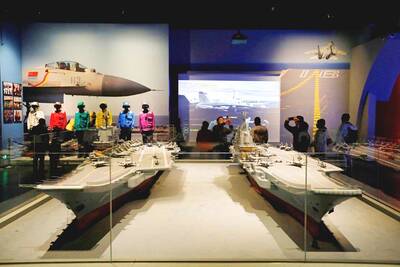
China on Wednesday teased in a video an aircraft carrier that could be its fourth, and the first using nuclear power, while making an allusion to Taiwan and vowing to further build up its islands, as it looks to boost maritime power, secure resources and bolster territorial claims. The video, issued on the eve of the 77th founding anniversary of the Chinese People’s Liberation Army Navy, featured fictional officers with names that are homophones of three commissioned aircraft carriers, the Liaoning (遼寧), Shandong (山東) and Fujian (福建). Titled Into the Deep, it showed a 19-year-old named “Hejian” (何劍) joining the group, sparking
Taiwan Semiconductor Manufacturing Co (TSMC, 台積電), the world’s largest contract chipmaker, said it expects its 2-nanometer (2nm) chip capacity to grow at a compound annual rate of 70 percent from this year to 2028. The projection comes as five fabs begin volume production of 2-nanometer chips this year — two in Hsinchu and three in Kaohsiung — TSMC senior vice president and deputy cochief operating officer Cliff Hou (侯永清) said at the company’s annual technology symposium in Silicon Valley, California, last week. Output in the first year of 2-nanometer production, which began in the fourth quarter of last year, is expected to


 RSS
RSS