


The Hong Kong government on Friday issued a statement calling on Taiwan to refrain from interfering in the territory’s internal affairs.
The statement, delivered by a government spokesman at a press conference, was apparently issued in response to comments by Mainland Affairs Council spokesperson Chiu Chui-cheng (邱垂正), who said the council would be closely following Hong Kong politics to see whether the legislative seats of Sixtus “Baggio” Leung (梁頌恆) and Yau Wai-ching (游蕙禎) would be declared invalid.
Leung and Yau refused to state the oath correctly — in essence refusing to pledge allegiance to the People’s Republic of China — at their inauguration as legislators, and the secretary-general of the Hong Kong Legislative Council refused to accept their oaths.
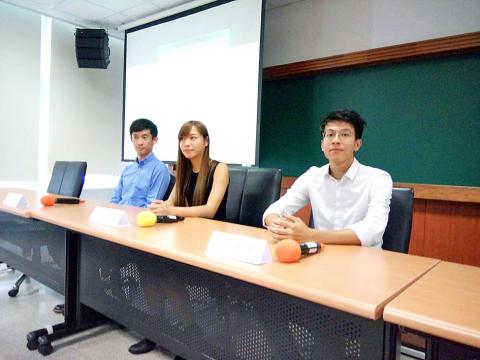
Photo: CNA
Leung and Yau’s action is seen as being part of a pro-Hong Kong independence stance.
The Hong Kong government spokesperson on Friday said that “since the [Hong Kong’s] return [to China], the Special Administrative Region (SAR) of Hong Kong has been given great autonomy under the Basic Law, fully embodying the success of the ‘one country, two systems’ approach.”
Leung and Yau were in Taipei yesterday to speak at National Taiwan University about Hong Kong’s localization movement.
Yau said the main reason for her visit to Taiwan was because she was invited to deliver the speech and there were no plans to meet with politicians.
Yau said she would be willing to interact with political parties in the future, adding that her visit has “gone smoothly.”
Leung and Yau were joined at the university event by Hong Kong Indigenous spokesperson Ray Wong (黃台仰), who spoke about his experience with the independence movements in Taiwan and Hong Kong.
Meanwhile, former Hong Kong Legislative Council president Rita Fan (范徐麗泰) said in a radio interview in Hong Kong yesterday that the Taiwanese government’s statements lately have been an apparent challenge to the Hong Kong government.
“Are Hong Kongers willing to be used?” she said, an apparent reference to Leung and Yau’s visit.
In an editorial, the Mingpao said that Beijing would regard intervention by Taipei in Leung and Yau’s inauguration incident as a precursor to pro-Taiwanese independence and pro-Hong Kong independence groups working together.
“Should Hong Kong become one of the bargaining chips in the ongoing gambit of cross-strait affairs, Hong Kong will face inestimable challenges while further complicating its own affairs,” the Chinese-language newspaper said.

A signaling system malfunction disrupted high-speed rail (HSR) services beginning at 8am today, with trains temporarily reduced to three northbound and three southbound trains per hour as authorities conduct inspections. The malfunction occurred on a section of track in Miaoli County during pre-operation checks early this morning, forcing northbound and southbound trains to use a single track, the HSR operator said. The regular schedule has been replaced with three hourly trains offering only nonreserved seating in each direction, stopping at every station, it said, adding that business class cars would still have reserved seating. Departures from terminal stations are scheduled at the top

Taiwan is still in the process of assessing the possibility of recruiting workers from Eswatini, the Ministry of Foreign Affairs said yesterday, adding that its goal is to help Eswatini upgrade its vocational training centers. If there are plans to recruit workers from Eswatini, safeguarding national security, protecting public health and ensuring the employment rights of Taiwanese would be prerequisites, Department of West Asian and African Affairs Director-General Yen Chia-liang (顏嘉良) told a news conference. Key considerations would also include filling labor shortages in specific industries, and fostering bilateral professional and technical exchanges, he said. Yen was asked about the progress of labor

A US uncrewed surface vessel (USV) encountered multiple Chinese warships during an autonomous transit of the Taiwan Strait, US defense company Seasats said in a statement on Wednesday. Seasats announced that a Lightfish USV had completed the first autonomous transit of the Taiwan Strait. Over five days, the USV traversed the entire length of the Strait while constantly monitoring surface vessel traffic, the company said. The Lightfish encountered multiple Chinese warships, one of which was a Chinese People’s Liberation Army Navy (PLAN) Type 056 corvette, it said. The Chinese vessels were operating “well within Taiwan’s exclusive economic zone without transmitting their identity via the

VERBOSE VESSELS: A CGA cutter and a China Coast Guard exchanged verbal barbs for more than a day in Taiwanese-controlled waters before the Chinese vessel left The Taiwanese and Chinese coast guards had a standoff near the strategically located Pratas Islands (Dongsha Islands, 東沙群島) in the north of the South China Sea, the Coast Guard Administration (CGA) said yesterday. The two sides engaged in intense radio exchanges over sovereignty claims during the 33-hour standoff. China Coast Guard vessel 3501 eventually left the restricted waters, 26.6 nautical miles (49.2km) west of the Pratas Islands, at 5pm yesterday, the CGA said. Lying approximately between southern Taiwan and Hong Kong, the Taiwan-controlled Pratas are seen by some security experts as vulnerable to Chinese attack due to their distance — more than


 RSS
RSS