


Representatives of the Chinese Nationalist Party (KMT) and the KMT-owned Central Investment Co (中央投資公司) yesterday criticized the Act Governing the Handling of Ill-gotten Properties by Political Parties and Their Affiliate Organizations (政黨及其附隨組織不當取得財產處理條例) as unconstitutional and protested what they said were flaws in a hearing arranged by the Ill-gotten Party Assets Settlement Committee .
The committee yesterday held a hearing in Taipei to determine whether Central Investment Co and its subsidiary Hsinyutai Co (欣裕台) should be considered KMT affiliate organizations; whether Central Investment Co president Gordon Chen (陳樹) and four other listed shareholders acquired their shares via a KMT-established trust; whether the KMT’s shares in the two firms were ill-gotten assets; and whether those shares should be transferred to the nation, local governments and the shareholders from whom the KMT allegedly acquired them.
During a committee question-and-answer session, Chen and a Central Investment accountant confirmed that the KMT is the sole shareholder in the two firms.
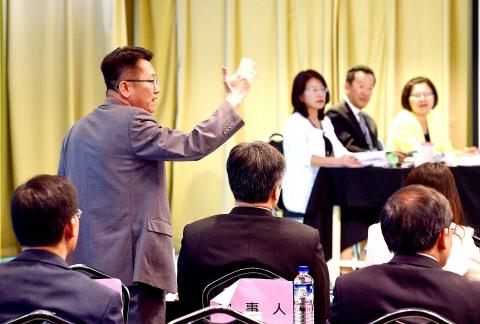
Photo: Peter Lo, Taipei Times
Shortly after the hearing began, Chen requested that committee chairman Wellington Koo (顧立雄) and vice chairman Shih Chin-fang (施錦芳) leave, citing a conflict of interest stemming from “biased” remarks the two have made against his firm.
The rest of the committee members rejected Chen’s request after an impromptu meeting, saying that Koo’s and Shih’s remarks were based on available investigative results, and that the information gathered at the hearing would not be the only reference in the committee’s decisions on whether to take punitive measures against the firms.
KMT Administration and Management Committee director Chiu Da-chan (邱大展) protested against the hearing before it had started.
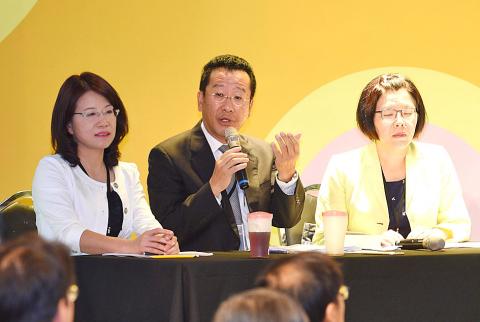
Photo: Peter Lo, Taipei Times
“Everyone already knows the results before the hearing. The plaintiffs and judges are from the same group,” Chiu said.
Saying that the committee comprises Democratic Progressive Party (DPP) proponents, he called on the Council of Grand Justices to deliver an impartial ruling on the legitimacy of the act, in reference to a constitutional interpretation the KMT requested last month.
Chiu said that the KMT would renounce land it holds if the land is ruled to be ill-gotten, but it would be committing malfeasance and painted in a negative light if it agreed to have its assets confiscated according to an unconstitutional act.
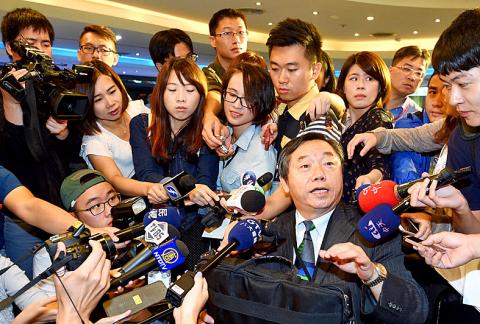
Photo: Peter Lo, Taipei Times
He said that the KMT is a defender of the law and the Constitution.
“Can we call ourselves a lawful political party if we do not even obey the Constitution?” he said.
Chiu said that the KMT lawfully registered the land it possesses, but that under the act, anyone who has purchased land since 1945 could be investigated and stripped of their property.
He questioned whether calling Central Investment a KMT affiliate organization can be justified.
“If so, 41 companies in which the government has shares should be deemed state-run corporations,” he said. “If you reveal the names of those companies now, I guarantee that the nation’s stock market will suffer a major decline tomorrow.”
Chang Shao-teng (張少騰), a lawyer representing the KMT, said that since the committee only informed the KMT of the types of assets it should declare on Tuesday, it is impossible that the KMT could have collated all of the requested information.
He said that there is a lack of legal basis for determining whether the two firms are KMT affiliate organizations, as the enforcement rules for the act have not been approved by the Executive Yuan.
The committee later inquired into the company’s finances dating to 1971.
Koo said that Central Investment bought NT$200 million (US$6.35 million) worth of KMT-issued government securities shortly after it was founded.
He asked Chen if the company had paid the then-KMT administration the money, or if the KMT took directly from the nation’s coffers and how the company acquired the money if it had actually bought the securities.
Chen said that he was unable to provide an answer, as he only assumed office in July last year and did not have access to the information Koo requested.
Koo later asked Chen and Chiu questions about Chiloo Industries Co (齊魯公司), in which Central Investment bought shares in 2007 and which runs Tsingtao Brewery Co (青島啤酒).
A committee member asked Chen why Central Investment enjoyed the privilege of buying large amounts of shares in petrochemical, electronics and concrete companies in its early years and how it managed to accrue considerable profits.
Other committee members questioned Chen about why the KMT asked him to head the company, how top KMT officials came to the decision to hire him and how much he is paid.
National Chong Cheng University history professor Yang Wei-chen (楊維真), who served as one of the KMT’s “witnesses,” said that the committee had turned the hearing into an inquest and that its style of questioning was based on a “presumption of guilt.”
“If the people summoned refuse to answer a question, they would be presumed guilty, and if they comply, they would be forced to forfeit their right to remain silent,” Yang said.
“As a witness, I cannot put up with a hearing like this,” he said before walking out.
Koo said that if the committee decides to hold another hearing, it would deliberate over the need to hold a pre hearing to determine whether the KMT’s stakes in the two firms are legitimate.
He said that as a governing body, the committee has the authority to interpret and enforce the act within legal parameters.
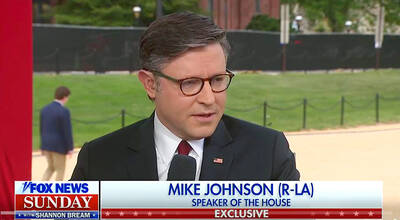
RESOLUTE BACKING: Two Republican senators are planning to introduce legislation that would impose immediate sanctions on China if it attempts to invade Taiwan US House of Representatives Speaker Mike Johnson on Sunday reaffirmed US congressional support for Taiwan, saying the US and “all freedom-loving people” have a stake in preventing China from seizing Taiwan by force. Johnson made the remarks in an interview with Fox News Sunday on US President Donald Trump’s summit with Chinese President Xi Jinping (習近平) last week. In an interview that aired on Friday on Fox News, just as Trump wrapped up a high-stakes visit to China, he said he has yet to green-light a new US$14 billion arms package to Taiwan and that it “depends on China.” “It’s a very good
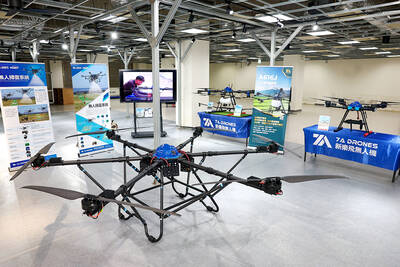
DRONE CENTRAL: Taiwan aims to become Asia’s democratic hub for drones, with most exports focused on high-quality military-grade models, an official said Taiwan’s drone industry is expected to expand significantly by 2030, producing 100,000 units per month and exporting half of them, the Ministry of Economic Affairs said yesterday. Current drone production capacity is about 15,000 units per month, but the industry can quickly scale up as demand increases, Industrial Development Administration Director-General Chiou Chyou-huey (邱求慧) told a news conference in Taipei. Taiwan’s drone output grew 2.5-fold last year to NT$12.9 billion (US$408.3 million) under a government program to develop the uncrewed vehicle sector, he said. The Executive Yuan in October last year approved plans to invest NT$44.2 billion into domestic production of uncrewed aerial
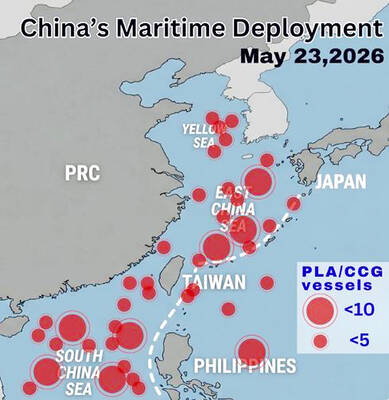
WARNING: China should stop engaging in actions that undermine regional peace and stability, as it would only build resentment among people across the Strait, the CGA said China has deployed more than 100 navy, coast guard and other vessels in waters from the Yellow Sea to the South China Sea and the western Pacific since US President Donald Trump and Chinese President Xi Jinping (習近平) met in Beijing, National Security Council Secretary-General Joseph Wu (吳釗燮) said yesterday. “In this part of the world, #China is the one & only PROBLEM wrecking the #StatusQuo & threatening regional peace & stability,” Wu wrote on X. In a separate post, he said Beijing was coercing Taiwan’s maritime domain, calling it illegal and provocative, after the Coast Guard Administration (CGA) expelled a
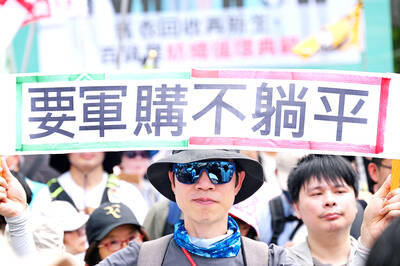
More than 8,000 people took part in a rally in Taipei yesterday to express support for more defense spending, after the opposition slashed the Cabinet’s proposed NT$1.25 trillion (US$39.6 billion) special defense budget and capped it at NT$780 billion. The demonstrators urged the Cabinet to propose another bill. Taiwan Economic Democracy Union convener Lai Chung-chiang (賴中強) said the main problem of the passed budget plan is the removal of funding for critical items, not just that the total amount is smaller. Critical budget items included purchasing or developing uncrewed vehicles, Strong Bow (強弓) missile systems, additional ammunition, artificial intelligence-powered combat systems and Taiwan-US


 RSS
RSS