


Financial Supervisory Commission (FSC) Chairman Ding Kung-wha (丁克華) and Vice Chairman Kuei Hsien-nung (桂先農) yesterday resigned over issues involving Mega International Commercial Bank’s (兆豐銀行) New York branch and XPEC Entertainment Inc (樂陞科技).
FSC Vice Chairman Huang Tien-mu (黃天牧) will be the commission’s acting chairman, the Executive Yuan said.
Ding on Saturday last week offered a verbal resignation to Premier Lin Chuan (林全), who rejected it, but Ding lodged another resignation on Sunday, which Lin approved, Executive Yuan spokesman Hsu Kuo-yung (徐國勇) said.
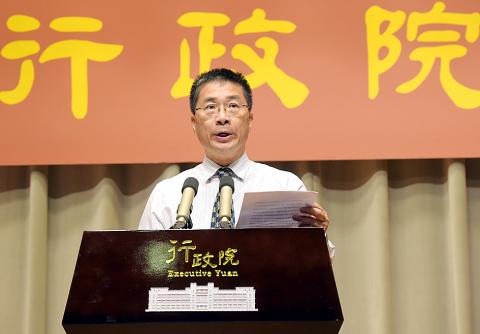
Photo: Huang Yao-cheng, Taipei Times
“To claim responsibility [for the Mega International and the XPEC case], Ding tendered his formal resignation yesterday, which was ... reported to President Tsai Ing-wen (蔡英文),” Hsu said.
Mega Bank’s New York branch was fined for breaches of US money laundering regulations, while XPEC was involved in a proposed takeover that failed, causing major losses for investors.
The president said she “respected” Lin’s decision, Hsu said.
Kuei, who was appointed alongside Ding, had to resign in accordance with the political appointments system, Hsu said.
Hsu said he did not know whether Ding resigned due to pressure from lawmakers and critics.
Ding said in the letter that he had to resign to “protect his integrity,” while Hsu supported the media’s right to question government officials.
“To prevent further effects on and misgivings about the commission, I have no other choice but to resign,” Ding said in a separate statement.
The FSC has achieved its intermediate goals that would pave the way toward bolstering regulatory standards for the nation’s financial sector, as well as placing responsibilities on companies involved in Bai Chi Gan Tou Digital Entertainment Co’s (百尺竿頭) botched bid to acquire XPEC, he said.
Hsu said there was no information on whether the resignations, along with the change of former Executive Yuan spokesman Tung Chen-yuan (童振源), was a preface to a minor Cabinet reshuffle.
When asked whether Lin lost his authority over Cabinet appointments, Hsu said, “the premier’s authority is intact and he saw to the appointments of myself and others.”
The Executive Yuan will seek suitable candidates to replace Ding and Kuei, Hsu said, adding that there are plenty of candidates in the financial sector.
The FSC would propose measures to reinforce oversight of financial institutions at a meeting called by an Executive Yuan task force to address the Mega Bank case, he said.
Meanwhile, Taiwan Stock Exchange (TWSE) chairman Shih Jun-ji (施俊吉) denied reports that he has been tapped as a candidate for the FSC chairmanship.
“I have no knowledge of a decision over the appointment,” Shih told the Taipei Times by telephone, adding that market rumors should be ignored.
“Three months into my appointment as TWSE chairman, there are still many tasks that must be completed,” Shih said.
Additional reporting by Ted Chen

A signaling system malfunction disrupted high-speed rail (HSR) services beginning at 8am today, with trains temporarily reduced to three northbound and three southbound trains per hour as authorities conduct inspections. The malfunction occurred on a section of track in Miaoli County during pre-operation checks early this morning, forcing northbound and southbound trains to use a single track, the HSR operator said. The regular schedule has been replaced with three hourly trains offering only nonreserved seating in each direction, stopping at every station, it said, adding that business class cars would still have reserved seating. Departures from terminal stations are scheduled at the top

DRONE CENTRAL: Taiwan aims to become Asia’s democratic hub for drones, with most exports focused on high-quality military-grade models, an official said Taiwan’s drone industry is expected to expand significantly by 2030, producing 100,000 units per month and exporting half of them, the Ministry of Economic Affairs said yesterday. Current drone production capacity is about 15,000 units per month, but the industry can quickly scale up as demand increases, Industrial Development Administration Director-General Chiou Chyou-huey (邱求慧) told a news conference in Taipei. Taiwan’s drone output grew 2.5-fold last year to NT$12.9 billion (US$408.3 million) under a government program to develop the uncrewed vehicle sector, he said. The Executive Yuan in October last year approved plans to invest NT$44.2 billion into domestic production of uncrewed aerial

VERBOSE VESSELS: A CGA cutter and a China Coast Guard exchanged verbal barbs for more than a day in Taiwanese-controlled waters before the Chinese vessel left The Taiwanese and Chinese coast guards had a standoff near the strategically located Pratas Islands (Dongsha Islands, 東沙群島) in the north of the South China Sea, the Coast Guard Administration (CGA) said yesterday. The two sides engaged in intense radio exchanges over sovereignty claims during the 33-hour standoff. China Coast Guard vessel 3501 eventually left the restricted waters, 26.6 nautical miles (49.2km) west of the Pratas Islands, at 5pm yesterday, the CGA said. Lying approximately between southern Taiwan and Hong Kong, the Taiwan-controlled Pratas are seen by some security experts as vulnerable to Chinese attack due to their distance — more than
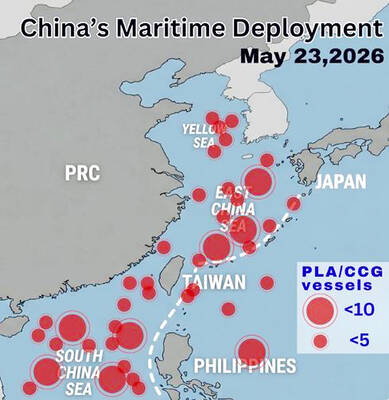
WARNING: China should stop engaging in actions that undermine regional peace and stability, as it would only build resentment among people across the Strait, the CGA said China has deployed more than 100 navy, coast guard and other vessels in waters from the Yellow Sea to the South China Sea and the western Pacific since US President Donald Trump and Chinese President Xi Jinping (習近平) met in Beijing, National Security Council Secretary-General Joseph Wu (吳釗燮) said yesterday. “In this part of the world, #China is the one & only PROBLEM wrecking the #StatusQuo & threatening regional peace & stability,” Wu wrote on X. In a separate post, he said Beijing was coercing Taiwan’s maritime domain, calling it illegal and provocative, after the Coast Guard Administration (CGA) expelled a


 RSS
RSS