


President Tsai Ing-wen (蔡英文) yesterday instructed the Executive Yuan and the Democratic Progressive Party (DPP) caucus to push through the legislature a draft amendment to introduce a five-day workweek with two mandatory days off, while reiterating her administration’s determination to carry out pension reform.
Tsai issued the instruction after convening the first weekly “administrative decisionmaking coordination meeting,” bringing together officials from the Executive Yuan and the DPP to deliberate on major issues, such as the proposal for mandatory two-day weekends, pension reform and money-laundering allegations against Mega International Commercial Bank (兆豐銀行).
“With regard to the unnecessary confusion caused by inconsistent national holidays, we should unify all public holidays and establish a uniform system applicable to every person in the nation,” Presidential Office spokesman Alex Huang (黃重諺) quoted Tsai as saying at the meeting.

Photo: Peter Lo, Taipei Times
Huang said the DPP caucus and the Executive Yuan have been ordered to complete the legislative process of the proposed mandatory two-day weekends by the end of this year to ensure that a system is implemented so that workers and employers can arrange their holiday schedules for next year.
Tsai urged the legislative and executive branches to review the annual paid leave system, as the problem at the center of public disputes over the proposed mandatory two-day weekends is not the number of national holidays per year, but whether employees are entitled to enough days off, Huang said.
Regarding the progress on pension reform, Huang quoted Tsai as saying that conflicting opinions at meetings of the Presidential Office’s National Pension Reform Committee in the past few months, as well as public discussions and discontent caused by them, have demonstrated two things: “The first is that reform is indeed difficult. Second, success can be expected from the government’s efforts this time,” adding that the administration is determined to carry out drastic, yet feasible, pension reform.
Participants at the meeting included Vice President Chen Chien-jen (陳建仁), Premier Lin Chuan (林全), Vice Premier Lin Hsi-yao (林錫耀), DPP caucus convener Ker Chien-ming (柯建銘), DPP caucus chief executive Wu Ping-jui (吳秉叡), DPP Secretary-General Hung Yao-fu (洪耀福), the DPP’s New Frontier Foundation think tank chief executive officer Chiou I-jen (邱義仁) and Kaohsiung Mayor Chen Chu (陳菊).
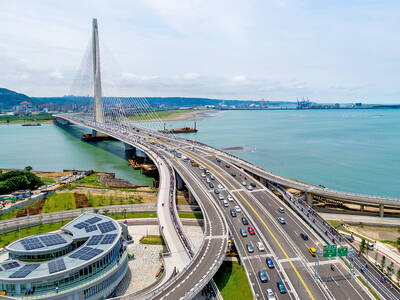
The Ministry of Transportation and Communications yesterday inaugurated the Danjiang Bridge across the Tamsui River in New Taipei City, saying that the structure would be an architectural icon and traffic artery for Taiwan. Feted as a major engineering achievement, the Danjiang Bridge is 920m long, 211m tall at the top of its pylon, and is the longest single-pylon asymmetric cable-stayed bridge in the world, the government’s Web site for the structure said. It was designed by late Iraqi-British architect Zaha Hadid. The structure, with a maximum deck of 70m, accommodates road and light rail traffic, and affords a 200m navigation channel for boats,
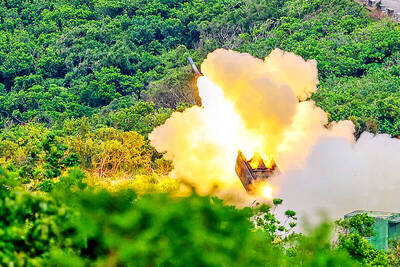
PRECISION STRIKES: The most significant reason to deploy HIMARS to outlying islands is to establish a ‘dead zone’ that the PLA would not dare enter, a source said A High Mobility Artillery Rocket System (HIMARS) would be deployed to Penghu County and Dongyin Island (東引) in Lienchiang County (Matsu) to force the Chinese military to retreat at least 100km from the coastline, a military source said yesterday. Taiwan has been procuring HIMARS and Army Tactical Missile Systems (ATACMS) from the US in batches. Once all batches have been delivered, Taiwan would possess 111 HIMARS units and 504 ATACMS, which have a range of 300km. Considering that “offense is the best defense,” the military plans to forward-deploy the systems to outlying islands such as Penghu and Dongyin so that
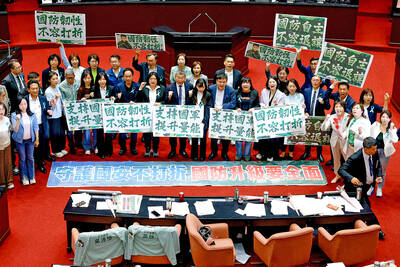
WHAT WAS ALL THAT FOR? Jaw Shaw-kong said that Cheng Li-wen had pushed for more drastic cuts and attacked him, just for the outcome to be nearly identical to his bill The legislature yesterday passed a supplementary budget bill to fund the purchase of separate packages of US military equipment, with the combined amount of spending capped at NT$780 billion (US$24.8 billion). The Chinese Nationalist Party (KMT) and Taiwan People’s Party (TPP) used their legislative majority to pass the bill, which runs until 2033 and has two main funding provisions. One was for NT$300 billion of arms sales already approved by the US for Taiwan on Dec. 17 last year, the other was for NT$480 billion for another arms package expected to be announced by Washington. The bill, which fell short of the NT$1.25
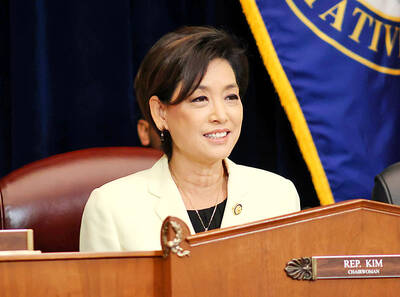
‘CLEAR MESSAGE’: The bill would set up an interagency ‘tiger team’ to review sanctions tools and other economic options to help deter any Chinese aggression toward Taiwan US Representative Young Kim has introduced a bill to deter Chinese aggression against Taiwan, calling for an interagency “tiger team” to preplan coordinated sanctions and economic measures in response to possible Chinese military or political action against Taiwan. “[Chinese President] Xi Jinping [習近平] has directed the People’s Liberation Army to be ready to invade Taiwan by 2027. China has a plan. America should have one too,” Kim said in a news release on Thursday last week. She introduced the “Deter PRC [People’s Republic of China] aggression against Taiwan act” to “ensure the US has a coordinated sanctions strategy ready should


 RSS
RSS