


Beijing’s continued suppression of Taiwan’s international space is a “lose-lose” — and not a “win-win” — strategy, Premier Lin Chuan (林全) said yesterday, in response to a report that the Irish government has advised its ministers not to attend celebrations marking Taiwan’s National Day to avoid provoking China.
The Irish Times reported on Thursday said that the Irish Department of Foreign Affairs and Trade “has issued strong advice to ministers to resist all invitations to mark the occasion.”
According to the newspaper, the department said in an e-mail that the attendance of Irish ministers would be contrary to the government’s policy, and that “meetings between Irish and Taiwan public representatives are perceived in China as implicit recognition of the government of Taiwan and thus breach the ‘one China’ policy, which has been adhered to by successive Irish governments.”
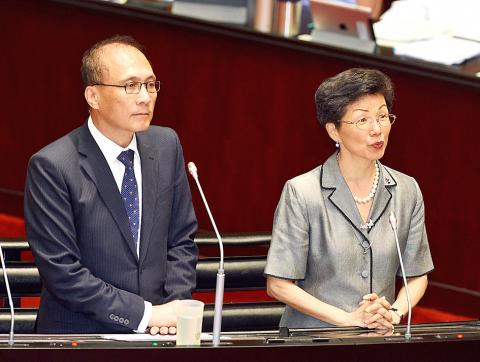
Photo: Peter Lo, Taipei Times
When asked about the report, Lin said such obstruction is “not a good move,” adding, without referring to whom, “boycotting Taiwan would result in a lose-lose, rather than a win-win, situation.”
Minister of Foreign Affairs David Lee (李大維) said the nation’s diplomatic difficulties did not begin this year.
“[The obstruction] has been a long-time practice. Over the past 10 years it has been like this, and we are now in the process of dealing with the issue,” he said, adding that it has always been Ireland’s policy to advise their officials against attending the Double Ten National Day celebrations.
“[Irish] members of parliament who are friendly to us have voiced their protest to their government,” he said.
He added that there were other nations that have been taking similar positions, “but I cannot reveal [who they are].”
Mainland Affairs Council Minister Katharine Chang (張小月) said President Tsai Ing-wen (蔡英文) is the democratically elected head of state and symbolizes the will of the Taiwanese public.
“Taiwanese will not bow to pressure,” she added.
Citing Aesop’s fable “The North Wind and the Sun,” Chang said: “If [China] really wants to move the cross-strait relationship in a more positive direction, communication and talks are necessary.”
She added that the more pressure Beijing exerts on Taiwan, the more resistance it will encounter.
Chinese Nationalist Party (KMT) Legislator Lin Te-fu (林德福) criticized the Irish government’s advice as trampling on Taiwan’s national dignity, but added that it was the result of the Tsai administration’s rejection of the so-called “1992 consensus” and “one China, different interpretations.”
The “1992 consensus,” a term former Mainland Affairs Council chairman Su Chi (蘇起) admitted to making up in 2000, refers to a tacit understanding between the KMT and the Chinese Communist Party that both sides acknowledge there is “one China,” with each having their own interpretation of what “China” means.
Democratic Progressive Party (DPP) Legislator Chen Ting-fei (陳亭妃) called on the Ministry of Foreign Affairs to continue communicating with the Irish government, and warned Beijing that Taiwanese would only become more unified if the oppression continues.
Meanwhile, Tsai, who is also the DPP chairperson, on Thursday made public a letter to party members marking the 30th anniversary of the DPP’s founding on Wednesday.
In addition to reforms she pledged to follow through on, Tsai asked party members to have faith in the DPP’s determination to “safeguard certain values.”
“We will fight against China’s oppression and develop our relationships with other nations. We will free ourselves from overdependence on China and form a healthy and normal economic relationship [with China],” she said.
Additional Reporting by CNA
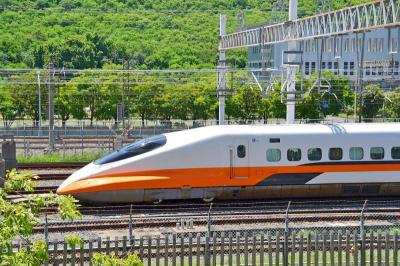
A signaling system malfunction disrupted high-speed rail (HSR) services beginning at 8am today, with trains temporarily reduced to three northbound and three southbound trains per hour as authorities conduct inspections. The malfunction occurred on a section of track in Miaoli County during pre-operation checks early this morning, forcing northbound and southbound trains to use a single track, the HSR operator said. The regular schedule has been replaced with three hourly trains offering only nonreserved seating in each direction, stopping at every station, it said, adding that business class cars would still have reserved seating. Departures from terminal stations are scheduled at the top
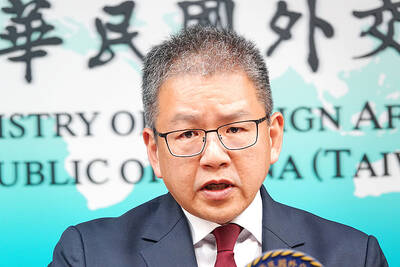
Taiwan is still in the process of assessing the possibility of recruiting workers from Eswatini, the Ministry of Foreign Affairs said yesterday, adding that its goal is to help Eswatini upgrade its vocational training centers. If there are plans to recruit workers from Eswatini, safeguarding national security, protecting public health and ensuring the employment rights of Taiwanese would be prerequisites, Department of West Asian and African Affairs Director-General Yen Chia-liang (顏嘉良) told a news conference. Key considerations would also include filling labor shortages in specific industries, and fostering bilateral professional and technical exchanges, he said. Yen was asked about the progress of labor

A US uncrewed surface vessel (USV) encountered multiple Chinese warships during an autonomous transit of the Taiwan Strait, US defense company Seasats said in a statement on Wednesday. Seasats announced that a Lightfish USV had completed the first autonomous transit of the Taiwan Strait. Over five days, the USV traversed the entire length of the Strait while constantly monitoring surface vessel traffic, the company said. The Lightfish encountered multiple Chinese warships, one of which was a Chinese People’s Liberation Army Navy (PLAN) Type 056 corvette, it said. The Chinese vessels were operating “well within Taiwan’s exclusive economic zone without transmitting their identity via the

‘NO SECURITY RISK’: The Railway Bureau reassured the public that the technicians’ activities were limited to technical guidance and did not involve sensitive systems The Railway Bureau yesterday said it had invited eight Chinese technicians to assist with an airport MRT construction project. The bureau issued the confirmation after an Internet user said Chinese nationals had entered the construction zone of Taiwan Taoyuan International Airport’s Terminal 3 project. They asked why “individuals from an enemy state” were allowed access to such a major national infrastructure project, which raised serious concerns over Taiwan’s industrial safety, sensitive systems and information security. The bureau’s Northern Region Engineering Branch Office said subcontractor Taiwan Handle Industrial Co (台灣手把工業) of the Taoyuan airport MRT’s “Contract No. CU05 Project A14 Station Civil, MEP &


 RSS
RSS