


Representatives from a coalition of young people’s groups voiced their support for pension reform in Taipei yesterday.
The group called for “generational justice” and equal treatment for people from all occupations, adding that young people are unfairly shouldering the financial burden of public pensions.
Jennifer Lu (呂欣潔), an executive for the Social Democratic Party, said that the viewpoints of the younger generation are not being heard at government meetings.
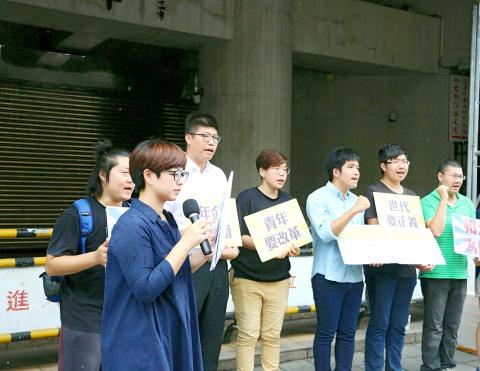
Photo: CNA
“I have many young adult friends around me who are civil servants, public-school teachers, or enlisted in the military, but they support the government’s drive for pension reform,” Lu said. “However, they are afraid to speak out due to pressure from their superiors.”
“Many young adults doubt that they can receive pensions in the future, even though they have paid into the system,” Lu said. “They worry that they have to pay now, but when they retire, they would have to face a bankrupt nation.”
Hsu Tzu-wei (徐子為), head of National Chengchi University’s graduate students association, said that public-school teachers receive on average NT$68,000 in monthly pensions, while workers in most other occupations only receive at most NT$16,000 per month.
“Our society has belatedly discovered that the pension system and working rights are unfair to private-sector employees,” Hsu said. “Pension reform is not a ‘class struggle’ against groups in higher wage levels. We just want to achieve reform so that private-sector employees have the same pensions as civil servants, teachers and military personnel.”
The government must be more prudent in its spending, he said, adding that it must find other revenue sources, so the pension system can be stabilized, easing the financial burden on young workers who have to support retirees.
Chen Chia-hsin (陳佳菁), president of the National Yang Ming University student union, said problems with the pension system have a historical and institutional background, and proposed reforms are not aimed at any particular group as some have claimed.
“Spending is allocated unevenly, for which the younger generation has to shoulder the financial burdens of the future,” Chen said. “We want the government to carry on dialogue with all sectors of society to make the pension system fair, equitable and sustainable.”
Wu Yun-ching (吳昀慶), head of National Taiwan University’s graduate students association, said statistics show that the nation’s “old-age dependency” ratio is at 5.6, meaning one person aged 65 or more is dependent on the financial contributions of 5.6 working adults.
“However, the ratio will be reduced to 2.2 within the next 20 years,” Wu said. “Taiwan will become an impoverished society. Therefore we must discuss the fair distribution of financial resources right now.”
Yao Chieh-hsiang (姚介祥), a figure in the Sunflower movement, said Taiwan risks bankruptcy, so Taiwanese should tighten their belts and face the hardship together.
“Those people protesting today [yesterday] ... should understand that they are also a part of this nation,” Yao said. “They should not see reform as a punishment.”

CREDIT-GRABBER: China said its coast guard rescued the crew of a fishing vessel that caught fire, who were actually rescued by a nearby Taiwanese boat and the CGA Maritime search and rescue operations do not have borders, and China should not use a shipwreck to infringe upon Taiwanese sovereignty, the Coast Guard Administration (CGA) said yesterday. The coast guard made the statement in response to the China Coast Guard (CCG) saying it saved a Taiwanese fishing boat. The Chuan Yu No. 6 (全漁6號), a fishing vessel registered in Keelung, on Thursday caught fire and sank in waters northeast of Diaoyutai Islands (釣魚台). The vessel left Keelung’s Badouzih Fishing Harbor (八斗子漁港) at 3:35pm on Sunday last week, with seven people on board — a 62-year-old Taiwanese captain surnamed Chang (張) and six
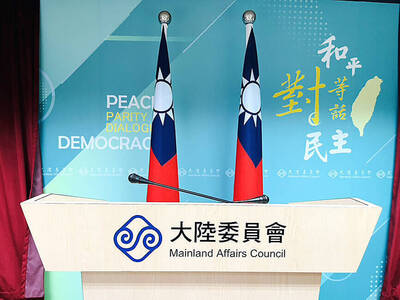
RISKY BUSINESS: The ‘incentives’ include initiatives that get suspended for no reason, creating uncertainty and resulting in considerable losses for Taiwanese, the MAC said China’s “incentives” failed to sway sentiment in Taiwan, as willingness to work in China hit a record low of 1.6 percent, a Ministry of Labor survey showed. The Directorate-General of Budget, Accounting and Statistics (DGBAS) also reported that the number of Taiwanese workers in China has nearly halved from a peak of 430,000 in 2012 to an estimated 231,000 in 2024. That marked a new low in the proportion of Taiwanese going abroad to work. The ministry’s annual survey on “Labor Life and Employment Status” includes questions respondents’ willingness to seek employment overseas. Willingness to work in China has steadily declined from

The number of pet cats in Taiwan surpassed that of pet dogs for the first time last year, reaching 1,742,033, a 32.8 percent increase from 2023, the Ministry of Agriculture said yesterday, citing a survey. By contrast, the number of pet dogs declined slightly by 1.2 percent over the same period to 1,462,528, the ministry said. Despite the shift, households with dogs still slightly outnumber those with cats by 1.2 percent. However, while the number of households with multiple dogs has remained relatively stable, households keeping more than two cats have increased, contributing to the overall rise in the feline population. The trend

The Legislative Yuan’s Finance Committee yesterday approved proposed amendments to the Amusement Tax Act (娛樂稅法) that would abolish taxes on films, cultural activities and competitive sporting events, retaining the fee only for dance halls and golf courses. The proposed changes would set the maximum tax rate for dance halls and golf courses at 50 and 20 percent respectively, with local governments authorized to suspend the levies. Article 2 of the act says that “amusement tax shall be levied on tickets sold or fees charged by amusement places, facilities or activities” in six categories: “Cinema; professional singing, story-telling, dancing, circus, magic show, acrobatics


 RSS
RSS