


The Ministry of Foreign Affairs (MOFA) yesterday reiterated that ties between Taiwan and its sole European diplomatic ally, the Vatican, remain strong following a report by a Hong Kong media outlet that the Holy See and China have reached an agreement on the appointment of Chinese bishops, which is rumored to signal the forthcoming resumption of diplomatic relations between the two states.
The Chinese-language Hong Kong Apple Daily on Thursday reported that Hong Kong Cardinal John Tong Hon (湯漢) published an article on the Catholic Diocese of Hong Kong’s Web site, saying that after years of efforts, the Catholic Church has “gradually gained the reconsideration of the Chinese government, which is now willing to reach an understanding with the Holy See on the question of the appointment of bishops in the Catholic Church in China and seek a mutually acceptable plan.”
“Even though the agreement’s concrete terms have not been made public, we believe that Pope Francis ... would not accept any agreement that would harm the integrity of faith of the universal church or the communion between the Catholic Church in China and the universal church,” the article said.
The newspaper said that the mentioning of the agreement indirectly confirmed the speculation, which has been circulating for the past six months, that the two sides have been negotiating an agreement.
The cardinal said that the agreement between the Holy See and Beijing “is an example of human dialogue, the beginning of the normalization of a mutual relationship.”
Responding to media queries about the report, the ministry emphasized the strong ties between Taiwan and the Vatican and the frequent interactions between their top echelons.
“We have been in close co-operation with the Vatican and officials from both sides have often paid visits to each other,” the ministry said, citing various examples of co-sponsored activities and humanitarian aid plans, as well as agreements signed in the past few years.
Congregation for the Evangelization of Peoples secretary Archbishop Savio Hon Tai-fai (韓大輝) and the Holy See’s Pontifical Council for the Family president Archbishop Vincenzo Paglia came to Taiwan last year, the ministry said, adding that Pontifical Committee for International Eucharistic Congresses president Archbishop Piero Marini and Filipino Cardinal Luis Antonio Cardinal Tagle visited Taiwan in May, while Apostolic Nuncio of Japan Archbishop Joseph Chennoth attended the presidential inauguration ceremony on May 20.
“We will continue to proactively participate in the international activities held by the Holy See and improve the bilateral relationship,” the ministry said.
The ministry added that it has been staying abreast of the dialogue between the Holy See and China and will continue to follow the developments.
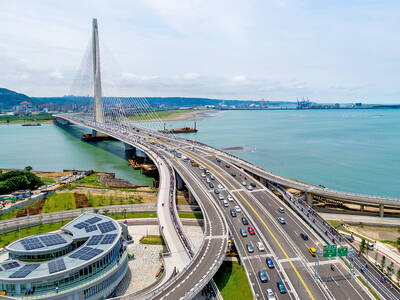
The Ministry of Transportation and Communications yesterday inaugurated the Danjiang Bridge across the Tamsui River in New Taipei City, saying that the structure would be an architectural icon and traffic artery for Taiwan. Feted as a major engineering achievement, the Danjiang Bridge is 920m long, 211m tall at the top of its pylon, and is the longest single-pylon asymmetric cable-stayed bridge in the world, the government’s Web site for the structure said. It was designed by late Iraqi-British architect Zaha Hadid. The structure, with a maximum deck of 70m, accommodates road and light rail traffic, and affords a 200m navigation channel for boats,
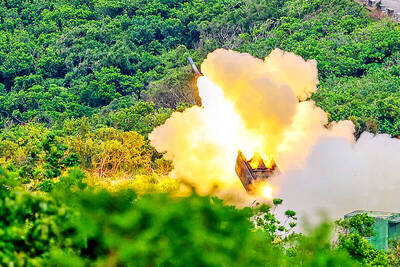
PRECISION STRIKES: The most significant reason to deploy HIMARS to outlying islands is to establish a ‘dead zone’ that the PLA would not dare enter, a source said A High Mobility Artillery Rocket System (HIMARS) would be deployed to Penghu County and Dongyin Island (東引) in Lienchiang County (Matsu) to force the Chinese military to retreat at least 100km from the coastline, a military source said yesterday. Taiwan has been procuring HIMARS and Army Tactical Missile Systems (ATACMS) from the US in batches. Once all batches have been delivered, Taiwan would possess 111 HIMARS units and 504 ATACMS, which have a range of 300km. Considering that “offense is the best defense,” the military plans to forward-deploy the systems to outlying islands such as Penghu and Dongyin so that
Taiwan Semiconductor Manufacturing Co (TSMC, 台積電), the world’s largest foundry service provider, yesterday said that global semiconductor revenue is projected to hit US$1.5 trillion in 2030, after the figure exceeds US$1 trillion this year, as artificial intelligence (AI) demand boosts consumption of token and compute power. “We are still at the beginning of the AI revolution, but we already see a significant impact across the whole semiconductor ecosystem,” TSMC deputy cochief operating officer Kevin Zhang (張曉強) said at the company’s annual technology symposium in Hsinchu City. “It is fair to say that in the past decade, smartphones and other mobile devices were
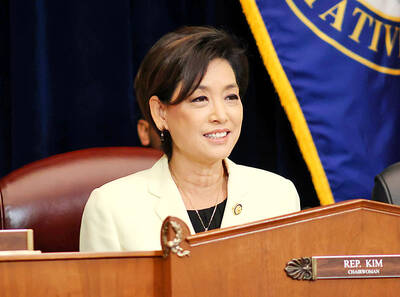
‘CLEAR MESSAGE’: The bill would set up an interagency ‘tiger team’ to review sanctions tools and other economic options to help deter any Chinese aggression toward Taiwan US Representative Young Kim has introduced a bill to deter Chinese aggression against Taiwan, calling for an interagency “tiger team” to preplan coordinated sanctions and economic measures in response to possible Chinese military or political action against Taiwan. “[Chinese President] Xi Jinping [習近平] has directed the People’s Liberation Army to be ready to invade Taiwan by 2027. China has a plan. America should have one too,” Kim said in a news release on Thursday last week. She introduced the “Deter PRC [People’s Republic of China] aggression against Taiwan act” to “ensure the US has a coordinated sanctions strategy ready should


 RSS
RSS