


President Tsai Ing-wen (蔡英文) yesterday issued a formal apology on behalf of the government to Aborigines for the discrimination and neglect they suffered over the past 400 years.
The apology was made after a ceremony in front of the Presidential Office Building in Taipei, where representatives of Taiwan’s 16 recognized Aboriginal communities gathered on Indigenous People’s Day.
Following a Paiwan tradition, the representatives announced their arrival by singing songs and burning stalks of foxtail millet.
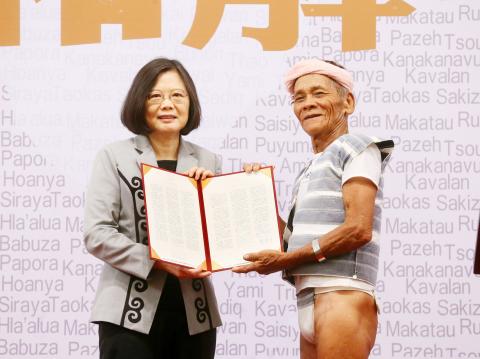
Photo: EPA/Office of the president
Tsai then greeted them at the entrance of the Presidential Office Building and invited them in, where a Bunun blessing ceremony was held and prayers were offered by six Christian priests of Aboriginal heritage.
In her apology on behalf of the government, Tsai said it was a further step toward protecting the social status of Aborigines and promoting their development in education, culture, social welfare and economic development, as laid out in an article of the Constitution that was added on Aug. 1, 1994.
The article also abolished the widely used term shanbao (山胞, “mountain fellow”) to refer to Aborigines, after they campaigned against it for decades because of racist connotations, Tsai said.
“For the unfair treatment and pain suffered by all of you in the past 400 years, I apologize on behalf of the government,” Tsai said. “I believe that even now, there are still some people who think there is no need for such an apology, but that is the main reason why I need to make this apology on behalf of the government today.”
Tsai also announced the establishment of a Presidential Office “commission for historical and transitional justice,” which she is to head.
The commission is to hold discussions with representatives of Aboriginal communities on issues such as national policies toward Aborigines so that their voices can be heard, she said.
Tsai added that the Cabinet would seek to introduce a basic law for Aborigines, revive the historic memories of Aboriginal communities and pay attention to their education, health and economic development.
She said a legal service center would be created to deal with the increasing number of conflicts between existing laws and traditional Aboriginal practices, such as the hunting of non-protected animals.
Tsai also said that before the publication of a final report, she would re-examine a government decision to store nuclear waste on Orchid Island (Lanyu, 蘭嶼) and would offer compensation to members of the Tao community who live there.
She called for efforts to ensure better public understanding of the history and culture of Taiwan’s various ethnic groups to help achieve reconciliation and prosperity for all, and promote justice, diversity and equality.
The apology to Aborigines was one of Tsai’s campaign promises, which she said would signal respect for the early inhabitants of the nation and a move toward solving related issues.
An 80-year-old Tao elder from Orchid Island responded on behalf of the Aboriginal representatives, saying that he hoped the government’s apology on Indigenous People’s Day would mark the beginning of peace and reconciliation.
On behalf of the 16 Aboriginal communities, he accepted a printed copy of Tsai’s apology and offered her foxtail millet in a traditional gesture.

‘NO SECURITY RISK’: The Railway Bureau reassured the public that the technicians’ activities were limited to technical guidance and did not involve sensitive systems The Railway Bureau yesterday said it had invited eight Chinese technicians to assist with an airport MRT construction project. The bureau issued the confirmation after an Internet user said Chinese nationals had entered the construction zone of Taiwan Taoyuan International Airport’s Terminal 3 project. They asked why “individuals from an enemy state” were allowed access to such a major national infrastructure project, which raised serious concerns over Taiwan’s industrial safety, sensitive systems and information security. The bureau’s Northern Region Engineering Branch Office said subcontractor Taiwan Handle Industrial Co (台灣手把工業) of the Taoyuan airport MRT’s “Contract No. CU05 Project A14 Station Civil, MEP &

The National Chungshan Institute of Science and Technology yesterday showcased its locally developed variants of the Vision 60 robotic patrol dog, which it plans to deploy on the nation’s outlying territories in the South China Sea. The variants were produced under the Joint Lab project — created by the institute and domestic companies — and assembled with domestically produced motors, lenses and artificial intelligence (AI) systems alongside licensed tech from the US, Missile and Rocket Systems Research Division deputy director Jen Kuo-kang (任國光) told the media event at a military base in Taipei’s Dazhi (大直) area. Taiwan has built up its strengths

NOT IMMEDIATE: Taiwan has a chance to appeal the proposed 10 percent tariff before it starts, while other countries face a 12.5 percent tariff from the trade office Taiwan is among 60 economies determined by the US to have failed to impose or enforce a ban on the importation of goods produced with forced labor, according to a notice released on Tuesday by the Office of the US Trade Representative (USTR), which proposed imposing an additional 10 percent or more tariff on them. The USTR in a statement said that following an investigation, it had determined under Section 301 of the Trade Act of 1974 that the failure of the 60 economies to impose and effectively enforce a prohibition on the importation of goods produced with forced labor is

RIGHT DIRECTION: Taiwan’s efforts to prevent forced labor include a proposal to ‘fully prohibit’ employers from withholding workers’ documents, an official said Taiwan is to establish a mechanism to restrict imports of goods linked to forced labor, the Executive Yuan said yesterday, after the US proposed imposing additional tariffs on Taiwanese goods over labor concerns. “The Ministry of Labor and the Ministry of Economic Affairs are to establish an interministerial review procedure,” Executive Yuan spokesperson Michelle Lee (李慧芝) said at a news briefing in Taipei. “The government is to use the Foreign Trade Act [貿易法] as the legal basis to restrict imports of goods produced with forced labor” and bring its supply chain governance more in line with international standards on human rights, resilience


 RSS
RSS