


The legislative caucuses reached a consensus in the second round of cross-caucus negotiations yesterday afternoon on the handling of budget bills for state-owned businesses, after a Legislative Yuan staff member was admitted for medical care on Wednesday night following an around-the-clock session that started on Tuesday afternoon.
The legislature on Tuesday began a marathon session that is scheduled to continue until midnight tonight to vote on more than 1,000 budget-slashing proposals proposed by the Chinese Nationalist Party (KMT) caucus due to the KMT’s refusal to negotiate with the Democratic Progressive Party (DPP).
After the collapse of the female clerk, the legislature on Wednesday night resolved to temporarily adjourn the meeting and resume it yesterday morning.
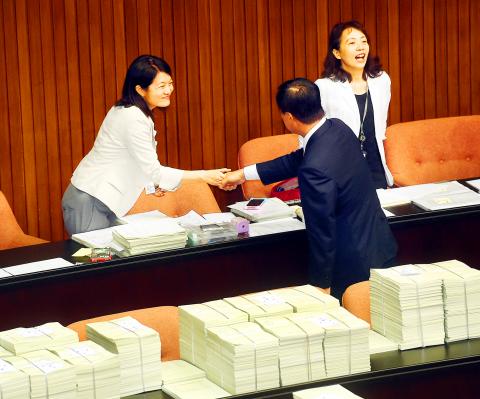
Photo: Fang Pin-chao, Taipei Times
However, the first round of negotiations yesterday morning failed to reach a consensus, with the KMT demanding an arrangement for state-owned enterprises representatives to present their cases to the Legislative Yuan to facilitate further talks on the budget bills.
KMT caucus secretary-general Lin Te-fu (林德福) said the caucus would not retract the budget-slashing motions it has proposed.
He added that the party would stand its ground on voting through each individual proposal until the leadership of the state-owned businesses initiates talks with KMT legislators.
The caucus is still waiting to meet with the presidents and chief executive officers of state-owned businesses, who had not come to discuss their budget proposals with lawmakers since the beginning of last month, he said.
Lin said that the KMT was playing by the rules and that its intentions are to “ensure that taxpayers’ money is put to good use.”
The KMT’s call for four votes to be conducted on each proposal to cut a budget has brought the Legislative Yuan to a standstill, as there are more than 1,000 proposals that have yet to be voted on, DPP caucus whip Ker Chien-ming (柯建銘) said.
“We are willing to work with the KMT on any proposal they want to talk about or want for more oversight on,” Ker said, calling for unity to restore functionality to the Legislative Yuan.
DPP caucus secretary-general Chen Ting-fei (陳亭妃) said audio and visual recordings of the cross-caucus negotiations are available and the process would be transparent, adding that the DPP is willing to work with the KMT on the issue.
The caucuses undertook another round of negotiations in the afternoon and concluded that the session would run through tomorrow and end at 6pm, adding that all unresolved issues would be slated for sessions meetings, pending the next legislative session.
The caucuses also agreed to retract similar or repeated motions and to have executive departments communicate with each caucus concerning the budget bills.
According to the resolution reached by the second negotiation, voting on each bill would be limited to two votes — a vote and a revote of approval, which means that the KMT caucus would not propose a vote and a revote on whether a roll call is to be used.
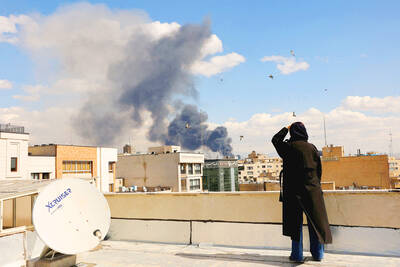
CHAOS: Iranians took to the streets playing celebratory music after reports of Khamenei’s death on Saturday, while mourners also gathered in Tehran yesterday Iranian Supreme Leader Ayatollah Ali Khamenei was killed in a major attack on Iran launched by Israel and the US, throwing the future of the Islamic republic into doubt and raising the risk of regional instability. Iranian state television and the state-run IRNA news agency announced the 86-year-old’s death early yesterday. US President Donald Trump said it gave Iranians their “greatest chance” to “take back” their country. The announcements came after a joint US and Israeli aerial bombardment that targeted Iranian military and governmental sites. Trump said the “heavy and pinpoint bombing” would continue through the week or as long
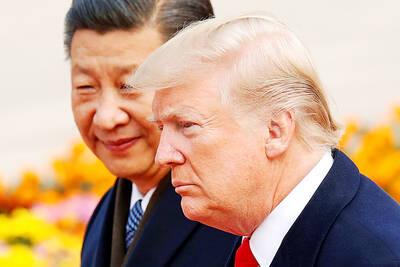
TRUST: The KMT said it respected the US’ timing and considerations, and hoped it would continue to honor its commitments to helping Taiwan bolster its defenses and deterrence US President Donald Trump is delaying a multibillion-dollar arms sale to Taiwan to ensure his visit to Beijing is successful, a New York Times report said. The weapons sales package has stalled in the US Department of State, the report said, citing US officials it did not identify. The White House has told agencies not to push forward ahead of Trump’s meeting with Chinese President Xi Jinping (習近平), it said. The two last month held a phone call to discuss trade and geopolitical flashpoints ahead of the summit. Xi raised the Taiwan issue and urged the US to handle arms sales to
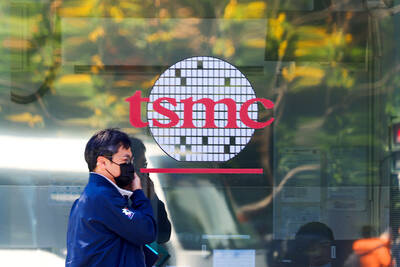
BIG SPENDERS: Foreign investors bought the most Taiwan equities since 2005, signaling confidence that an AI boom would continue to benefit chipmakers Taiwan Semiconductor Manufacturing Co’s (TSMC, 台積電) market capitalization swelled to US$2 trillion for the first time following a 4.25 percent rally in its American depositary receipts (ADR) overnight, putting the world’s biggest contract chipmaker sixth on the list of the world’s biggest companies by market capitalization, just behind Amazon.com Inc. The site CompaniesMarketcap.com ranked TSMC ahead of Saudi Aramco and Meta Platforms Inc. The Taiwanese company’s ADRs on Tuesday surged to US$385.75 on the New York Stock Exchange, as strong demand for artificial intelligence (AI) applications led to chip supply constraints and boost revenue growth to record-breaking levels. Each TSMC ADR represents

State-run CPC Corp, Taiwan (CPC, 台灣中油) yesterday said that it had confirmed on Saturday night with its liquefied natural gas (LNG) and crude oil suppliers that shipments are proceeding as scheduled and that domestic supplies remain unaffected. The CPC yesterday announced the gasoline and diesel prices will rise by NT$0.2 and NT$0.4 per liter, respectively, starting Monday, citing Middle East tensions and blizzards in the eastern United States. CPC also iterated it has been reducing the proportion of crude oil imports from the Middle East and diversifying its supply sources in the past few years in response to geopolitical risks, expanding


 RSS
RSS