


The legislature yesterday passed the Act Governing Distant Water Fisheries (遠洋漁業條例) as well as amendments to the Fisheries Act (漁業法) and the Ordinance to Govern Investment in the Operation of Foreign Flag Fishing Vessels (投資經營非我國籍漁船管理條例), tightening regulations and raising the fines for illegal fishing, “fish laundering” and other significant violations.
The EU on Oct. 1 last year issued a “yellow card” to Taiwan following the discovery of a Taiwanese fishing vessel violating shark finning regulations in international waters and threatened to issue a “red card,” which could prompt an EU embargo on Taiwanese seafood exports, which would seriously damage the country’s fishing industry, should the nation fail to improve its legal framework and take corrective measures.
The government has since made an effort to work with the legislature to draft a bill governing the nation’s distant water fisheries. The Executive Yuan came to an agreement with the legislature on the draft bill on Monday last week and the legislative caucuses reached a final consensus on Wednesday last week.
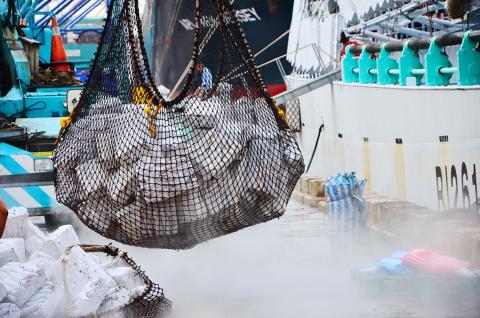
Photo: Huang Chien-hua, Taipei Times
The Act Governing Distant Water Fisheries lists 19 activities as “major violations,” including undertaking distant fishing without registration; failing to install a vessel monitoring system and a system to report each vessel’s catch; unloading and transshipping fish and fishing in foreign waters without official approval; counterfeiting and hiding identification markers, such as the name and number of a fishing boat; fishing in excess of the authority’s announced quotas; fishing, possessing, transshipping, unloading or selling banned species; avoiding or obstructing inspection and cooperating with boats that have been undertaking illegal, unreported and unregulated (IUU) fishing.
The act stipulates that business operators or employees who perpetrate any of the major violations would be severely fined and their fishing permits would be revoked for up to two years. The fines are categorized in proportion to the size of the boat in question.
Boats weighing 500 tonnes and above are to be subject to a fine between NT$6 million and NT$30 million (US$185,862 and US$929,310); boats weighing 100 tonnes to 500 tonnes, between NT$4 million and NT$20 million; boats weighing between 50 tonnes and 100 tonnes, between NT$2 million and NT$10 million; and boats weighing less than 50 tonnes are to be subjected to a fine of between NT$1 million and NT$5 million.
If the fines are “less than the value of seized fishery products, the perpetrator would instead be fined up to five times of the value of the seized products.”
Repeat violations are subject to more severe punishment, the act stipulates.
“Some fishermen might consider the penalties too heavy. However, the act is not established to punish fishermen, but to protect oceanic resources and encourage legal fishing,” Chinese Nationalist Party (KMT) Legislator Sufin Siluko (廖國棟) said.
Amendments to the Ordinance to Govern Investment in the Operation of Foreign Flag Fishing Vessels prohibit Taiwanese from investing in or operating boats that are non-Taiwanese without official permission. If investments are planned for boats that undertake IUU fishing, the permission would not be granted, or, if already granted, would be revoked, according to the amendment.
The amendment also defines “major violations” of its own, similar to those outlined by the Act Governing Distant Water Fisheries.

KEY INDUSTRY: The vice premier discussed a plan to create a non-red drone supply chain by next year, which has been allocated a budget of more than NT$7.2 billion The government has budgeted NT$44.2 billion (US$1.38 billion) to cultivate Taiwan’s uncrewed aerial vehicle (UAV) industry over the next five years, which would make the nation a major player in the industry’s democratic supply chain in the Asia-Pacific region, Premier Cho Jung-tai (卓榮泰) said yesterday. Cho made the remarks during a visit to the facilities of Cub Elecparts Inc (為升電裝). Democratic Progressive Party (DPP) Legislator Chen Su-yueh (陳素月) and Chinese Nationalist Party (KMT) Legislator Hsieh Yi-fong (謝依鳳) also participated in the trip. Cub Elecparts has transitioned from the automotive industry to the defense industry, which is the top priority among the nation’s
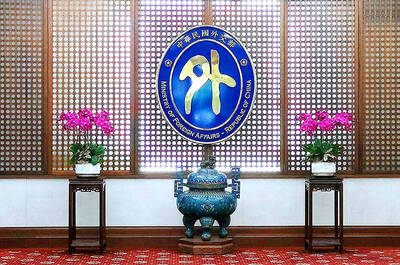
SOUTH KOREA DISPUTE: If Seoul continues to ignore its request, Taiwan would change South Korea’s designation on its arrival cards, the foreign ministry said If South Korea does not reply appropriately to a request to correct Taiwan’s name on its e-Arrival card system before March 31, the government would take corresponding measures to change how South Korea is labeled on the online Taiwan Arrival Card system, the Ministry of Foreign Affairs said yesterday. South Korea’s e-Arrival card system lists Taiwan as “China (Taiwan)” in the “point of departure” and “next destination” fields. Taipei has asked Seoul to change the wording. Since March 1, South Koreans who hold government-issued Alien Resident Certificates (ARC) have been identified as from “South Korea” rather than the “Republic of Korea,” the

‘UNFRIENDLY’: Changing the nationality listing of Taiwanese residents to ‘China’ goes against EU foreign policy as well as democratic and human rights principles, MOFA said Taiwan yesterday called on Denmark to correct its designation of the nationality of Taiwanese residents as “China” or face retaliatory measures. The Danish government in 2024 changed the nationality of Taiwanese citizens on their residence permits from “Taiwan” to “China.” The decision goes against EU foreign policy and contravenes democratic and human rights principles, Ministry of Foreign Affairs (MOFA) spokesman Hsiao Kuang-wei (蕭光偉) said. Denmark should present a solution acceptable to Taiwan as soon as possible and correct the erroneous designation to preserve the longstanding friendship between the two nations, Hsiao said. The issue could damage Denmark’s image and business reputation in Taiwan,
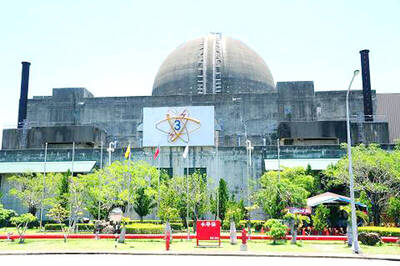
SUFFICIENT: The president said Taiwan has enough oil for next month, with reserves covering more than 100 days and natural gas enough for 12 to 14 days A restart plan for the Guosheng Nuclear Power Plant in New Taipei City’s Wanli District (萬里) and the Ma-anshan Nuclear Power Plant in Pingtung County’s Hengchun Township (恆春) would be submitted to the Nuclear Safety Commission by the end of the month, President William Lai (賴清德) said yesterday, reversing the government’s policy to abolish nuclear energy. On May 17 last year, Taiwan shut down its last nuclear reactor and became the first non-nuclear nation in East Asia, fulfilling the Democratic Progressive Party (DPP) government’s pledge of a “nuclear-free homeland.” Even without nuclear power, Taiwan can maintain a stable electricity supply until 2032,


 RSS
RSS