


Taipei Department of Sports Commissioner Hung Chia-wen (洪嘉文) yesterday confirmed that he verbally tendered his resignation to Taipei Mayor Ko Wen-je (柯文哲) last week over a recent case involving parking lots, in which a department contractor reportedly owes the city government NT$29 million (US$895,476) in premiums.
Hung’s resignation is likely to complicate the city government’s preparations for next year’s Summer Universiade, an international athletic event that is widely perceived to be a public test of Ko’s competence.
The city government is scheduled to decide today on whether to approve Hung’s resignation.
In a news conference on May 30, Chinese Nationalist Party (KMT) Taipei City Councilor Chung Hsiao-ping (鍾小平) said Chunsheng Development and Industry Co (群晟開發實業), which operates the department’s parking lots near the Taipei Gymnasium and Taipei Municipal Gymnasium, had not paid its monthly NT$3 million premiums since January last year.
Despite a total of NT$29 million in arrears, Chunsheng was again awarded city contracts in January this year, Chung said.
Department of Sports Deputy Commissioner Chen Liang-hui (陳良輝) later acknowledged and apologized for the oversight, while the city government said Chunsheng’s contract was terminated in March.
Ko, reportedly angered by the revelation, which he viewed as the first major incidence of misconduct in his government, responded by firing Chen on June 8 and established a task force headed by Taipei Deputy Mayor Teng Chia-chi (鄧家基) to investigate and discipline officials responsible for the matter.
According to sources, Hung told Ko that he would resign after the task force completed its investigation to take responsibility for failing to effectively supervise the contracts, regardless of whether the final report found him personally responsible.
Eleven officials — including the department’s chief secretary, a division director, a former division director and the project’s handler — were issued demerits and reprimands as a result of the task force’s investigation.
Former department commissioner Yang Jong-her (楊忠和), Hung’s predecessor and the first sports commissioner appointed by Ko, quit in January last year after just 26 days in office, saying without elaboration that he had completed his “interim tasks.”
Ko chose Hung, who held office for about a year-and-a-half, as Yang’s replacement through the i-Voting platform — an online election system developed by the city government. At the time, Hung was working for the New Taipei City Government.

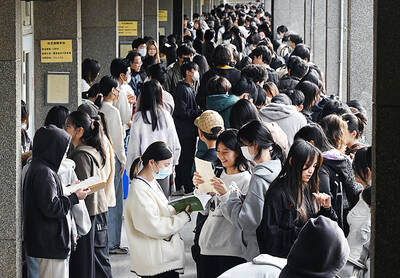
A global survey showed that 60 percent of Taiwanese had attained higher education, second only to Canada, the Ministry of the Interior said. Taiwan easily surpassed the global average of 43 percent and ranked ahead of major economies, including Japan, South Korea and the US, data from the Organisation for Economic Co-operation and Development (OECD) for 2024 showed. Taiwan has a high literacy rate, data released by the ministry showed. As of the end of last year, Taiwan had 20.617 million people aged 15 or older, accounting for 88.5 percent of the total population, with a literacy rate of 99.4 percent, the data

NEW LOW: The council in 2024 based predictions on a pessimistic estimate for the nation’s total fertility rate of 0.84, but last year that rate was 0.69, 17 percent lower An expected National Development Council (NDC) report expects the nation’s population to drop below 12 million by 2065, with the old-age dependency ratio to top 100 percent sooner than 2070, sources said yesterday. The council is slated to release its latest population projections in August, using an ultra-low fertility model, the sources said. The previous report projected that Taiwan’s population would fall to 14.37 million by 2070, but based on a new estimate of the total fertility rate (TFR) — the average number of children born to a woman over her lifetime — the population is expected to reach 12 million by
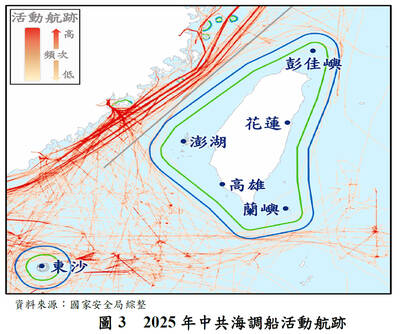
INTENSIFYING THREATS: Beijing’s tactics include massive attacks on the government service network, aircraft and naval vessel incursions and damaging undersea cables China is prepared to interfere in November’s nine-in-one local elections by launching massive attacks on the Taiwanese government’s service network (GSN), a report published by the National Security Bureau showed. The report was submitted to the Legislative Yuan ahead of the bureau’s scheduled briefing at the Foreign Affairs and National Defense Committee tomorrow. The national security team has identified about 13,000 suspicious Internet accounts and 860,000 disputed messages, the bureau said of China’s cognitive warfare against Taiwan. The disputed messages focus on major foreign affairs, national defense and economic issues, which were produced using generative artificial intelligence (AI) and distributed through Chinese

COUNTERING HOSTILITY: The draft bill would require the US to increase diplomatic pressure on China and would impose sanctions on those who sabotage undersea cable networks US lawmakers on Thursday introduced a bipartisan bill to bolster the resilience of Taiwan’s submarine cables to counter China’s hostile activities. The proposal, titled the critical undersea infrastructure resilience initiative act, was cosponsored by Republican representatives Mike Lawler and Greg Stanton, and Democratic Representative Dave Min. US Senators John Curtis and Jacky Rosen also introduced a companion bill in the US Senate, which has passed markup at the chamber’s Committee on Foreign Relations. The House’s version of the bill would prioritize the deployment of sensors to detect disruptions or potential sabotage in real-time and enhance early warning capabilities through global intelligence sharing frameworks,


 RSS
RSS