


Former president Chen Shui-bian (陳水扁) is planning to attend a fundraising dinner for the Ketagalan Foundation in Taipei tonight, despite Taichung Prison advising against his attendance, Chen’s son, Chen Chih-chung (陳致中), said, adding that his father would comply with all of the preconditions of his medical parole set by the judicial authority.
Although Taichung Prison said in a press release yesterday that it would be “inappropriate” for Chen Shui-bian to attend the fundraising event because of its political nature, Chen Chih-chung yesterday told media in Kaohsiung that his father “would definitely go to Taipei to attend the fundraising dinner held by the Ketagalan Foundation,” saying that the dinner was not a political event.
“He will do so, in order not to cause trouble for the judicial authorities. We see the matter as a medical issue, and it should not be mixed up with politics,” Chen Chih-chung said.
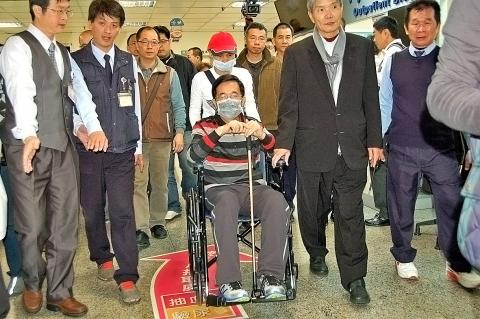
Photo: Yang Chin-cheng, Taipei Times
In the same press statement, Taichung Prison said that Chen Shui-bian would be allowed to attend private gatherings with friends, under the conditions that the events be kept private, and that he should not get on stage, speak in public or talk to the media.
Asked to comment on the issue at an anti-drug conference in Taipei, Minister of Justice Chiu Tai-san (邱太三) said that he would support the prison authority’s decision, adding that “a fundraising dinner would certainly not be an appropriate place” for private meetings.
Unnamed prison officials also said that Chen Shui-bian should “be prepared to go back to prison if he violates the conditions of his medical parole.”
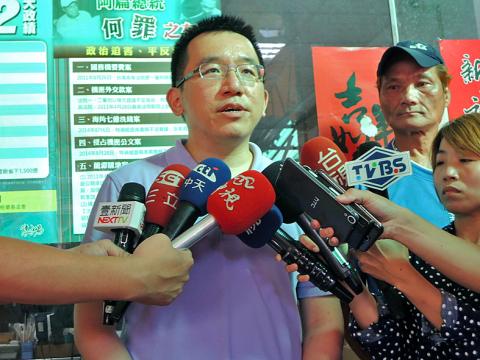
Photo: Wang Jung-hsiang, Taipei Times
The Chens have been living in Kaohsiung since the former president was released from Taichung Prison on medical parole in January last year.
According to his family, Chen Shui-bian on Monday submitted a formal application to the prison seeking permission to attend the event to be held by the Ketagalan Foundation, of which he is a founding member.
The application also requested permission for Chen Shui-bian to return to his former residence in Taipei before returning to Kaohsiung on the same day.
Officials at Taichung Prison, which is under the Ministry of Justice’s Agency of Corrections, on Thursday decided to reject the former president’s request to attend the fundraising dinner, but said he was permitted to attend private gatherings.
Due to Chen Shui-bian’s insistence that he would attend the fundraising dinner, the prison yesterday relaxed his parole conditions.
It released a statement saying it would permit the former president to meet and speak with his old friends.
“It can be at a reserved private room at the fundraising dinner,” the statement said.
Taichung Prison deputy warden Su Kun-ming (蘇坤銘) said: “As long as Chen Shui-bian does not appear within the confines of the Ketagalan Foundation event — he could appear at an area nearby the dinner function, or at a place which is demarcated off the main event — then he would not be in violation of the conditions of his medical parole.”
Taipei Mayor Ko Wen-je (柯文哲), who was a former member of Chen Shui-bian’s medical team, said: “President Tsai Ing-wen [蔡英文] must feel troubled as I am.”
“It is very difficult to say whether Chen Shui-bian should attend, it is a tough question to answer,” Ko said.
Additional reporting by CNA
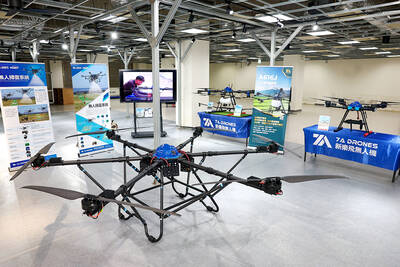
DRONE CENTRAL: Taiwan aims to become Asia’s democratic hub for drones, with most exports focused on high-quality military-grade models, an official said Taiwan’s drone industry is expected to expand significantly by 2030, producing 100,000 units per month and exporting half of them, the Ministry of Economic Affairs said yesterday. Current drone production capacity is about 15,000 units per month, but the industry can quickly scale up as demand increases, Industrial Development Administration Director-General Chiou Chyou-huey (邱求慧) told a news conference in Taipei. Taiwan’s drone output grew 2.5-fold last year to NT$12.9 billion (US$408.3 million) under a government program to develop the uncrewed vehicle sector, he said. The Executive Yuan in October last year approved plans to invest NT$44.2 billion into domestic production of uncrewed aerial
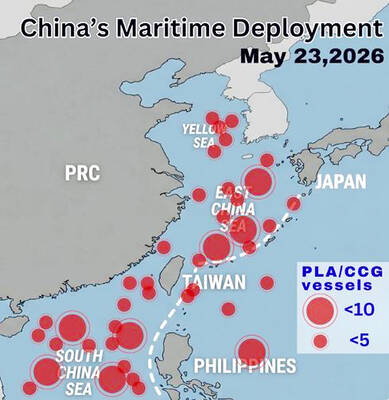
WARNING: China should stop engaging in actions that undermine regional peace and stability, as it would only build resentment among people across the Strait, the CGA said China has deployed more than 100 navy, coast guard and other vessels in waters from the Yellow Sea to the South China Sea and the western Pacific since US President Donald Trump and Chinese President Xi Jinping (習近平) met in Beijing, National Security Council Secretary-General Joseph Wu (吳釗燮) said yesterday. “In this part of the world, #China is the one & only PROBLEM wrecking the #StatusQuo & threatening regional peace & stability,” Wu wrote on X. In a separate post, he said Beijing was coercing Taiwan’s maritime domain, calling it illegal and provocative, after the Coast Guard Administration (CGA) expelled a

VERBOSE VESSELS: A CGA cutter and a China Coast Guard exchanged verbal barbs for more than a day in Taiwanese-controlled waters before the Chinese vessel left The Taiwanese and Chinese coast guards had a standoff near the strategically located Pratas Islands (Dongsha Islands, 東沙群島) in the north of the South China Sea, the Coast Guard Administration (CGA) said yesterday. The two sides engaged in intense radio exchanges over sovereignty claims during the 33-hour standoff. China Coast Guard vessel 3501 eventually left the restricted waters, 26.6 nautical miles (49.2km) west of the Pratas Islands, at 5pm yesterday, the CGA said. Lying approximately between southern Taiwan and Hong Kong, the Taiwan-controlled Pratas are seen by some security experts as vulnerable to Chinese attack due to their distance — more than
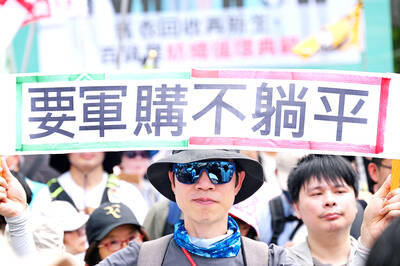
More than 8,000 people took part in a rally in Taipei yesterday to express support for more defense spending, after the opposition slashed the Cabinet’s proposed NT$1.25 trillion (US$39.6 billion) special defense budget and capped it at NT$780 billion. The demonstrators urged the Cabinet to propose another bill. Taiwan Economic Democracy Union convener Lai Chung-chiang (賴中強) said the main problem of the passed budget plan is the removal of funding for critical items, not just that the total amount is smaller. Critical budget items included purchasing or developing uncrewed vehicles, Strong Bow (強弓) missile systems, additional ammunition, artificial intelligence-powered combat systems and Taiwan-US


 RSS
RSS