


Premier Lin Chuan (林全) yesterday vowed to reduce land expropriation and enhance communication with the public as the government pushes forward with the Taoyuan Aerotropolis project, which is to be a key component of a larger “Asian Silicon Valley” project that President Tsai Ing-wen (蔡英文) proposed during her campaign.
The premier made the remarks during a visit to Taoyuan to inspect the future site of the Asian Silicon Valley project, where he was briefed about a dispute between area residents and the government over the Taoyuan Aerotropolis project.
“Politically speaking, [the government] should reduce unnecessary land expropriation to avoid delays in the project’s progress due to protests by local residents,” Lin said in response to media queries for comments on the stalled project.
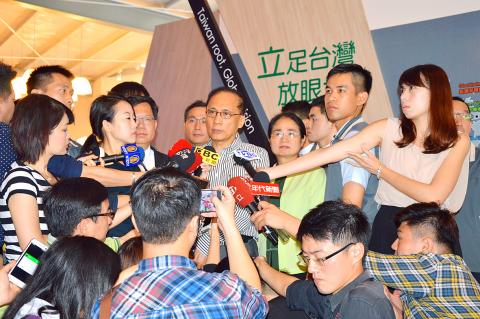
Photo: Hsieh Wu-hsiung, Taipei Times
“The government should also do its best to communicate with the public. I believe that [Taoyuan Mayor] Cheng Wen-tsang (鄭文燦) would help negotiate and he should not only follow the rules and regulations, but also pay attention to things that have been overlooked.”
“Better communication with the public should be the government’s attitude when dealing with land expropriation issues,” the premier added.
The Taoyuan Aerotropolis project, proposed by the then- Taoyuan County Government, comprises a new town around Taiwan Taoyuan International Airport with a free-trade zone, an expanded airport zone, an industrial exposition zone, an industrial zone, an agricultural zone, a coastal recreation zone, and residential and commercial zones, all of which would cover 6,845 hectares.
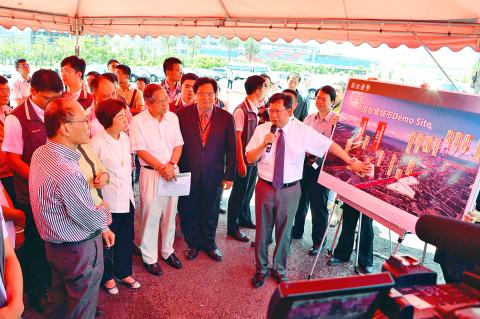
Photo: Hsieh Wu-hsiung, Taipei Times
In addition to land that has already been expropriated or developed, 3,130 hectares is to be taken from private owners, which has triggered mass protests from landowners, who took to the streets and filed lawsuits. In 2013, a farmer committed suicide, reportedly in protest over the land grabs.
“Taipei and Hsinchu are the right and left hands of Taoyuan, with Taipei being an international metropolis and Hsinchu being an important research and development hub for the IT industry,” Lin said. “We have chosen Taoyuan as the base for the Asian Silicon Valley project to revive the economy in northern Taiwan.”
Lin said that Taoyuan is also a good choice due to its robust industry, international airport and the Aerotropolis project.
He added that while the entire Asian Silicon Valley might take a long time to complete, the government would maintain its focus on it and regularly check on its progress.
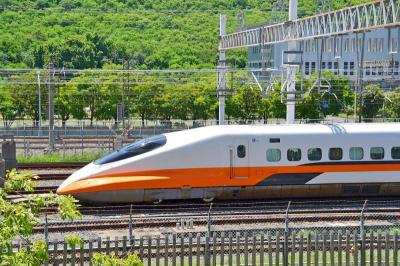
A signaling system malfunction disrupted high-speed rail (HSR) services beginning at 8am today, with trains temporarily reduced to three northbound and three southbound trains per hour as authorities conduct inspections. The malfunction occurred on a section of track in Miaoli County during pre-operation checks early this morning, forcing northbound and southbound trains to use a single track, the HSR operator said. The regular schedule has been replaced with three hourly trains offering only nonreserved seating in each direction, stopping at every station, it said, adding that business class cars would still have reserved seating. Departures from terminal stations are scheduled at the top
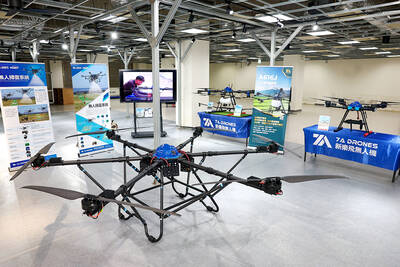
DRONE CENTRAL: Taiwan aims to become Asia’s democratic hub for drones, with most exports focused on high-quality military-grade models, an official said Taiwan’s drone industry is expected to expand significantly by 2030, producing 100,000 units per month and exporting half of them, the Ministry of Economic Affairs said yesterday. Current drone production capacity is about 15,000 units per month, but the industry can quickly scale up as demand increases, Industrial Development Administration Director-General Chiou Chyou-huey (邱求慧) told a news conference in Taipei. Taiwan’s drone output grew 2.5-fold last year to NT$12.9 billion (US$408.3 million) under a government program to develop the uncrewed vehicle sector, he said. The Executive Yuan in October last year approved plans to invest NT$44.2 billion into domestic production of uncrewed aerial
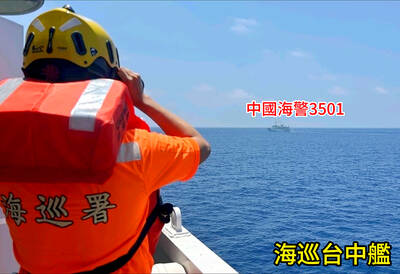
VERBOSE VESSELS: A CGA cutter and a China Coast Guard exchanged verbal barbs for more than a day in Taiwanese-controlled waters before the Chinese vessel left The Taiwanese and Chinese coast guards had a standoff near the strategically located Pratas Islands (Dongsha Islands, 東沙群島) in the north of the South China Sea, the Coast Guard Administration (CGA) said yesterday. The two sides engaged in intense radio exchanges over sovereignty claims during the 33-hour standoff. China Coast Guard vessel 3501 eventually left the restricted waters, 26.6 nautical miles (49.2km) west of the Pratas Islands, at 5pm yesterday, the CGA said. Lying approximately between southern Taiwan and Hong Kong, the Taiwan-controlled Pratas are seen by some security experts as vulnerable to Chinese attack due to their distance — more than
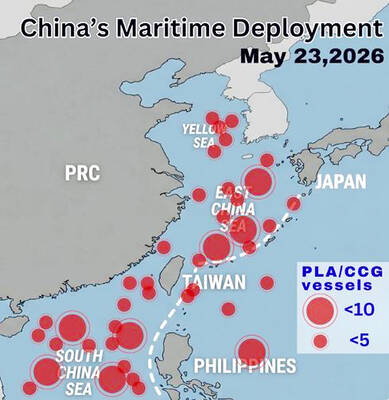
WARNING: China should stop engaging in actions that undermine regional peace and stability, as it would only build resentment among people across the Strait, the CGA said China has deployed more than 100 navy, coast guard and other vessels in waters from the Yellow Sea to the South China Sea and the western Pacific since US President Donald Trump and Chinese President Xi Jinping (習近平) met in Beijing, National Security Council Secretary-General Joseph Wu (吳釗燮) said yesterday. “In this part of the world, #China is the one & only PROBLEM wrecking the #StatusQuo & threatening regional peace & stability,” Wu wrote on X. In a separate post, he said Beijing was coercing Taiwan’s maritime domain, calling it illegal and provocative, after the Coast Guard Administration (CGA) expelled a


 RSS
RSS