


The Shilin District Court yesterday found event organizer Lu Chung-chi (呂忠吉) guilty of professional negligence in causing deaths in the Formosa Fun Coast (八仙樂園) water park disaster on June 27 last year, sentencing him to four years and 10 months in prison.
The ruling, the first verdict on the disaster, sparked furious reactions from people affected by the inferno, who said the sentence was too lenient considering the enormity of the catastrophy.
Fifteen people of the 508 injured in the blaze that swept through a Color Play Asia party at the park died as a result of their injuries. More than 200 sustained serious injuries, and many of them are still in pain, fighting for recovery and requiring medical treatment and daily rehabilitation work.
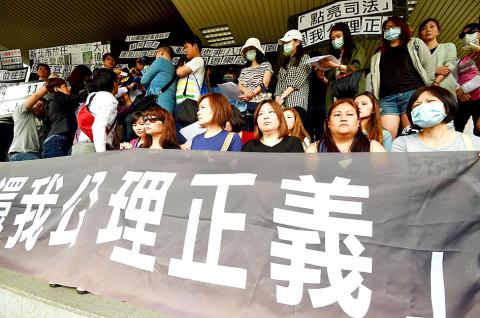
Photo: Lo Pei-der, Taipei Times
Most of those who sustained injuries were between the ages of 18 and 25, when they attended the event organized by Lu, proprietor of Color Play Co (玩色創意) and Juipo International Marketing Co (瑞博國際整合行銷), who rented out facilities at the park in New Taipei City’s Bali District (八里).
Lu did not appear in court for yesterday’s ruling.
His lawyer, Chen Chun-wei (陳君瑋), said “the sentence was too heavy.”
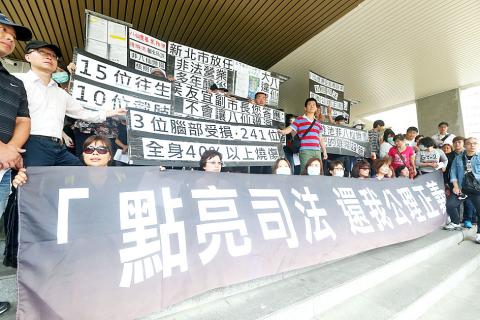
Photo: CNA
“After receiving the official court statement, I will discuss it with Lu. We will certainly appeal this decision,” Chen said.
A group of about 50 people, members of a self-help association, along with relatives and supporters, demonstrated outside the Shilin District Court in Taipei, while some attended the court session to hear the ruling.
They held up banners that read: “We Want Justice” and placards that demanded that the judiciary investigate possible negligence on the part of the New Taipei City Government and the company that owns the water park.
Lee Meng-hsiu (李孟修), who sustained second and third-degree burns to more than 70 percent of his body and is still fighting to recover, said the sentence was far too lenient.
“I felt heavy-hearted when I heard the ruling. I am disappointed at Taiwan’s justice system,” he said.
The father of Liu Chih-wei (劉致葦), who died in the disaster, said he was “disgusted” by the ruling.
“Lu is responsible for the deaths of 15 young people and more than 400 injured people, but for 15 lives, he only got less than a five-year term. In our nation, human lives seem to be worth less than dogs’,” he said.
“I will be talking to our lawyers. We must appeal, because we want justice to be served,” he said.
Association for Victims Support in Taiwan executive Wang Yu-hsiu (王鈺琇) said the nation’s judiciary too often gives convicted criminals light punishments.
“Lu only has to serve a few years in jail, then he will be free, but who will bear the burden for more than 400 young people’s lifetime of pain and stigma after being disfigured by burns?” Wang said.
According to the Ministry of Health and Welfare data, 281 of the victims sustained burns that covered more than 40 percent of their bodies, including 41 people with burns to more than 80 percent of their bodies.
Three people were still hospitalized as of Monday, the ministry said.
As of December last year, the National Health Insurance program had paid more than NT$800 million (US$24.72 million) to cover the medical costs of burn patients from the disaster, the ministry said.
The National Health Insurance Administration has filed a lawsuit with the Shilin District Court to demand compensation of NT$436 million — the costs incurred during the first month after the accident — from Lu.
Additional reporting by CNA
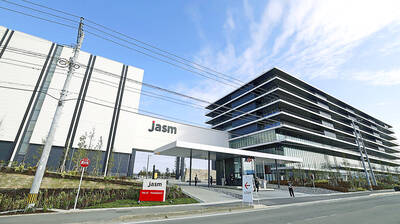
The subsidiary of Taiwan Semiconductor Manufacturing Co (TSMC, 台積電) in Kumamoto, Japan, turned a profit in the first quarter of this year, marking the first time the first fab of the unit has become profitable since mass production started at the end of 2024. According to the contract chipmaker’s financial statement released on Friday, Japan Advanced Semiconductor Manufacturing Inc (JASM), a joint venture running the fab in Kumamoto, posted NT$951 million (US$30.19 million) in profit in the January-to-March period, compared with a loss of NT$1.39 billion in the previous quarter, and a loss of NT$3.25 billion in the first quarter of
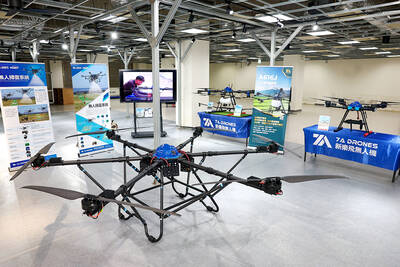
DRONE CENTRAL: Taiwan aims to become Asia’s democratic hub for drones, with most exports focused on high-quality military-grade models, an official said Taiwan’s drone industry is expected to expand significantly by 2030, producing 100,000 units per month and exporting half of them, the Ministry of Economic Affairs said yesterday. Current drone production capacity is about 15,000 units per month, but the industry can quickly scale up as demand increases, Industrial Development Administration Director-General Chiou Chyou-huey (邱求慧) told a news conference in Taipei. Taiwan’s drone output grew 2.5-fold last year to NT$12.9 billion (US$408.3 million) under a government program to develop the uncrewed vehicle sector, he said. The Executive Yuan in October last year approved plans to invest NT$44.2 billion into domestic production of uncrewed aerial
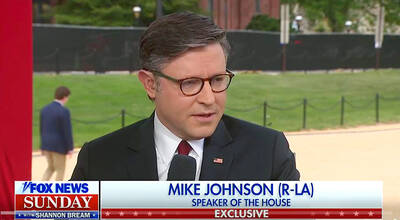
RESOLUTE BACKING: Two Republican senators are planning to introduce legislation that would impose immediate sanctions on China if it attempts to invade Taiwan US House of Representatives Speaker Mike Johnson on Sunday reaffirmed US congressional support for Taiwan, saying the US and “all freedom-loving people” have a stake in preventing China from seizing Taiwan by force. Johnson made the remarks in an interview with Fox News Sunday on US President Donald Trump’s summit with Chinese President Xi Jinping (習近平) last week. In an interview that aired on Friday on Fox News, just as Trump wrapped up a high-stakes visit to China, he said he has yet to green-light a new US$14 billion arms package to Taiwan and that it “depends on China.” “It’s a very good
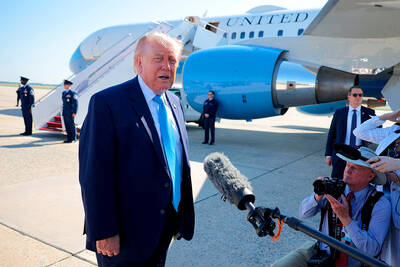
US President Donald Trump yesterday said he would speak to President William Lai (賴清德) as his administration considers whether to move ahead with a US$14 billion weapons sale to Taiwan — a potential arms deal that has drawn criticism from China. “Well, I’ll speak to him. I speak to everybody,” Trump told reporters yesterday when asked if he had any plans to call his counterpart, although he did not offer a time frame for when such a conversation could take place. Trump previously said he would speak to the person “that’s running Taiwan,” without specifying who he meant. “We have that situation very


 RSS
RSS