


The Chinese Nationalist Party (KMT) has accused the Democratic Progressive Party (DPP) of “scamming” the public after Council of Agriculture minister-designate Tsao Chi-hung (曹啟鴻) said in an interview that Taiwan does not have the leverage to refuse imports of US pork.
In an interview with the Chinese-language United Daily News, Tsao said that, while not a decision to be made solely by the council, opening up the nation to US pork imports containing the leanness additive ractopamine is “the direction” the future government is heading in.
The newspaper quoted Tsao as saying the council does not have the power to thwart globalization and that, while still too early to say, he does not want to lie to the nation’s pig farmers.
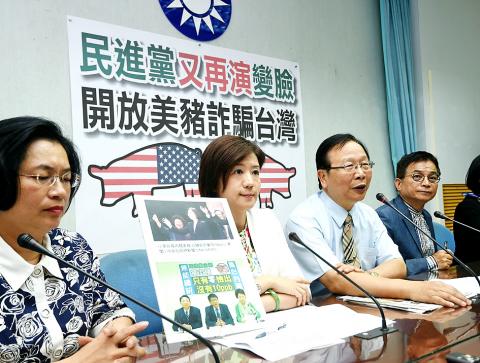
Photo: Fang Pin-chao, Taipei Times
“Unlike powerful economies, we are an export-led nation, constrained by different conditions compared with the EU or China,” Tsao was quoted as saying.
In a radio interview yesterday morning, Tsao said that if the future government decides to open the market to US pork, the Cabinet should share the work of preparing supporting measures and face the impact together.
“The Council of Agriculture would enforce a rigorous ban on the use of leanness-inducing additives in domestic pig farming to segment the market [on the basis of whether pork contains traces of ractopamine],” Tsao said.
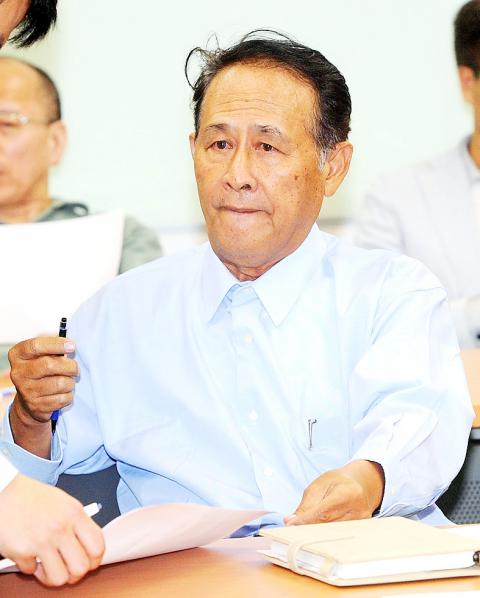
Photo courtesy of Taipei City Journalist Association
KMT caucus whip Lin Te-fu (林德福) told a news conference that the DPP was “acting like a fraud ring” and “replacing its brain after changing its position.”
Tsao is “playing bad cop” to bear the brunt of criticism to spare president-elect Tsai Ing-wen (蔡英文) from the potential public furor, Lin said.
KMT Legislator Lai Shyh-bao (賴士葆) called for Tsai to “make public what she promised to the US government when she visited the US before the January presidential election and why she was able to receive friendly treatment from the US.”
Lai said Tsai should detail her agreement with the US government before being sworn in to dispel suspicions that she “sold out the Taiwanese public’s health” for the presidency.
The DPP caucus in 2012 fiercely opposed the import of pork with traces of ractopamine and implemented a “zero tolerance” policy on the feed additive, he added.
“The KMT caucus will simply follow the DPP’s position on the matter, which is to uphold a ‘zero tolerance’ policy on ractopamine residue in imported pork products and refuse to accept so-called international standards allowing up to 10 parts per billion of ractopamine residue,” Lai said.
More pork is consumed in Taiwan than in Japan or South Korea, two countries that have opened up their markets to US pork products and “that eat pig offal, where the highest concentration of additive residue is found,” KMT Legislator Alicia Wang (王育敏) said, adding that allowing US pork imports might create health risks.
Lai said the KMT would launch nationwide demonstrations if necessary should the future government plan to force the decision.
In response, Legislative Speaker Su Jia-chyuan (蘇嘉全) said that some of the nation’s industries, including agriculture, would be affected if Taiwan were to join various international economic and trade organizations, such as the US-led Trans-Pacific Partnership.
“Opening up Taiwan’s market to agricultural imports would be contingent upon farmers’ interests being protected and food safety being guaranteed, areas into which the government should concentrate its efforts,” Su said.

PROVOCATIVE: Chinese Deputy Ambassador to the UN Sun Lei accused Japan of sending military vessels to deliberately provoke tensions in the Taiwan Strait China denounced remarks by Japan and the EU about the South China Sea at a UN Security Council meeting on Monday, and accused Tokyo of provocative behavior in the Taiwan Strait and planning military expansion. Ayano Kunimitsu, a Japanese vice foreign minister, told the Council meeting on maritime security that Tokyo was seriously concerned about the situation in the East China and South China seas, and reiterated Japan’s opposition to any attempt to change the “status quo” by force, and obstruction of freedom of navigation and overflight. Stavros Lambrinidis, head of the EU delegation to the UN, also highlighted South China Sea

The final batch of 28 M1A2T Abrams tanks purchased from the US arrived at Taipei Port last night and were transported to the Armor Training Command in Hsinchu County’s Hukou Township (湖口), completing the military’s multi-year procurement of 108 of the tanks. Starting at 12:10am today, reporters observed more than a dozen civilian flatbed trailers departing from Taipei Port, each carrying an M1A2T tank covered with black waterproof tarps. Escorted by military vehicles, the convoy traveled via the West Coast Expressway to the Armor Training Command, with police implementing traffic control. The army operates about 1,000 tanks, including CM-11 Brave Tiger

China on Wednesday teased in a video an aircraft carrier that could be its fourth, and the first using nuclear power, while making an allusion to Taiwan and vowing to further build up its islands, as it looks to boost maritime power, secure resources and bolster territorial claims. The video, issued on the eve of the 77th founding anniversary of the Chinese People’s Liberation Army Navy, featured fictional officers with names that are homophones of three commissioned aircraft carriers, the Liaoning (遼寧), Shandong (山東) and Fujian (福建). Titled Into the Deep, it showed a 19-year-old named “Hejian” (何劍) joining the group, sparking
Taiwan Semiconductor Manufacturing Co (TSMC, 台積電), the world’s largest contract chipmaker, said it expects its 2-nanometer (2nm) chip capacity to grow at a compound annual rate of 70 percent from this year to 2028. The projection comes as five fabs begin volume production of 2-nanometer chips this year — two in Hsinchu and three in Kaohsiung — TSMC senior vice president and deputy cochief operating officer Cliff Hou (侯永清) said at the company’s annual technology symposium in Silicon Valley, California, last week. Output in the first year of 2-nanometer production, which began in the fourth quarter of last year, is expected to


 RSS
RSS