


Nearly one-third of the business of the law firm at the center of the “Panama Papers” scandal came from its offices in Hong Kong and China, reports said yesterday, with the Asian giant assailed by corruption and capital flight.
More than 16,300 of Panamanian law firm Mossack Fonseca’s active shell companies were incorporated through its Hong Kong and China offices, 29 percent of the worldwide total, according to the International Consortium of Investigative Journalists (ICIJ), which coordinated a year-long investigation into a trove of 11.5 million documents.
The investigation found that relatives of at least eight current or former members of the Central Politburo of the Chinese Communist Party (CCP), the party’s most powerful body, have been implicated in the use of offshore companies.
Such vehicles are not illegal in themselves and can be used for legitimate business needs. However, they commonly feature in corruption cases, when they can be used to secretly move ill-gotten gains abroad.
Graft is rife in China, which Transparency International rates in 83rd place out of 168 in its most recent Corruption Perceptions Index. At the same time, growth in the world’s second-largest economy is slowing, and its wealthy have increasingly sought to move funds abroad, but have to contend with Beijing’s strict exchange-control regime.
Under Chinese President Xi Jinping (習近平), Beijing has launched a much-publicized anti-graft drive, but has not instituted systemic reforms, such as public declarations of assets.
Xi’s brother-in-law and family members of two current members of the Central Politburo Standing Committee (CPSC) of the CCP, Zhang Gaoli (張高麗) and Liu Yunshan (劉雲山), have offshore holdings, the ICIJ reported.
Deng Jiagui (鄧家貴), Xi’s brother-in-law, was previously a shareholder in three companies: Supreme Victory Enterprises, Wealth Ming International and Best Effect Enterprises, reports said.
The companies were closed before Xi took power in 2012.
Relatives of former CPSC members Jia Qinglin (賈慶林), once the fourth-ranked leader in China, Li Peng (李鵬), who led the Tiananmen Square crackdown, Hu Yaobang (胡耀邦), former Chinese vice president Zeng Qinghong (曾慶紅) and Tian Jiyun (田紀雲) were named by the Guardian, which took part in the investigation.
The documents also named movie star Jackie Chan (成龍), billionaire heiress Kelly Zong Fuli and shopping-mall magnate Shen Guojun (沈國軍).
Chinese media have avoided reporting on the leaks’ revelations, and social media has been scrubbed of references to them.
The Global Times, a newspaper with close links to the CCP, yesterday sought to cast doubt on the documents’ provenance.
In Western countries, it said in an editorial, “the politics-business relationship has been largely legalized,” and “politics and the media are both under the control of capital.”
“Whether the journalists investigating the Panama Papers include those serving the US intelligence agencies as fake reporters is a question,” it said.
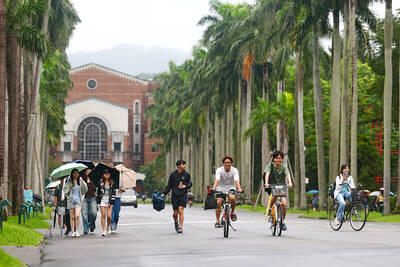
National Taiwan University (NTU) yesterday said it disqualified a person from an entrance examination for using AI smart glasses to cheat, along with two others for making untruthful statements in their curriculum vitae. The three applicants were given null scores, Taiwan’s highest-ranked university said, calling on prospective students to be honest in the admissions process. NTU registrar Lee Hung-sen (李宏森) said that the cheating applicant wore a hat and thick-rimmed glasses to the second written exam for medical school, claiming that they felt cold. Suspicions were aroused when the applicant stared oddly at the test for long stretches while steadily bringing the paper
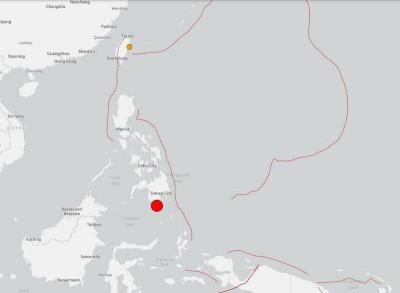
A magnitude 7.8 earthquake struck off the southern coast of Mindanao in the Philippines at 7:38am today, prompting the US Tsunami Warning System to issue an alert for neighboring countries, including Taiwan. The system issued a purple alert indicating a "tsunami threat." The potential threat zone includes Taiwan, the Philippines, Papua New Guinea, Yap and Palau. Philippine authorities were assessing the damage from the quake, with the office of civil defense seeking to verifying initial reports that 15 people had been killed and 129 injured in the region, mostly from falling debris. Arlene Hollero, disaster chief of Maasim town in the Philippines' Sarangani Province,
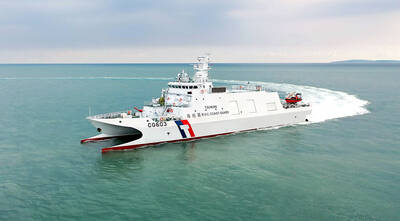
‘GRAY ZONE’ PRESSURE: Beijing’s activities are intended to create the deceitful impression that China has jurisdiction over the area around Taiwan, the CGA said Taiwan’s rights over its territorial waters and exclusive economic zone must not be violated by any country, the Mainland Affairs Council said yesterday, adding that it will not accept any unprovoked actions. The council issued the remarks in response to the China Coast Guard conducting maritime enforcement drills near eastern Taiwan and claiming to fully exercise China’s maritime administrative law enforcement authority. The Coast Guard Administration (CGA) has been closely monitoring the situation and is taking concrete steps to defend the nation’s sovereignty and secure its waters, the council said. China has no sovereign rights over the waters off eastern
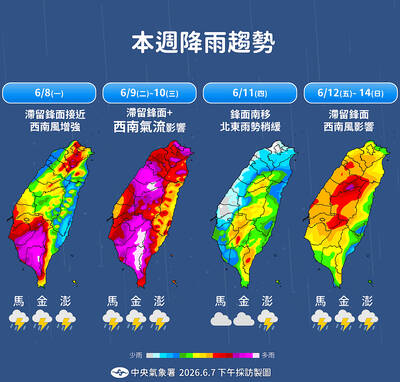
Heavy rain is expected to affect parts of Taiwan this week, the Central Weather Administration (CWA) said yesterday as a meteorologist said the active part of the annual plum rain season has started. A stationary plum rain front and southwesterly winds would bring unstable weather and abundant moisture to Taiwan from today for about a week, with the heaviest rainfall forecast for tomorrow and Wednesday, the CWA said. The agency said western and northeastern Taiwan, and mountainous areas in the east and southeast, could expect showers or thunderstorms on those two days, with localized heavy rain possible. Other parts of


 RSS
RSS