


US and Philippine troops began major exercises yesterday as China’s state media warned “outsiders” against interfering in tense South China Sea territorial disputes.
Xinhua news agency gave the warning as Manila and Washington launched the 11-day Balikatan (“Shoulder-to-Shoulder”) exercises with a low-key opening ceremony in Manila.
US Secretary of Defense Ashton Carter is to fly to the Philippines next week to observe live-firing of artillery and visit US Navy ships taking part.
About 5,000 US troops are taking part, along with nearly 4,000 Philippine soldiers and 80 from Australia.
“The ... exercises cap Manila’s recent attempts to involve outsiders in [a] regional row,” Xinhua said in a commentary.
It cited Japan, which sent a submarine on a visit to the Philippines last weekend, and Australia.
“However, a provocation so fear-mongering and untimely as such is likely to boomerang on the initiators,” Xinhua added. “A big country with vital interests in Asia, the US should first clarify the targets of its ‘pivot’ to Asia strategy, which so far has featured no more than unscrupulous inconsistency between fear-mongering deeds and peace-loving words.”
China lays claim to almost all of the South China Sea, despite partial counter-claims by Taiwan, Brunei, Malaysia, Vietnam and the Philippines. In recent years, it has built major structures, including radar systems and airstrips, over reclaimed reefs and outcrops, sparking international concern it could impose military controls over the entire area.
The US does not take sides in the territorial disputes, but has asserted the importance of keeping sea and air routes open.
It has sent US bombers and warships on patrol close to the Chinese construction activity in recent months, infuriating Beijing.
Lieutenant-General John Toolan, commander of US Marine Corps forces in the Pacific, told reporters in Manila the exercises would help the allies improve maritime security and maintain regional stability.
“Our alliance is strong. The United States is committed to this relationship, and these are not empty words... Peace in Southeast Asia depends on our cooperation,” Toolan added.
The exercises come ahead of a decision this year by a UN-backed tribunal on a legal challenge by Manila to China’s territorial claims.
The Philippines is also preparing to host US troops at five bases under a defense pact born out of US President Barack Obama’s plan to reassert US influence in the Pacific.

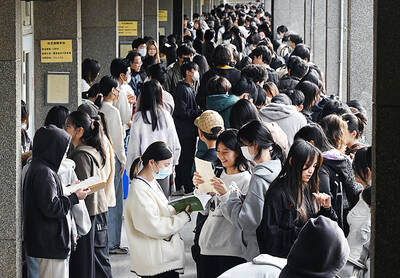
A global survey showed that 60 percent of Taiwanese had attained higher education, second only to Canada, the Ministry of the Interior said. Taiwan easily surpassed the global average of 43 percent and ranked ahead of major economies, including Japan, South Korea and the US, data from the Organisation for Economic Co-operation and Development (OECD) for 2024 showed. Taiwan has a high literacy rate, data released by the ministry showed. As of the end of last year, Taiwan had 20.617 million people aged 15 or older, accounting for 88.5 percent of the total population, with a literacy rate of 99.4 percent, the data

NEW LOW: The council in 2024 based predictions on a pessimistic estimate for the nation’s total fertility rate of 0.84, but last year that rate was 0.69, 17 percent lower An expected National Development Council (NDC) report expects the nation’s population to drop below 12 million by 2065, with the old-age dependency ratio to top 100 percent sooner than 2070, sources said yesterday. The council is slated to release its latest population projections in August, using an ultra-low fertility model, the sources said. The previous report projected that Taiwan’s population would fall to 14.37 million by 2070, but based on a new estimate of the total fertility rate (TFR) — the average number of children born to a woman over her lifetime — the population is expected to reach 12 million by
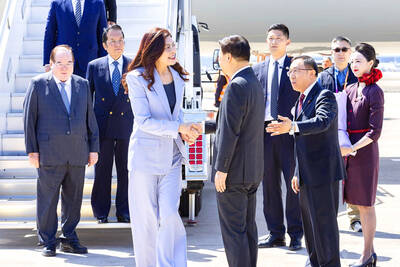
CCP ‘PAWN’? Beijing could use the KMT chairwoman’s visit to signal to the world that many people in Taiwan support the ‘one China’ principle, an academic said Chinese Nationalist Party (KMT) Chairwoman Cheng Li-wun (鄭麗文) yesterday arrived in China for a “peace” mission and potential meeting with Chinese President Xi Jinping (習近平), while a Taiwanese minister detailed the number of Chinese warships currently deployed around the nation. Cheng is visiting at a time of increased Chinese military pressure on Taiwan, as the opposition-dominated Legislative Yuan stalls a government plan for US$40 billion in extra defense spending. Speaking to reporters before going to the airport, Cheng said she was going on a “historic journey for peace,” but added that some people felt uneasy about her trip. “If you truly love Taiwan,
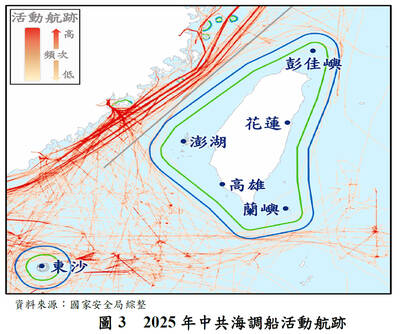
INTENSIFYING THREATS: Beijing’s tactics include massive attacks on the government service network, aircraft and naval vessel incursions and damaging undersea cables China is prepared to interfere in November’s nine-in-one local elections by launching massive attacks on the Taiwanese government’s service network (GSN), a report published by the National Security Bureau showed. The report was submitted to the Legislative Yuan ahead of the bureau’s scheduled briefing at the Foreign Affairs and National Defense Committee tomorrow. The national security team has identified about 13,000 suspicious Internet accounts and 860,000 disputed messages, the bureau said of China’s cognitive warfare against Taiwan. The disputed messages focus on major foreign affairs, national defense and economic issues, which were produced using generative artificial intelligence (AI) and distributed through Chinese


 RSS
RSS