

The mother of a four-year-old girl who was decapitated in an apparently random attack in Taipei’s Neihu District (內湖) on Monday has urged the public to donate money to needy charitable organizations instead of her family.
Flowers, toys, gifts and messages were left on a sidewalk near the Xihu Elementary School in Neihu District, close to where the toddler — nicknamed Xiao Deng Pao (小燈泡, little lightbulb) — was killed.
The girl’s mother, who has identified only as Clair Wang, said that a mourning hall for her daughter has been set up near the Taipei City No. 1 Funeral Parlor on Minquan E Road, and called on people to visit and write condolence messages on prepared cards.
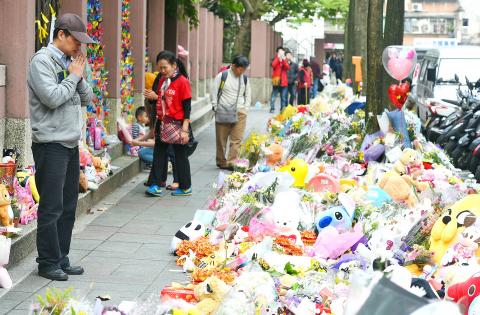
Photo: Chang Chia-ming, Taipei Times
She also called on the public to leave their hatred behind them, urging an end to attacks between people with different opinions on capital punishment and criminal justice issues.
She also said that she does not support any organization that tries to use the case and her daughter’s name for its own agenda.
Meanwhile, political commentators and government officials condemned the Taipei Police Department for releasing information from a preliminary investigation that said Wang Ching-yu (王景玉), the suspect in the brutal killing, had a history of mental illness and had exhibited eccentric behavior for some time.
Political commentator Wang Rui-de (王瑞德) said it is the job of prosecutors and other judicial agencies to consider all evidence and witness testimonies to determine if cases should be prosecuted and if a suspect is fit to stand trial.
“The police officials pronounced that Wang [Ching-yu] clearly has a mental disorder, but they based it only on sketchy evidence, a few interviews with Wang [Ching-yu’s] family and some neighbors, while the investigation is still in an early phase,” Wang Rui-de said. “These officials are taking over the judicial duties of prosecutors and judges. They are subverting the due process of law.”
The issue was raised when police released the details of a preliminary investigation on Tuesday, one day after the girl’s killing, which said Wang [Ching-yu] had a history of mental health issues. It also seemed to blame random knife attacks on the nation’s health system and called for better monitoring and follow-up treatment of mental health patients.
Separately, judicial officials yesterday said that Wang Ching-yu was punched at the Taipei Detention Center where he was being held, but added that he was not injured.
He was reportedly attacked by two other detainees who were sent to a cell to repair the floor.
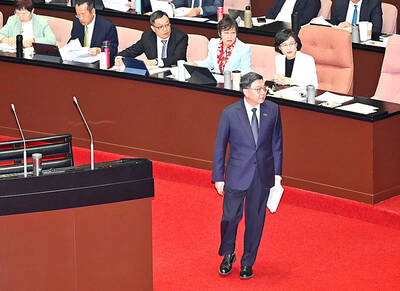
The government is monitoring online rumors that a pneumonic plague outbreak has spread from Russia into China, and it might enhance quarantine measures, Premier Cho Jung-tai (卓榮泰) said yesterday. During a legislative meeting, Democratic Progressive Party Legislator Wang Ting-yu (王定宇) said that rumors had circulated that the disease had spread across several Chinese provinces. He asked Cho whether the government was prepared to prevent the disease spreading to Taiwan, given the volume of traffic between the two sides, and how concerned the government was about the alleged outbreak. The Ministry of Health and Welfare had implemented border quarantine measures after briefing the Executive
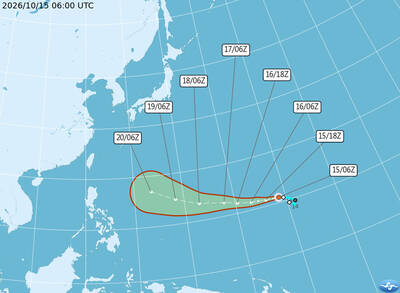
EAST OF GUAM: Tropical Storm Champi is forecast to strengthen into a typhoon, but its effect on Taiwan is uncertain due to the presence of a high-pressure system Tropical Storm Champi formed yesterday and has the potential to increase in strength, the Central Weather Administration (CWA) said yesterday. Forecasters are closely monitoring a Pacific high-pressure system that would dictate whether the storm turns north or moves toward Taiwan next week, the CWA said. The most likely scenario is that it turns northward after passing the Ryukyu Islands, CWA forecaster Cheng Chieh-jen (鄭傑仁) said. As of 8pm yesterday, Champi was east of Guam moving west-northwest at 20kph, CWA data showed. It had maximum sustained winds near the center of 72kph and gusts of up to 101kph, the data showed. If the Pacific high-pressure system
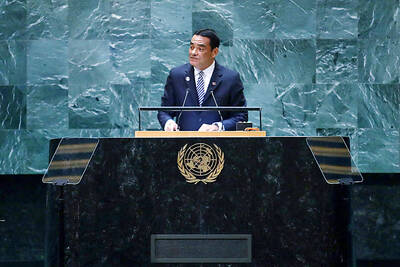
RIGHT TO DIPLOMACY: Under the UN Charter, every state has the right to conduct foreign policy free from external pressure, Belize said in a statement Belize and Paraguay on Monday condemned Beijing sanctions over their countries’ ties with Taiwan, saying China’s actions create unnecessary tensions. Earlier on Monday, Beijing announced sanctions against Paraguayan Minister of Information and Communication Technologies Gustavo Villate and Belizean Minister of Foreign Affairs Francis Fonseca. The Paraguayan Ministry of Foreign Affairs said it rejected the sanctions, writing on X that they created unnecessary friction. It added that it reaffirmed its support for Taiwan and its commitment to democratic values and principles. Villate told the Spanish-language Paraguayan daily ABC Color the sanctions were “predictable” and linked them to several cooperation projects between Taiwan and Paraguay. The projects
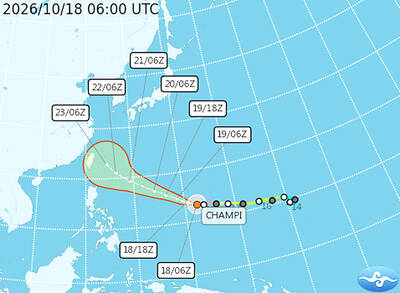
A sea warning for Typhoon Champi could be issued as early as Wednesday night, possibly followed by a land warning on Thursday night or Friday, as the storm approaches Taiwan, the Central Weather Administration (CWA) said yesterday. The typhoon is expected to have its greatest impact on Taiwan on Friday and Saturday, bringing heavy rain to central and northern Taiwan and to Yilan and Hualien counties in the east, CWA forecaster Liu Pei-teng (劉沛滕) said. As of 2pm yesterday, Champi was about 2,470km east-southeast of Oluanpi (鵝鑾鼻), Taiwan’s southernmost tip, moving westnorthwest at 20kph. It had maximum sustained winds of 191kph and a


 RSS
RSS