


Minister of Justice Luo Ying-shay (羅瑩雪) yesterday at a Legislative Yuan committee inquiry session denied the ministry’s involvement in an ongoing investigation of the Taipei Dome project started when President Ma Ying-jeou (馬英九) was mayor of Taipei.
Luo said the case was being investigated by the Taipei District Prosecutors’ Office and she had not asked about it out of respect for the office’s jurisdiction.
According to reports by Storm Media Group, Chinese Nationalist Party (KMT) Legislator Lin Te-fu (林德福) — who is also a member of the legislature’s Judicial Committee — asked Luo whether the ministry would reject an investigation request on the grounds that the ministry does not have investigative authority.
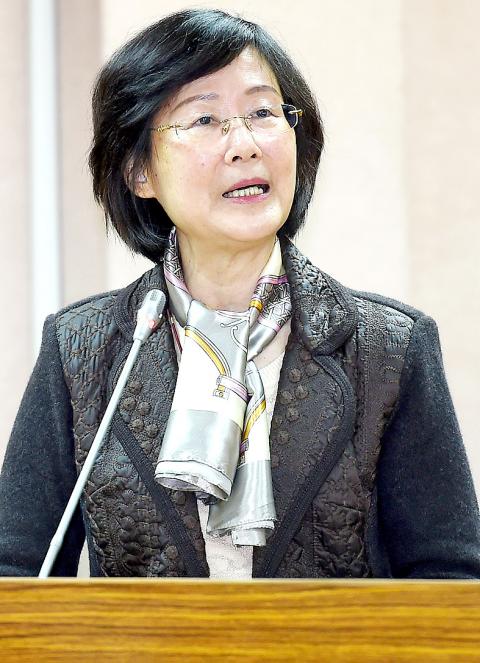
Photo: Chu Pei-hsiung, Taipei Times
The ministry had cited that reason for rejecting an investigation into the Taipei Dome and MeHAS City projects after the Taipei City Government asked that the investigation be turned over to the ministry, the report said.
The municipality’s Clean Government Committee attempted to turn over the investigation to the ministry before the Lunar New Year holiday last month, the report said.
Luo said the Taipei District Prosecutors’ Office was investigating the issue and there was no other reason that the request would be rejected, adding that while the master copy of the official request had been sent to the ministry, the prosecutors’ office received a copy as well.
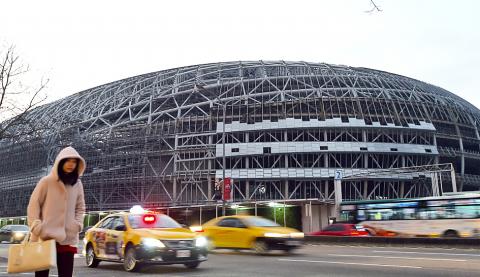
Photo: Chien Jung-fong, Taipei Times
The investigation is being carried out by the prosecutors’ office and the ministry would not intervene or ask about it, Luo said.
Meanwhile, Presidential Office spokesperson Charles Chen (陳以信) said Ma has a clean record, one that could stand up against the most critical of inspections.
Ma has made known his willingness to cooperate with the ongoing investigation if required, Chen said.
However, Chen said the committee’s credibility has been doubtful since last year.
Even Taipei Mayor Ko Wen-je (柯文哲) has changed his rhetoric and simply calls the five controversial cases the “five cases” instead of the “five scandals,” Chen said.
The five cases also include the Twin Star project, the Songshan Cultural and Creative Park and the Syntrend Digital Park.
Ko has said that all five projects benefitted contractors prior to his election as mayor in 2014.
Ko and Taipei Department of Legal Affairs Director Yang Fang-ling (楊芳玲) have both said the Taipei Dome project was “legal, but unreasonable,” Chen said, adding that if Ma is proved innocent, Ko must take both legal and political responsibility for accusing the president of collusion with corporations during his tenure as mayor of Taipei.

‘NO SECURITY RISK’: The Railway Bureau reassured the public that the technicians’ activities were limited to technical guidance and did not involve sensitive systems The Railway Bureau yesterday said it had invited eight Chinese technicians to assist with an airport MRT construction project. The bureau issued the confirmation after an Internet user said Chinese nationals had entered the construction zone of Taiwan Taoyuan International Airport’s Terminal 3 project. They asked why “individuals from an enemy state” were allowed access to such a major national infrastructure project, which raised serious concerns over Taiwan’s industrial safety, sensitive systems and information security. The bureau’s Northern Region Engineering Branch Office said subcontractor Taiwan Handle Industrial Co (台灣手把工業) of the Taoyuan airport MRT’s “Contract No. CU05 Project A14 Station Civil, MEP &
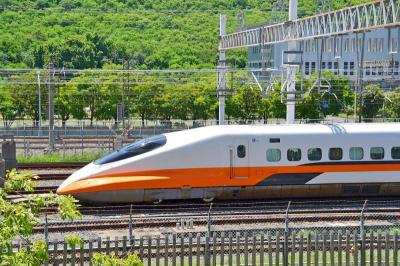
A signaling system malfunction disrupted high-speed rail (HSR) services beginning at 8am today, with trains temporarily reduced to three northbound and three southbound trains per hour as authorities conduct inspections. The malfunction occurred on a section of track in Miaoli County during pre-operation checks early this morning, forcing northbound and southbound trains to use a single track, the HSR operator said. The regular schedule has been replaced with three hourly trains offering only nonreserved seating in each direction, stopping at every station, it said, adding that business class cars would still have reserved seating. Departures from terminal stations are scheduled at the top

Taiwan is still in the process of assessing the possibility of recruiting workers from Eswatini, the Ministry of Foreign Affairs said yesterday, adding that its goal is to help Eswatini upgrade its vocational training centers. If there are plans to recruit workers from Eswatini, safeguarding national security, protecting public health and ensuring the employment rights of Taiwanese would be prerequisites, Department of West Asian and African Affairs Director-General Yen Chia-liang (顏嘉良) told a news conference. Key considerations would also include filling labor shortages in specific industries, and fostering bilateral professional and technical exchanges, he said. Yen was asked about the progress of labor

A US uncrewed surface vessel (USV) encountered multiple Chinese warships during an autonomous transit of the Taiwan Strait, US defense company Seasats said in a statement on Wednesday. Seasats announced that a Lightfish USV had completed the first autonomous transit of the Taiwan Strait. Over five days, the USV traversed the entire length of the Strait while constantly monitoring surface vessel traffic, the company said. The Lightfish encountered multiple Chinese warships, one of which was a Chinese People’s Liberation Army Navy (PLAN) Type 056 corvette, it said. The Chinese vessels were operating “well within Taiwan’s exclusive economic zone without transmitting their identity via the


 RSS
RSS