


Myanmar’s parliament elected Htin Kyaw as the country’s new president yesterday in a watershed moment that ushers the longtime opposition party of Aung San Suu Kyi into government after 54 years of direct or indirect military rule.
The joint session of the two houses of parliament broke into thundering applause as the speaker Mann Win Khaing Than announced the result: “I hereby announce the president of Myanmar is Htin Kyaw, as he won the majority of votes.”
Immediately, the state-run Myanmar TV’s camera zoomed in from above on a beaming Aung San Suu Kyi, sitting in the front row, clapping excitedly, for a live nationwide audience.
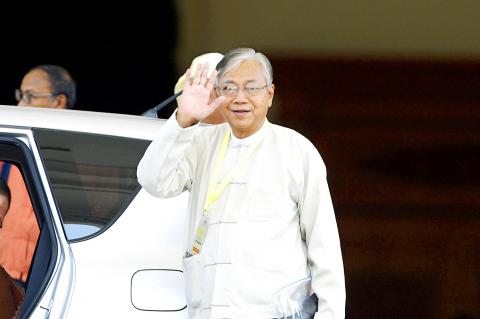
Photo: EPA
The 70-year-old Htin Kyaw, a longtime confidant of Aung San Suu Kyi, is to take office on April 1, but questions remain about his position and power.
Rightfully, the job belonged to Aung San Suu Kyi, who has been the face of the pro-democracy movement and who endured decades of house arrest and harassment by military rulers without ever giving up on her non violent campaign to unseat them.
However, a constitutional provision barred her from becoming president, and she made it clear that whoever sits in that chair would be her proxy.
Still, Htin Kyaw will be remembered by history as the first civilian president for Myanmar and the head of its first government to be elected in free and fair polls.
After the parliament session ended, Aung San Suu Kyi did not comment as she exited, leaving the new president to deliver the first reaction.
“This is a victory for the people of this country,” Htin Kyaw said in a brief comment to reporters.
He secured 360 votes from among 652 ballots cast in the bicameral parliament, where the vote count was read aloud and announced by a parliament official.
The military’s nominee, Myint Swe, won 213 votes and will become the first vice president. Htin Kyaw’s running mate from the National League for Democracy (NLD) party, Henry Van Tio, won 79 votes and is to take the post of second vice president.
“We are very satisfied with the result of the presidential election,” said Tun Win, a legislator from the Arakan National Party. “He really should be the leader. I hope he can lead this country to peace and stability, equality and implement the rule of law in this country.”
Htin Kyaw, who has known Aung San Suu Kyi since grade school, became her confidant and adviser on foreign relations.
As Myanmar lurched from one political crisis to another, Aung San Suu Kyi was released and re-arrested several times. The junta finally started loosening its grip on power in 2010, allowing elections, which were won by a military-allied party after the NLD boycotted the polls as unfair.
After more reforms, another general election was held on Nov. 8 last year that was swept by the NLD, a reflection of Aung San Suu Kyi’s widespread public support.
The constitutional clause that denied her the presidency excludes anyone from the job who has a foreign spouse or children. Aung San Suu Kyi’s two sons are British, as was her late husband. The clause is widely seen as having been written by the military with Aung San Suu Kyi in mind.
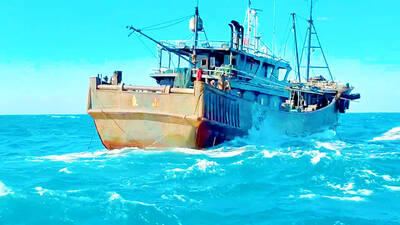
MAKING WAVES: China’s maritime militia could become a nontraditional threat in war, clogging up shipping lanes to prevent US or Japanese intervention, a report said About 1,900 Chinese ships flying flags of convenience and fishing vessels that participated in China’s military exercises around Taiwan last month and in January have been listed for monitoring, Coast Guard Administration (CGA) Deputy Director-General Hsieh Ching-chin (謝慶欽) said yesterday. Following amendments to the Commercial Port Act (商港法) and the Law of Ships (船舶法) last month, the CGA can designate possible berthing areas or deny ports of call for vessels suspected of loitering around areas where undersea cables can be accessed, Oceans Affairs Council Minister Kuan Bi-ling (管碧玲) said. The list of suspected ships, originally 300, had risen to about 1,900 as
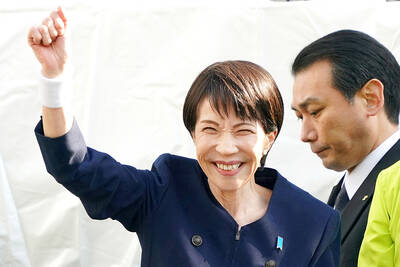
Japan’s strategic alliance with the US would collapse if Tokyo were to turn away from a conflict in Taiwan, Japanese Prime Minister Sanae Takaichi said yesterday, but distanced herself from previous comments that suggested a possible military response in such an event. Takaichi expressed her latest views on a nationally broadcast TV program late on Monday, where an opposition party leader criticized her for igniting tensions with China with the earlier remarks. Ties between Japan and China have sunk to the worst level in years after Takaichi said in November that a hypothetical Chinese attack on Taiwan could bring about a Japanese
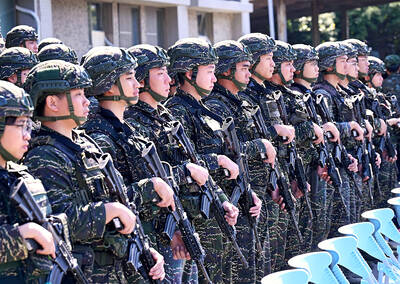
MORE RESPONSIBILITY: Draftees would be expected to fight alongside professional soldiers, likely requiring the transformation of some training brigades into combat units The armed forces are to start incorporating new conscripts into combined arms brigades this year to enhance combat readiness, the Executive Yuan’s latest policy report said. The new policy would affect Taiwanese men entering the military for their compulsory service, which was extended to one year under reforms by then-president Tsai Ing-wen (蔡英文) in 2022. The conscripts would be trained to operate machine guns, uncrewed aerial vehicles, anti-tank guided missile launchers and Stinger air defense systems, the report said, adding that the basic training would be lengthened to eight weeks. After basic training, conscripts would be sorted into infantry battalions that would take
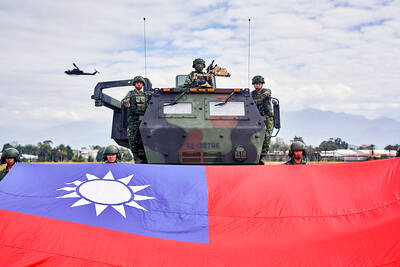
DEEP-STRIKE CAPABILITY: The scenario simulated a PLA drill that turned into an assault on Taiwan’s critical infrastructure, with the launchers providing fire support Taiwan yesterday conducted this year’s first military exercises at Longsiang Base in Taichung, demonstrating the newly acquired High Mobility Artillery Rocket System’s (HIMARS) ability to provide fire support and deep-strike capabilities. The scenario simulated an attack on Penghu County, with HIMARS trucks immediately rolling into designated launch areas and firing barrages at the Wangan (望安) and Cimei (七美) islands, simulating the provision of fire support against invading forces. The HIMARS are supposed to “fire and leave,” which would significantly increase personnel and equipment survivability, a military official said. The drill simulated an exercise launched by the Chinese People’s Liberation Army (PLA) Eastern


 RSS
RSS