


Premier Simon Chang (張善政) yesterday urged the Ministry of National Defense to temporarily remove from their posts officials who were involved in the warrantless search by military police of a private residence for documents said to be related to the White Terror era, pending an investigation.
Amid growing public outcry over the search, Chang held a news conference at the Executive Yuan in an apparent effort to assuage the controversy.
The Taipei Military Police Station on Feb. 19 searched the home of a man, surnamed Wei (魏), who was later charged with possession of stolen property and violating personal privacy by selling government documents dated from the 1960s and 1970s. The documents in question were confiscated by the military police.
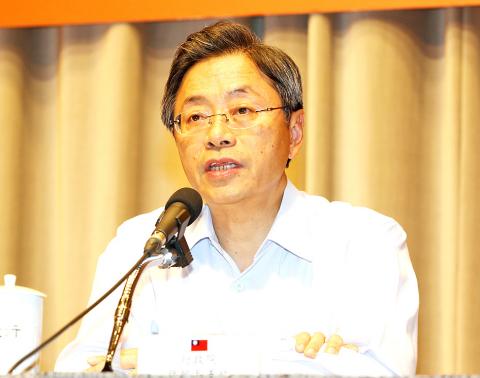
Photo: CNA
The case came to light after Wei’s daughter on Saturday posted on the Professional Technology Temple (PTT), the nation’s largest online academic bulletin board, about her father’s situation.
“Over the past few days, considerable controversy has arisen over a military police search for alleged White Terror-era documents at a civilian residence. The Executive Yuan would like to make a few comments on the case,” Chang said at the news conference, which Executive Yuan spokesman Sun Lih-chyun (孫立群) attended.
To ensure the smooth execution of the probe, all high-level officials involved in Wei’s case should be temporarily removed from their current posts, including those from the Ministry of National Defense’s Political Warfare Bureau, which ordered the investigation of Wei, and the Military Police Command, he said.
While pledging not to interfere with the investigation, Chang said he hoped that prosecutors could ascertain the truth in the shortest time possible and allow the maximum level of openness in their investigation.
The White Terror era ended decades ago and Taiwanese have been free from fear of the dark period ever since, Chang said.
“The documents [in Wei’s possession] were from 50 years ago and they were supposed to be destroyed two to three decades ago. It is debatable whether it is appropriate to launch an investigation based on the suspected offense of disclosing confidential information over some documents that escaped destruction,” Chang said.
The premier also questioned the propriety of deploying military police to deal with a case that involves civilians, saying prosecutors should have handled any investigation and police officers should have conducted the property search under a warrant.
“This is how the case should have been handled if it indeed needed looking into,” Chang said.
Chang said that although the ministry said that Wei had signed a consent-to-search form, having military police retrieve documents from civilians without a warrant was nevertheless improper.
About an hour after Chang’s news conference, the Presidential Office released a statement saying President Ma Ying-jeou (馬英九) is extremely concerned about Wei’s case.
“President Ma has instructed Premier Chang and relevant government agencies to seriously examine the matter, ascertain the truth and give the public a clear explanation as soon as possible,” Presidential Office spokesman Charles Chen (陳以信) said.
Chen said that the Republic of China is a nation that champions democracy and human rights and that the government exists for the purposes of safeguarding citizens’ fundamental human rights and creating a free environment for people.
However, any unwarranted innuendos made by political manipulators before the judicial authority finds out the truth about the case not only are unhelpful, but could also cause harm to society, Chen said.
Meanwhile, Control Yuan member Chang Kuei-mei (仉桂美) told reporters that she is considering whether to initiate an investigation into the case.
“The military and civilian systems function separately. If we do decide to look into the matter, our focus will be on whether the military police’s investigation into Wei conforms to the rule of law, as well as the mandate and scope of their work,” she said.
In other developments, five military police officers involved in the Wei case were summoned by the Taipei District Prosecutors’ Office.
After questioned, they were allowed to leave the office.
The White Terror era refers to the decades after the Chinese Nationalist Party (KMT) regime under former president Chiang Kai-shek (蔣介石) imposed martial law on Taiwan on May 19, 1949. Martial law was lifted on July 15, 1987.
Additional reporting by CNA
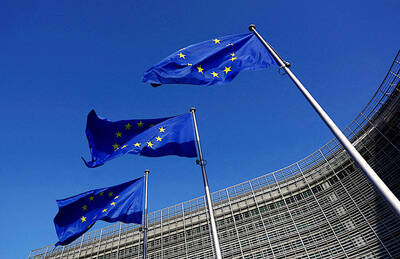
LEVERAGE: China did not ‘need to fire a shot’ to deny Taiwan airspace over Africa when it owns ‘half the continent’s debt,’ a US official said, calling it economic warfare The EU has raised concerns about overflight rights following the delay of President William Lai’s (賴清德) planned state visit to the Kingdom of Eswatini after three African nations denied overflight clearance for his charter at the last minute. Taiwanese allies Paraguay and Saint Kitts and Nevis, as well as several US lawmakers and the Inter-Parliamentary Alliance on China (IPAC) condemned China for allegedly pressuring the countries. Lai was scheduled to fly directly to Taiwan’s only African ally from yesterday to Sunday to celebrate the 40th anniversary of King Mswati III’s accession and his 58th birthday, but Seychelles, Mauritius and Madagascar suddenly revoked
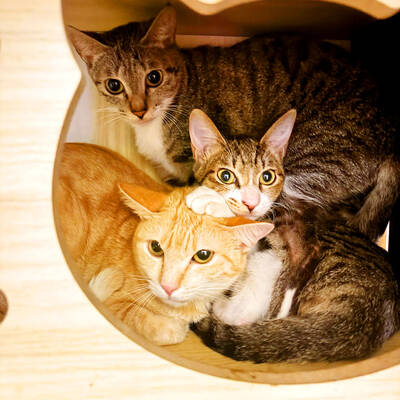
The number of pet cats in Taiwan surpassed that of pet dogs for the first time last year, reaching 1,742,033, a 32.8 percent increase from 2023, the Ministry of Agriculture said yesterday, citing a survey. By contrast, the number of pet dogs declined slightly by 1.2 percent over the same period to 1,462,528, the ministry said. Despite the shift, households with dogs still slightly outnumber those with cats by 1.2 percent. However, while the number of households with multiple dogs has remained relatively stable, households keeping more than two cats have increased, contributing to the overall rise in the feline population. The trend
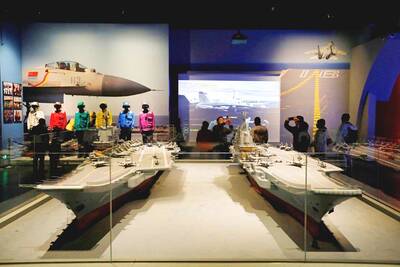
China on Wednesday teased in a video an aircraft carrier that could be its fourth, and the first using nuclear power, while making an allusion to Taiwan and vowing to further build up its islands, as it looks to boost maritime power, secure resources and bolster territorial claims. The video, issued on the eve of the 77th founding anniversary of the Chinese People’s Liberation Army Navy, featured fictional officers with names that are homophones of three commissioned aircraft carriers, the Liaoning (遼寧), Shandong (山東) and Fujian (福建). Titled Into the Deep, it showed a 19-year-old named “Hejian” (何劍) joining the group, sparking
BIG YEAR: The company said it would also release its A12 chip the same year to keep a ‘reliable stream of new silicon technologies’ flowing to its customers Taiwan Semiconductor Manufacturing Co (TSMC, 台積電) yesterday said its newest A13 chip is to enter volume production in 2029 as the chipmaker seeks to hold onto its tech leadership and demand for next-generation chips used in artificial intelligence (AI), high-performance-computing (HPC) and mobile applications. TSMC, the world’s biggest contract chipmaker, also unveiled its A12 chip at its annual technology symposium in Santa Clara, California. The A12 chip, which features TSMC’s super-power-rail technology to provide backside power delivery for AI and HPC applications, is also to enter volume production in 2029, a year after the scheduled release of the A14 chip. The technology moves


 RSS
RSS