


China’s defense budget this year is likely to rise at its slowest pace since 2010, in line with the decelerating economy and by a much lower figure than had been expected in military and diplomatic circles, although it probably does not represent true spending.
Chinese National People’s Congress spokeswoman Fu Ying (傅瑩) said the figure would increase by about 7 to 8 percent from last year, following a nearly unbroken two-decade run of double-digit budget increases.
China’s military buildup has rattled nerves in the region, particularly because China has taken an increasingly assertive stance in its territorial disputes in the East and South China seas.
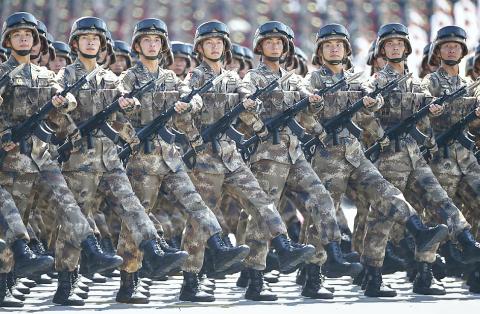
Photo: EPA
Fu told a news conference that the defense budget would be released today, when the annual session of China’s largely rubber-stamp legislative body opens.
It would be the first single-digit rise in defense spending since 2010, when the military budget logged a 7.5 percent increase.
Defense spending last year was budgeted to rise 10.1 percent to 886.9 billion yuan (US$136.1 billion), about one-quarter of that of the US.
The US Department of Defense budget for this year is US$573 billion.
China’s leaders have routinely sought to justify military modernization by linking defense spending to rapid GDP growth, but growth of 6.9 percent last year was the slowest in 25 years, and a further slowdown is widely expected this year.
“One simple reason for the lower increase is that double-digit growth is now harder to sustain,” said Bonji Obara of the Tokyo Foundation think tank, a former military attache at Japan’s embassy in Beijing.
However, “another reason is that China’s anticorruption campaign means less money is being siphoned off and spending has become more efficient,” he added, referring to Chinese President Xi Jinping’s (習近平) vigorous efforts to root out graft among officials.
The defense budget had been widely expected in military and diplomatic circles to log another double-digit increase.
Fu said the budget was based on national defense needs, the state of China’s economy and the performance of its fiscal revenue.
Xinhua news agency said the slower pace of the increase reflected both economic realities and Beijing’s determination to pursue peace, but that China still faces complex security threats, including from terrorism, and would not let down its guard.
“There are many reasons for China not to be able to sleep without worries,” Xinhua said in a commentary.
China has been repeatedly criticized for a lack of openness in its defense spending and its intentions.
“China needs to be transparent and explain its military spending to the international community,” Japanese Minister of Defense Gen Nakatani said in Tokyo ahead of Fu’s announcement.
“It’s crucial that China does not upset the regional balance and that it firmly contributes to international stability,” Nakatani added.
Beijing is feeling public pressure to show it can protect its claims to the South China Sea after the US began conducting “freedom of navigation” operations near islands where China has been carrying out controversial reclamation work and stationing advanced weapons.
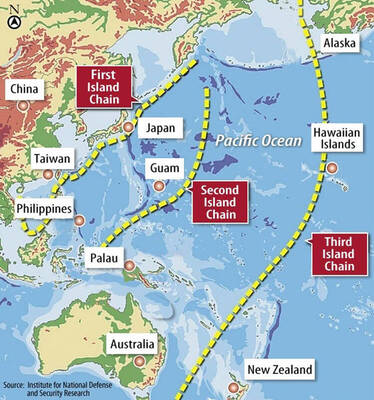
The US government has signed defense cooperation agreements with Japan and the Philippines to boost the deterrence capabilities of countries in the first island chain, a report by the National Security Bureau (NSB) showed. The main countries on the first island chain include the two nations and Taiwan. The bureau is to present the report at a meeting of the legislature’s Foreign Affairs and National Defense Committee tomorrow. The US military has deployed Typhon missile systems to Japan’s Yamaguchi Prefecture and Zambales province in the Philippines during their joint military exercises. It has also installed NMESIS anti-ship systems in Japan’s Okinawa
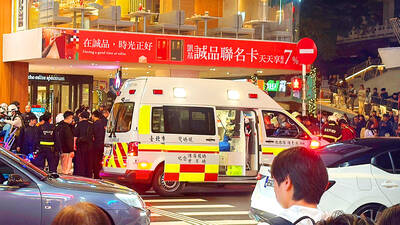
TRAGEDY STRIKES TAIPEI: The suspect died after falling off a building after he threw smoke grenades into Taipei Main Station and went on a killing spree in Zhongshan A 27-year-old suspect allegedly threw smoke grenades in Taipei Main Station and then proceeded to Zhongshan MRT Station in a random killing spree that resulted in the death of the suspect and two other civilians, and seven injured, including one in critical condition, as of press time last night. The suspect, identified as a man surnamed Chang Wen (張文), allegedly began the attack at Taipei Main Station, the Taipei Fire Department said, adding that it received a report at 5:24pm that smoke grenades had been thrown in the station. One man in his 50s was rushed to hospital after a cardiac arrest
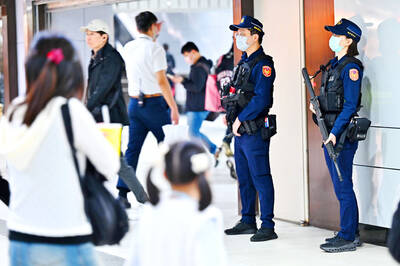
PUBLIC SAFETY: The premier said that security would be tightened in transport hubs, while President Lai commended the public for their bravery The government is to deploy more police, including rapid response units, in crowded public areas to ensure a swift response to any threats, President William Lai (賴清德) said yesterday after a knife attack killed three people and injured 11 in Taipei the previous day. Lai made the remarks following a briefing by the National Police Agency on the progress of the investigation, saying that the attack underscored the importance of cooperation in public security between the central and local governments. The attack unfolded in the early evening on Friday around Taipei Main Station’s M7 exit and later near the Taipei MRT’s Zhongshan
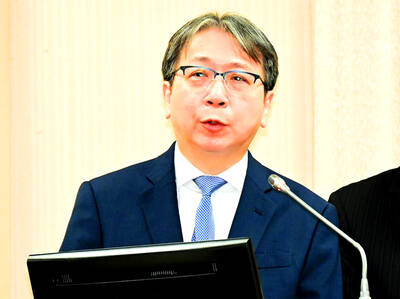
ON ALERT: Taiwan’s partners would issue warnings if China attempted to use Interpol to target Taiwanese, and the global body has mechanisms to prevent it, an official said China has stationed two to four people specializing in Taiwan affairs at its embassies in several democratic countries to monitor and harass Taiwanese, actions that the host nations would not tolerate, National Security Bureau (NSB) Director-General Tsai Ming-yen (蔡明彥) said yesterday. Tsai made the comments at a meeting of the legislature’s Foreign Affairs and National Defense Committee, which asked him and Minister of National Defense Wellington Koo (顧立雄) to report on potential conflicts in the Taiwan Strait and military preparedness. Democratic Progressive Party (DPP) Legislator Michelle Lin (林楚茵) expressed concern that Beijing has posted personnel from China’s Taiwan Affairs Office to its


 RSS
RSS