


Premier Simon Chang (張善政) yesterday promised to keep an open mind on a possible visa application from the Dalai Lama, saying the government would not reject his application on political grounds.
During a question-and-answer session at the Legislative Yuan, Democratic Progressive Party (DPP) Legislator Chuang Ruei-hsiung (莊瑞雄) asked Chang what the attitude of President Ma Ying-jeou’s (馬英九) administration was toward allowing the exiled Tibetan spiritual leader to visit Taiwan.
“The Dalai Lama has visited Taiwan three times. As I understand, he has not applied for another visa. As long as he files an application, we will process his request accordingly,” Chang said.
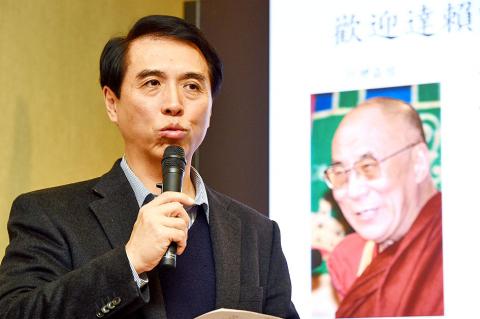
Photo: Lo Pei-der, Taipei Times
Approval of a visa application would hinge on the purpose of the proposed visit, the premier said, adding: “If the visit is beneficial to both sides, I do not see any reason why we should not let him come.”
“So, does that mean that the government would adopt an open attitude should the Tibetan spiritual leader submit a visa application?” Chuang said.
Chang said that by openness, he meant the government would accept a visa application and would refrain from impeding the Dalai Lama’s application using “bizarre political reasons of any kind.”
Earlier in the day he had said that the visa issue would be decided by consultations between the Mainland Affairs Council and other government agencies.
Chinese Nationalist Party (KMT) Legislator Apollo Chen (陳學聖) on Monday launched a petition urging Ma to issue a visa to the Dalai Lama so he could visit before Ma’s presidential term ends on May 20. He said that since the Dalai Lama is no longer the leader of the Tibetan government-in-exile, the administration has no reason not to let him visit.
Chen yesterday afternoon held a news conference in Taipei to reiterate his appeal.
Meanwhile, asked about the visa issue on the sidelines of the legislative session, Mainland Affairs Council Minister Andrew Hsia (夏立言) said that everything depended on the situation if and when the Dalai Lama submitted an application.
Asked if China would exert pressure on Taiwan over the issue, Hsia said: “I believe we all know about China’s stance on a visit by the Dalai Lama to Taiwan. We have our own procedures and everything will be processed accordingly.”
Andrew Lee (李憲章), the deputy director-general of the Ministry of Foreign Affairs’ Public Diplomacy Coordination Council, said that visa applicants must file documents detailing the purpose of their proposed trip before their applications can be evaluated.
“Since the Dalai Lama has not submitted an application yet, it is too early to say if such a request would be approved or not,” Lee said.
The Dalai Lama’s most recent visit to Taiwan began on Aug. 30, 2009, after he was invited by seven DPP mayors and county commissioners to hold religious services for victims of Typhoon Morakot, which had ravaged southern Taiwan earlier that month.

A signaling system malfunction disrupted high-speed rail (HSR) services beginning at 8am today, with trains temporarily reduced to three northbound and three southbound trains per hour as authorities conduct inspections. The malfunction occurred on a section of track in Miaoli County during pre-operation checks early this morning, forcing northbound and southbound trains to use a single track, the HSR operator said. The regular schedule has been replaced with three hourly trains offering only nonreserved seating in each direction, stopping at every station, it said, adding that business class cars would still have reserved seating. Departures from terminal stations are scheduled at the top

Taiwan is still in the process of assessing the possibility of recruiting workers from Eswatini, the Ministry of Foreign Affairs said yesterday, adding that its goal is to help Eswatini upgrade its vocational training centers. If there are plans to recruit workers from Eswatini, safeguarding national security, protecting public health and ensuring the employment rights of Taiwanese would be prerequisites, Department of West Asian and African Affairs Director-General Yen Chia-liang (顏嘉良) told a news conference. Key considerations would also include filling labor shortages in specific industries, and fostering bilateral professional and technical exchanges, he said. Yen was asked about the progress of labor

A US uncrewed surface vessel (USV) encountered multiple Chinese warships during an autonomous transit of the Taiwan Strait, US defense company Seasats said in a statement on Wednesday. Seasats announced that a Lightfish USV had completed the first autonomous transit of the Taiwan Strait. Over five days, the USV traversed the entire length of the Strait while constantly monitoring surface vessel traffic, the company said. The Lightfish encountered multiple Chinese warships, one of which was a Chinese People’s Liberation Army Navy (PLAN) Type 056 corvette, it said. The Chinese vessels were operating “well within Taiwan’s exclusive economic zone without transmitting their identity via the

VERBOSE VESSELS: A CGA cutter and a China Coast Guard exchanged verbal barbs for more than a day in Taiwanese-controlled waters before the Chinese vessel left The Taiwanese and Chinese coast guards had a standoff near the strategically located Pratas Islands (Dongsha Islands, 東沙群島) in the north of the South China Sea, the Coast Guard Administration (CGA) said yesterday. The two sides engaged in intense radio exchanges over sovereignty claims during the 33-hour standoff. China Coast Guard vessel 3501 eventually left the restricted waters, 26.6 nautical miles (49.2km) west of the Pratas Islands, at 5pm yesterday, the CGA said. Lying approximately between southern Taiwan and Hong Kong, the Taiwan-controlled Pratas are seen by some security experts as vulnerable to Chinese attack due to their distance — more than


 RSS
RSS