


In his new book, former president Lee Teng-hui (李登輝) said that the “status quo” for Taiwan means “not belonging to China,” which is why he has never backed the movement for Taiwanese independence.
According to reports in the Chinese-language United Daily Evening News, in Last Days: My Life’s Journey and the Roadmap of Taiwan’s Democratization, Lee writes that Taiwan already enjoys de jure independence, and if the president allows the conflict between pro-independence and pro-unification camps to grow, it would be to the detriment of the nation.
The report quoted Lee as writing that with the first direct presidential election in 1996, Taiwan “shook off the yoke of foreign occupation.”
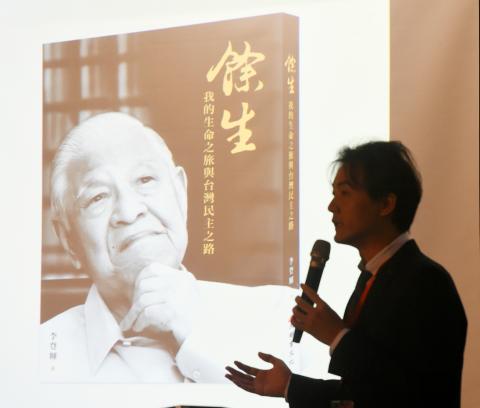
Photo: Liao Chen-huei, Taipei Times
While under “foreign occupation,” many tragedies occurred — which should be properly addressed — but Taiwan must ultimately move beyond such sentiments, Lee wrote.
When a person arrived in Taiwan should not be the deciding factor in whether they are considered Taiwanese, and while history must be understood, Taiwanese must look toward the future, Lee wrote, according to the report.
Taiwan must shake off the old system, with its notions of “one China” and that the Republic of China (ROC) is a legitimate continuation of “China” from the Qing Dynasty, Lee wrote.
More than 80 percent of Taiwanese back maintaining the “status quo” between China and Taiwan, and this “status quo” is that Taiwan is independent of China, Lee wrote, according to the report.
The nation should participate in international affairs under the name of Taiwan, which should be the only point of concern, Lee wrote.
The debate over whether Taiwan is independent would only tear the nation apart if allowed to continue, and Taiwan need not make controversial comments on the matter, because it already enjoys de jure independence, Lee wrote, according to the report.
Meanwhile, Lee yesterday canceled at the last minute his appearance at a publicity event for the book at the Taipei International Book Exhibition.
The book was originally scheduled for publication before the Jan. 16 presidential and legislative elections, but the date was pushed back due to concerns that it might influence voting, Metropolitan Culture Enterprise Co Ltd & Banner Publishing House (大都會文化事業出版社) president Lin Ching-pin (林敬斌) said, adding that the title of the book was chosen by Lee.
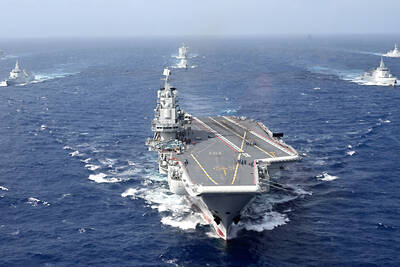
PROVOCATIVE: Chinese Deputy Ambassador to the UN Sun Lei accused Japan of sending military vessels to deliberately provoke tensions in the Taiwan Strait China denounced remarks by Japan and the EU about the South China Sea at a UN Security Council meeting on Monday, and accused Tokyo of provocative behavior in the Taiwan Strait and planning military expansion. Ayano Kunimitsu, a Japanese vice foreign minister, told the Council meeting on maritime security that Tokyo was seriously concerned about the situation in the East China and South China seas, and reiterated Japan’s opposition to any attempt to change the “status quo” by force, and obstruction of freedom of navigation and overflight. Stavros Lambrinidis, head of the EU delegation to the UN, also highlighted South China Sea
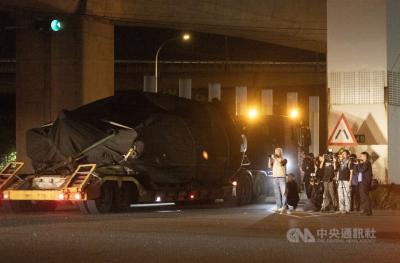
The final batch of 28 M1A2T Abrams tanks purchased from the US arrived at Taipei Port last night and were transported to the Armor Training Command in Hsinchu County’s Hukou Township (湖口), completing the military’s multi-year procurement of 108 of the tanks. Starting at 12:10am today, reporters observed more than a dozen civilian flatbed trailers departing from Taipei Port, each carrying an M1A2T tank covered with black waterproof tarps. Escorted by military vehicles, the convoy traveled via the West Coast Expressway to the Armor Training Command, with police implementing traffic control. The army operates about 1,000 tanks, including CM-11 Brave Tiger
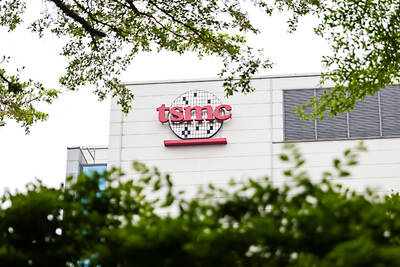
Taiwan Semiconductor Manufacturing Co (TSMC, 台積電), the world’s largest contract chipmaker, said it expects its 2-nanometer (2nm) chip capacity to grow at a compound annual rate of 70 percent from this year to 2028. The projection comes as five fabs begin volume production of 2-nanometer chips this year — two in Hsinchu and three in Kaohsiung — TSMC senior vice president and deputy cochief operating officer Cliff Hou (侯永清) said at the company’s annual technology symposium in Silicon Valley, California, last week. Output in the first year of 2-nanometer production, which began in the fourth quarter of last year, is expected to
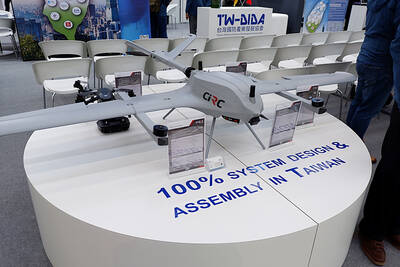
Taiwan’s drone exports surged past US$100 million in the first quarter, exceeding last year’s full-year total, with the Czech Republic emerging as the largest buyer, the Ministry of Economic Affairs said. Exports of complete drones reached US$115.85 million in the period, about 1.2 times the total recorded for all of last year, the ministry said in a report. Exports to the Czech Republic accounted for about US$100 million, far outpacing other markets. Poland, last year’s top destination, recorded about US$11.75 million in the first quarter. Taiwan’s drone exports have expanded rapidly in the past few years, with last year’s total


 RSS
RSS