


A magnitude 6.4 earthquake rattled the nation at 3:57am yesterday, killing at least 15 people and injuring hundreds.
Emergency personnel rushed to Tainan, which had the highest number of casualties after several buildings collapsed.
At press time, emergency workers were still trying to search for people who might be trapped inside the 17-story Weiguan Jinlong residential building in the city’s Yongkang District (永康), which was left lying on its side on Yongda Road, with twisted metal girders exposed and clouds of dust rising from the concrete debris.
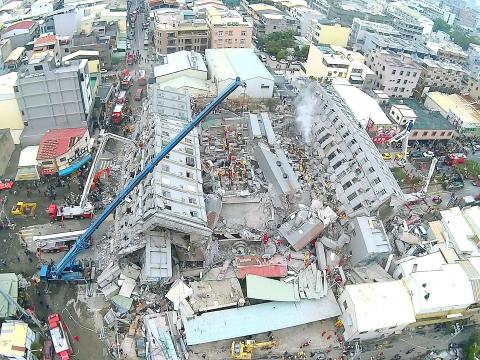
Photo: Huang Chih-yuan, Taipei Times
Officials said there were 256 people registered as living in the complex comprising 96 apartments. However, it was not clear how many people were inside the building at the time of the quake. As of 9:30 pm, rescuers had pulled 167 people from the building, while 155 remained unaccounted for, according to family members.
At least 30 people were rescued earlier from another seven-story residential building.
Officials said that eight other buildings collapsed or were semi-collapsed, several of which were left leaning at alarming angles.
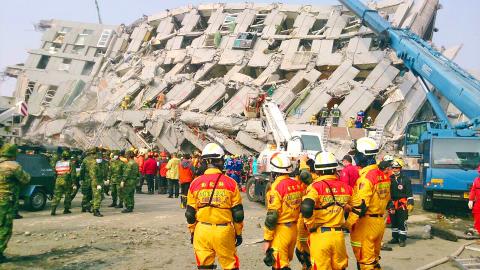
Photo courtesy of the Changhua County Fire Bureau
More than 400 people were injured, with over 60 hospitalized, across the city.
As of 8:30pm, the Central Emergency Operations Center said that among the 15 killed, 13 were found at the ruins of the Weiguan Jinlong apartment building, including a 10-day-old infant.
A water tower fell on a 56-year-old woman in Gueiren District (歸仁), and a man died after a cabinet fell on him.
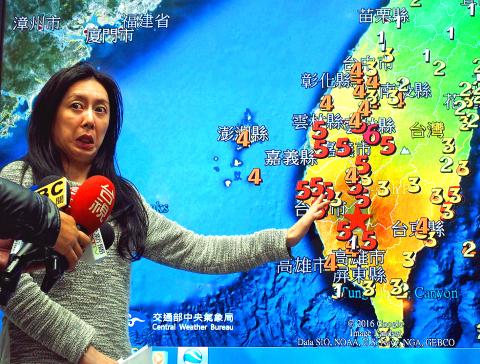
Photo: David Chang, EPA
There were also reports of people injured by falling debris. One man in Yunlin County broke his leg trying to escape by jumping out of a second-floor window.
Most people were asleep when the earthquake struck.
“[The building] first started shaking horizontally, then up and down, then a big shake right to left,” said Tainan resident Lin Bao-gui, a secondhand car salesman whose cars were smashed when the residential complex across the street from him collapsed. “I stayed in my bed, but jumped up when I heard the big bang that was the sound of the building falling.”
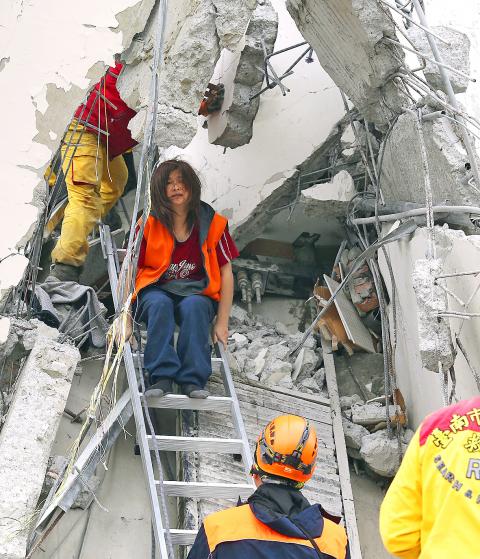
Photo: Patrick Lin, Reuters
The quake was centered in Kaohsiung’s Meinong District (美濃), at a depth of 17km, the Central Weather Bureau said. The strongest tremors, which had an intensity of 6 on the 0-7 seismic scale, were felt in Yunlin County, the bureau said. Kaohsiung, Pingtung, Tainan and Chiayi reported intensity 5, while Taitung, Penghu, Changhua, Nantou and Taichung felt level 4.
Strong aftershocks, which were centered in Tainan, were felt hours after the initial quake.
According to the National Fire Agency, the quake left about 400,000 households without water nationwide. Power outages affected about 121,000 residences in Tainan and hundreds in Kaohsiung.
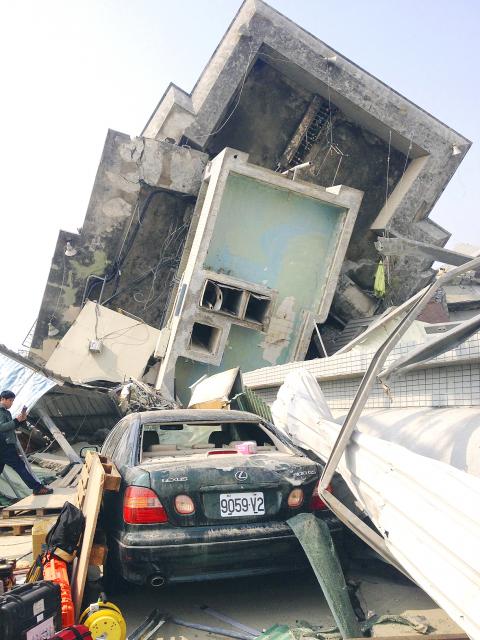
Photo: Gladys Tsai, AP
The government set up the Central Emergency Operations Center to coordinate relief efforts, sending helicopters as well as medical and rescue teams to the stricken areas.
President Ma Ying-jeou (馬英九) promised an all-out effort to rescue those trapped in collapsed buildings and to help survivors.
Ministry of National Defense officials said military units in southern Taiwan had mobilized 810 personnel, 11 medical teams, 24 teams equipped with breathing detection devices and 38 vehicles to join the search-and-rescue efforts.
Helicopters from the Army Aviation and Special Forces Command, based in Gueiren District, carried out aerial surveys, assisting ground crews in identifying priority disaster-relief zones and assessing damage, the ministry said.
The main defense troop detachment for southern Taiwan, the 8th Army Command, has also set up a joint military operations command center in Tainan to coordinate medical and rescue operations by various military units, it said.
Lieutenant General Chi Lien-cheng (季連成), who heads the 8th Army Command based in Kaohsiung’s Cishan District (旗山), said the army’s 54th Engineering Corps had deployed crane lifts and other heavy machinery to set up flood lights, enabling rescuers to work through the night as they search for people trapped in buildings.
Six medical teams from the 8th Army Command, along with five medical teams from the Kaohsiung Armed Forces General Hospital, arrived in Tainan, where they set up mobile field hospitals.
Officials from the air force’s 433rd Tactical Fighter Wing, which is headquartered at the Tainan Air Base, said it has turned the base into a temporary shelter that can accommodate up to 1,400 people whose houses were damaged by the quake.
The Ministry of Health and Welfare said it had launched six regional emergency operations centers at 4am yesterday and asked all hospitals to report the latest disaster relief situation.
Although the quake was felt throughout the nation, the most severe disaster was centered in Tainan. The first 72 hours after the quake are critical for rescuing people trapped under collapsed buildings, the ministry said, adding that 26 of its hospitals are participating in the emergency relief and support efforts.
Emergency relief is mainly provided by Tainan Hospital and its Sinhua Branch, while psychological trauma treatment is provided by Jianan Mental Hospital. Other hospitals will provide standby support, it added.
A 24-hour care and consultation hotline (0926-560-713) has been set up at the Jianan Mental Hospital, the ministry said.
The ministry has also set up a toll-free 24-hour care hotline (0800-788-995) for disaster victims who need psychological support.
The Financial Supervisory Commission said it had tasked the Taiwan Residential Earthquake Insurance Fund with coordinating with emergency response efforts. The commission also advised affected residents to notify their insurers to have their properties assessed for damage to expedite processing of their compensation claims.
Additional reporting by Ted Chen
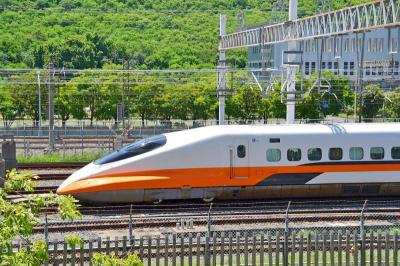
A signaling system malfunction disrupted high-speed rail (HSR) services beginning at 8am today, with trains temporarily reduced to three northbound and three southbound trains per hour as authorities conduct inspections. The malfunction occurred on a section of track in Miaoli County during pre-operation checks early this morning, forcing northbound and southbound trains to use a single track, the HSR operator said. The regular schedule has been replaced with three hourly trains offering only nonreserved seating in each direction, stopping at every station, it said, adding that business class cars would still have reserved seating. Departures from terminal stations are scheduled at the top

DRONE CENTRAL: Taiwan aims to become Asia’s democratic hub for drones, with most exports focused on high-quality military-grade models, an official said Taiwan’s drone industry is expected to expand significantly by 2030, producing 100,000 units per month and exporting half of them, the Ministry of Economic Affairs said yesterday. Current drone production capacity is about 15,000 units per month, but the industry can quickly scale up as demand increases, Industrial Development Administration Director-General Chiou Chyou-huey (邱求慧) told a news conference in Taipei. Taiwan’s drone output grew 2.5-fold last year to NT$12.9 billion (US$408.3 million) under a government program to develop the uncrewed vehicle sector, he said. The Executive Yuan in October last year approved plans to invest NT$44.2 billion into domestic production of uncrewed aerial
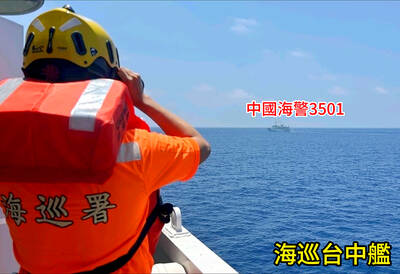
VERBOSE VESSELS: A CGA cutter and a China Coast Guard exchanged verbal barbs for more than a day in Taiwanese-controlled waters before the Chinese vessel left The Taiwanese and Chinese coast guards had a standoff near the strategically located Pratas Islands (Dongsha Islands, 東沙群島) in the north of the South China Sea, the Coast Guard Administration (CGA) said yesterday. The two sides engaged in intense radio exchanges over sovereignty claims during the 33-hour standoff. China Coast Guard vessel 3501 eventually left the restricted waters, 26.6 nautical miles (49.2km) west of the Pratas Islands, at 5pm yesterday, the CGA said. Lying approximately between southern Taiwan and Hong Kong, the Taiwan-controlled Pratas are seen by some security experts as vulnerable to Chinese attack due to their distance — more than
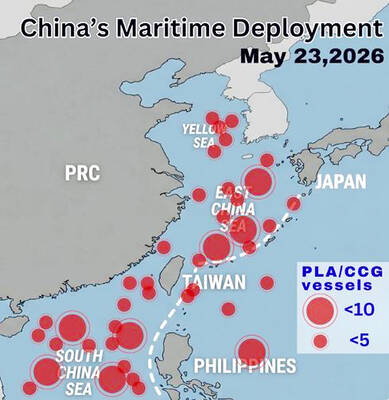
WARNING: China should stop engaging in actions that undermine regional peace and stability, as it would only build resentment among people across the Strait, the CGA said China has deployed more than 100 navy, coast guard and other vessels in waters from the Yellow Sea to the South China Sea and the western Pacific since US President Donald Trump and Chinese President Xi Jinping (習近平) met in Beijing, National Security Council Secretary-General Joseph Wu (吳釗燮) said yesterday. “In this part of the world, #China is the one & only PROBLEM wrecking the #StatusQuo & threatening regional peace & stability,” Wu wrote on X. In a separate post, he said Beijing was coercing Taiwan’s maritime domain, calling it illegal and provocative, after the Coast Guard Administration (CGA) expelled a


 RSS
RSS