

Legislative Yuan Secretary-General Lin Hsi-shan (林錫山) yesterday was detained for suspected corruption amid a probe into alleged irregularities in government procurements.
The Taipei District Prosecutors’ Office said Lin is suspected of having received more than NT$10 million (US$295,631) in kickbacks from Far Net Technologies Co (網遠科技), which won 32 computer and IT-related contracts at the Legislative Yuan amounting to NT$200 million.
Three other individuals were also detained as of last night, including Far Net Technologies owner Lin Pao-cheng (李保承) and sales manager Lin Ming-yu (林明玉), and Chen Liang-yin (陳亮吟), a section chief at the legislature’s Secretary-General’s Office.
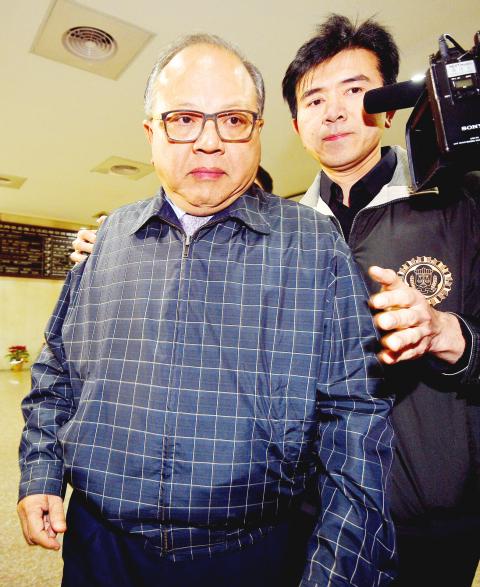
Photo: Lo Pei-der, Taipei Times
The four are being questioned over alleged violations of the Anti-Corruption Act (貪污治罪條例) and the Government Procurement Act (政府採購法), as well as accepting bribes, receiving improper benefit in contravention of their official duty and leaking secrets, Deputy Chief Prosecutor Chang Chieh-chin (張介欽) said.
He said that all four are being held incommunicado due to the risk that they might collude on testimony, destroy evidence or flee from prosecution.
Chang said that more than 160 people, including police officers, prosecutors and investigators, were involved in the raids on 19 locations on Tuesday and that more than NT$6 million was found at Lin Hai-shan’s office and his residence, which prosecutors suspect came from kickbacks from Far Net.
Nine others taken in for questioning on Tuesday were released yesterday after posting bail, including Lin Hsi-shan’s wife, Liu Hsin-wei (劉馨蔚), who was freed on NT$2 million bail; Lin’s secretary Tsai Pin-chuan (蔡斌全), freed on NT$100,000 bail; and Chen Lu-sheng (陳露生), a former section chief at the Legislative Yuan’s Information Technology Office, released on NT$500,000 bail.
Prosecutors said Lin Hsi-shan, Far Net and other officials were placed under surveillance in December 2013 as part of an investigation into allegations of graft and bid-rigging dating back to 2012.
Chang said Lin Hsi-shan allegedly ordered the heads of the Information Technology Office and its staff to cooperate with Far Net on a number of open public tenders for computer and IT-related procurement projects, where the technical specifications, equipment requirements, minimum bid price, details of tender contract, allocated budget and bids by competing companies were leaked to the firm.
Prosecutors said that while under surveillance, Lin Hsi-shan allegedly received NT$7 million in a brown envelope from an intermediary sent by Far Net as the pair took a Taiwan High Speed Rail train journey in January last year.

Taiwan, which accounts for more than half of the global outsourced semiconductor assembly and testing market, is well-positioned to develop copackaged optics (CPO) and manufacture precision silicon photonics chips, the Ministry of Economic Affairs said yesterday. Silicon photonics are emerging as a mainstream optical communications technology and is seen as key to overcoming bottlenecks in AI computing power. The technology is a key project under the government’s New 10 Major AI Infrastructure Projects, with industry, government, academia and research institutions working to overcome critical technological hurdles and build a self-reliant silicon photonics supply chain, the ministry said. Nvidia Corp in March invested US$4
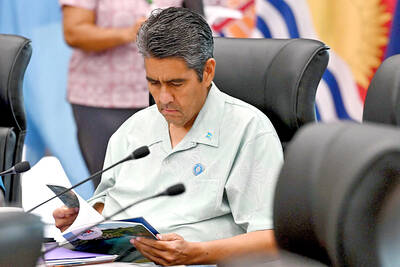
Palau’s president yesterday called for a “unified” Pacific response to a missile test by China in July, while Taiwan and its Pacific allies a day earlier at the Pacific Islands Forum (PIF) reaffirmed their commitment to peace, stability and prosperity. China gave only a handful of nations short notice before test-firing an intercontinental ballistic missile in July, sparking condemnation from several Pacific leaders. The 18-member PIF being held in Palau was expected to release a communique after press time last night, with a formal response to the test possibly included. Palau, which invited Taiwan to attend sideline events as an aid partner, urged
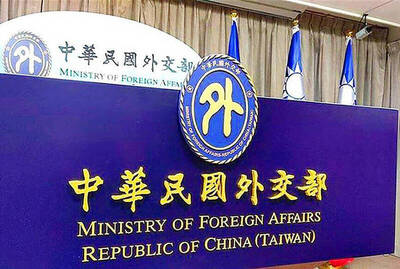
China’s continued efforts to inject geopolitical rivalry into the region and disrupt Pacific nations’ discussions of regional issues warrant greater international attention, a foreign affairs official said yesterday. Minister of Foreign Affairs Lin Chia-lung (林佳龍) last week led a delegation to diplomatic ally Palau to attend events related to the 55th Pacific Islands Forum (PIF) summit. However, the absence of some member-state leaders has been interpreted by some people as a sign of fracturing in Pacific unity. Thirteen PIF members were represented by their heads of state or government, while Fiji, New Caledonia, Vanuatu and Samoa sent ministerial-level representatives, a diplomatic official
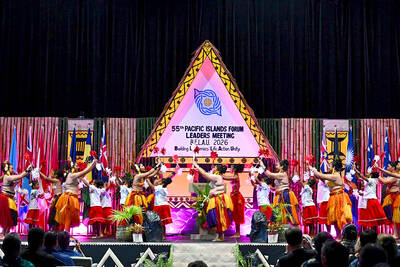
STATE DEPARTMENT: A US official said that Washington would provide more than US$150m for Pacific island nations, with Minister Lin Chia-lung welcoming the plans The US Department of State has announced partnerships with Taiwan on two Palau projects after Washington pledged more than US$150 million for Pacific island nations. Following the opening of the 55th Pacific Islands Forum (PIF) Leaders Meeting in Palau on Sunday, the department on Tuesday issued a statement titled “Promoting Pacific Prosperity: US Engagement at the Pacific Islands Forum,” which said that the US’ commitment to the security and prosperity of Pacific island nations “is steadfast and enduring, and remains a core pillar of its ‘America first’ foreign policy.” Meanwhile, US Deputy Secretary of State Christopher Landau announced at the PIF Partners


 RSS
RSS