


Hundreds of residents of Hong Kong have flown to Taiwan for Saturday’s elections to see free-wheeling democracy in action.
Politicians, students and “Umbrella soldiers” — activists who used umbrellas to fend off tear gas canisters during 79 days of street demonstrations in the former British colony in 2014 — signed up for tours to meet candidates, visit polling stations and join boisterous election rallies across Taiwan.
“You can watch and learn from Taiwan’s political culture ... and witness the elections with your own eyes,” Hong Kong-based Hong Thai Travel Services wrote in a commercial to lure takers for a sold-out four-day tour.
China allowed a direct vote for Hong Kong’s chief executive in 2017, but only from among pre-screened, pro-Beijing candidates, which the protesters denounced as a sham.
The Beijing-backed electoral reform was vetoed by Hong Kong’s legislature last year.
China has held out “one country, two systems” as a solution for Taiwan, but both the Chinese Nationalist Party (KMT) and the Democratic Progressive Party (DPP) have rejected the model.
The Hong Kong protests, which blocked key arteries, posed the biggest political challenge and embarrassment in years for Beijing’s Chinese Communist Party leaders, who are likely to be angered by Hong Kong tourists learning about democracy from their long-time foe.
Wang Dan (王丹), a student leader during the 1989 democracy movement in and around Beijing’s Tiananmen Square that was crushed by the military, who now lives in Taiwan, is to host groups of Hong Kong visitors at his “New School for Democracy” that advocates the democratization of China.
He said the issue was not the law that Beijing lays down to decide the next chief executive of Hong Kong, but rather the work for political change from the bottom up, even if it takes many more years.
“The only hope for Hong Kong’s future is election, not a fight on the street,” he said. “The [Taiwan] election is very important after the Umbrella Revolution. Hong Kong feels very desperate, that its future is not bright, but gradually they will see there is another way.”
Already there are fears that many of the freedoms promised to the territory are being eroded. Thousands of people took to the streets of Hong Kong on Sunday in a reprise of the anti-China protests, demanding to know the whereabouts of five missing people linked to a local publisher of books critical of Beijing’s leadership.
Other publishers and book vendors are unnerved by the mysterious disappearances, and in some cases they have pulled books critical of Beijing’s leaders from their shelves.
The nation votes in a new president and parliament on Saturday, when the KMT is expected to be defeated by the DPP, a party Beijing loathes.
The elections in Taiwan involve a diverse bunch of candidates, with a former gangster, a Chinese dissident and heavy-metal singer running for legislative seats.
“Taiwan is the only Chinese community in the world that practices democracy,” said Benny To (杜浩邦) a lecturer from Hong Kong’s Community College of City University, who is leading a group of 36 students to Taiwan. “There is something we can observe and learn from critically.”
High on the itinerary for the Hong Kong tourists are the campaign headquarters of DPP presidential candidate Tsai Ing-wen (蔡英文), likely to become the nation’s first female president.
“The Taiwan election is a motivation for us to keep moving towards the goal of democracy,” said Nathan Law (羅冠聰), a student leader in the Hong Kong protests that sparked what many residents saw as a political awakening. “[In Hong Kong,] many politicians, including the chief executive, are not elected by us. It’s really depressing.”
A Chinese student from the University of Hong Kong, on a six-day trip to Taiwan, said she was hoping to meet presidential candidates during their last campaign stops.
“It’s like a dream come true,” she said.

‘NO SECURITY RISK’: The Railway Bureau reassured the public that the technicians’ activities were limited to technical guidance and did not involve sensitive systems The Railway Bureau yesterday said it had invited eight Chinese technicians to assist with an airport MRT construction project. The bureau issued the confirmation after an Internet user said Chinese nationals had entered the construction zone of Taiwan Taoyuan International Airport’s Terminal 3 project. They asked why “individuals from an enemy state” were allowed access to such a major national infrastructure project, which raised serious concerns over Taiwan’s industrial safety, sensitive systems and information security. The bureau’s Northern Region Engineering Branch Office said subcontractor Taiwan Handle Industrial Co (台灣手把工業) of the Taoyuan airport MRT’s “Contract No. CU05 Project A14 Station Civil, MEP &

A US uncrewed surface vessel (USV) encountered multiple Chinese warships during an autonomous transit of the Taiwan Strait, US defense company Seasats said in a statement on Wednesday. Seasats announced that a Lightfish USV had completed the first autonomous transit of the Taiwan Strait. Over five days, the USV traversed the entire length of the Strait while constantly monitoring surface vessel traffic, the company said. The Lightfish encountered multiple Chinese warships, one of which was a Chinese People’s Liberation Army Navy (PLAN) Type 056 corvette, it said. The Chinese vessels were operating “well within Taiwan’s exclusive economic zone without transmitting their identity via the
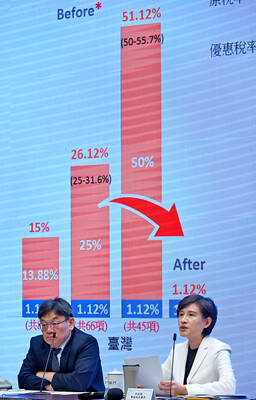
GREATER REACH? Auto parts and wood products would face tariffs of up to 15%, matching those targeting the EU, Japan and South Korea, Vice Premier said The US has announced that preferential tariff treatment for Taiwan’s non-semiconductor Section 232 goods would take effect retroactively from May 1, the Executive Yuan said yesterday. The US government yesterday posted a notice on the Federal Register’s public inspection Web site previewing tariff concessions for Taiwan under a memorandum of understanding (MOU) on Taiwan-US investment after two months of negotiations. The MOU signed on Jan. 15 stipulated three major preferential tariff arrangements: a 15 percent “reciprocal” tariff rate for Taiwan without stacking most-favored nation (MFN) rates; preferential Section 232 treatment for semiconductors and related products; and preferential Section 232 treatment for non-semiconductor

The National Chungshan Institute of Science and Technology yesterday showcased its locally developed variants of the Vision 60 robotic patrol dog, which it plans to deploy on the nation’s outlying territories in the South China Sea. The variants were produced under the Joint Lab project — created by the institute and domestic companies — and assembled with domestically produced motors, lenses and artificial intelligence (AI) systems alongside licensed tech from the US, Missile and Rocket Systems Research Division deputy director Jen Kuo-kang (任國光) told the media event at a military base in Taipei’s Dazhi (大直) area. Taiwan has built up its strengths


 RSS
RSS