


The three presidential candidates yesterday exchanged barbs in their first televised debate, putting the spotlight on cross-strait relations while engaging in finger-pointing over several contentious issues.
The closely watched presidential debate, broadcast by Public Television Service (PTS), began at 2pm with each candidate delivering an eight-minute opening remark.
That was followed by questions from five media representatives, including Liberty Times (the Taipei Times’ sister paper) deputy editor-in-chief Tzou Jiing-wen (鄒景雯), Central News Agency vice president and editor-in-chief Sheena Chang (張慧英), United Daily News editor-in-chief Yu Mei-yueh (游美月), China Times deputy director-in-chief James Chang (張景為) and Apple Daily Policy and Political Center executive vice president Kuo Shu-min (郭淑敏).
Photo: CNA
The candidates posed three questions each to their opponents in the third part of the debate, before making concluding remarks.
During the third part of the debate, People First Party (PFP) candidate James Soong (宋楚瑜) asked Chinese Nationalist Party (KMT) candidate Eric Chu (朱立倫) whether he would be able to keep a leash on senior KMT members who have served as cross-strait compradors to the detriment of small and medium-sized businesses.
“It is my belief that cross-strait ties must be forged based on the principles of openness, transparency and institutionalization,” Chu said. “Throughout my political career, I have never tolerated backroom dealings of any sort, whether in cross-strait relations or other exchanges.”
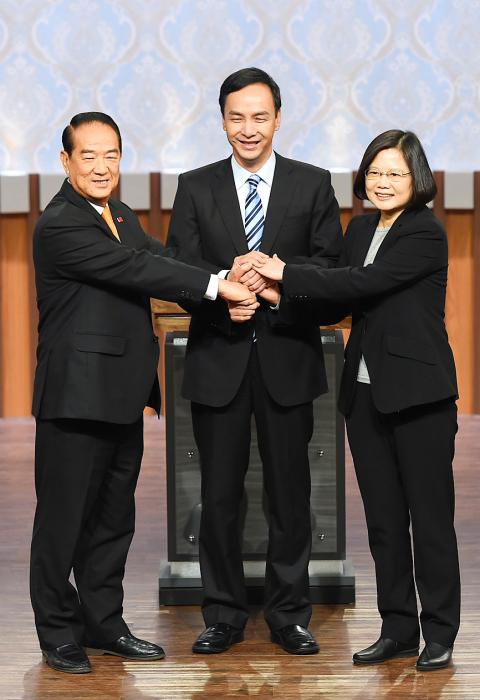
Photo: Chang Chia-ming, Taipei Times
Chu said he would show respect to senior KMT members and consider other opinions.
Chu asked Democratic Progressive Party (DPP) presidential candidate Tsai Ing-wen (蔡英文) whether she accepts the so-called “1992 consensus,” saying her ambiguous stance on the issue has left Taiwanese and the international community bewildered.
The “1992 consensus” refers to a tacit understanding between the KMT and the Chinese Communist Party (CCP) that both sides of the Taiwan Strait acknowledge there is “one China,” with each side having its own interpretation of what “China” means. Former KMT lawmaker Su Chi (蘇起) admitted making up the term in 2000 when he was head of the Mainland Affairs Council.
“There is a saying: ‘You cannot wake up someone who is only pretending to be asleep.’ I have clearly explained my stance on the consensus, including during my speech at the Center for Strategic and International Studies in Washington” in June, Tsai said.
Tsai said her goal would be to develop the cross-strait relationship within the Republic of China’s (ROC) constitutional framework and in accordance with public opinion and the nation’s democratic mechanisms, while building ties on achievements accumulated over the past two decades.
“Have I not explained it clearly enough?” Tsai asked. “I have acknowledged that cross-strait talks were held in 1992 for the purpose of furthering cross-strait ties by forging mutual understanding and seeking common ground, while reserving differences. Have I not been clear?”
“It is just that the term did not exist in 1992 and was only created in 2000. I think we should all sit down to discuss the use and interpretation of the term,” she said.
Chu shook his head eight times during Tsai’s response.
Tsai asked Chu whether he would continue President Ma Ying-jeou’s (馬英九) cross-strait policy, which she said has been dominated by the KMT and the CCP, while being marred by back-room dealings and compradors.
She said that Chu’s description of cross-strait relations during his May visit to China as two sides “belonging to one China” runs counter to mainstream public opinion.
“I have told you not to take things out of context. It is a dangerous thing to do when it comes to cross-strait ties,” Chu replied. “The KMT’s stance is to adhere to the 1992 consensus and the notion of one China, with different interpretations. This is our stance and it has never changed.”
Soong said that as Taiwan cannot afford to directly confront China, it should resort to pragmatic policies and seek broader cross-strait cooperation, mutual understanding and exchanges.
Drawing a parallel between Chu and Ma, Tsai questioned Chu’s ability to lead the nation and gain public trust, citing his promise to serve out his term as New Taipei City mayor and the controversial move in October to force the KMT’s previous presidential candidate, Deputy Legislative Speaker Hung Hsiu-chu (洪秀柱) — who was nominated through the party’s democratic primary mechanism — out of the race.
“What choice did I have when I know for certain that Taiwan will descend into misery should the DPP regain power and that many people could lose their jobs if Chairperson Tsai takes office?” Chu asked.
Chu said his decision to run was backed by an elderly woman he met during a trip to New Taipei City’s Tamsui District (淡水).
She told Chu “the gods will not forgive you if you do not run. You must do this for Taiwan and not think about yourself,” he said.
“Chairperson Tsai has yet to apologize for the corruption, mistakes and waste of national resources that occurred during the DPP’s eight years in power,” Chu said, adding that the DPP has ostensibly taken delight in criticizing and humiliating public servants.
Tsai said the DPP lacked administrative experience when it took over power from the KMT in 2000, adding that Chu had high disapproval ratings as New Taipei City mayor.
“We have reflected on ourselves ... and DPP members heading the six cities and counties [before last year’s nine-in-one elections] were often polled as the best-performing local leaders,” Tsai said. “On the contrary, Chu has repeatedly been ranked at the bottom.”
Chu asked Tsai how she plans to clamp down on land speculation and uphold housing justice when her family has reaped handsome profits from speculative sales of several plots of land in Taipei.
“I have offered a detailed explanation of the matter. Those [investments] were made by my father, who built his fortune from nothing and like many people of his generation saved up hard-earned money and purchased land as an investment,” Tsai said.
“All of his transactions are open and above board,” Tsai said, urging Chu to stop hiding behind others and publish his campaign expenditures.

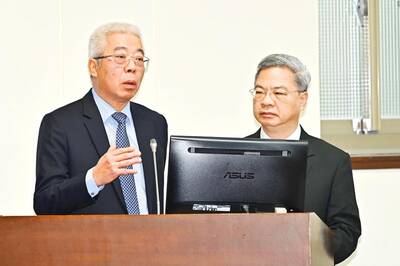
Taiwan has arranged for about 8 million barrels of crude oil, or about one-third of its monthly needs, to be shipped from the Red Sea this month to bypass the Strait of Hormuz and ease domestic supply pressures, CPC Corp, Taiwan (CPC, 台灣中油) said yesterday. The state-run oil company has worked with Middle Eastern suppliers to secure routes other than the Strait of Hormuz, through which about 20 percent of the world’s oil and liquefied natural gas typically passes, CPC chairman Fang Jeng-zen (方振仁) said at a meeting of the legislature’s Economics Committee in Taipei. Suppliers in Saudi Arabia have indicated they
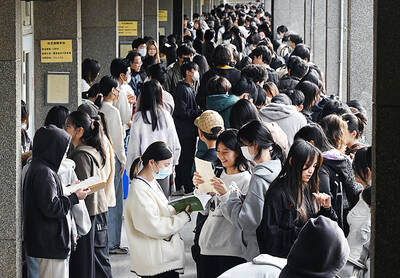
A global survey showed that 60 percent of Taiwanese had attained higher education, second only to Canada, the Ministry of the Interior said. Taiwan easily surpassed the global average of 43 percent and ranked ahead of major economies, including Japan, South Korea and the US, data from the Organisation for Economic Co-operation and Development (OECD) for 2024 showed. Taiwan has a high literacy rate, data released by the ministry showed. As of the end of last year, Taiwan had 20.617 million people aged 15 or older, accounting for 88.5 percent of the total population, with a literacy rate of 99.4 percent, the data
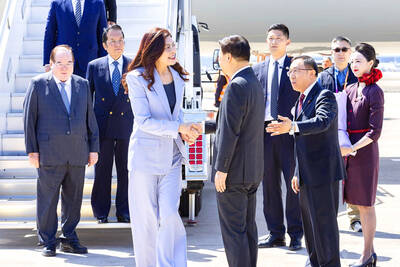
CCP ‘PAWN’? Beijing could use the KMT chairwoman’s visit to signal to the world that many people in Taiwan support the ‘one China’ principle, an academic said Chinese Nationalist Party (KMT) Chairwoman Cheng Li-wun (鄭麗文) yesterday arrived in China for a “peace” mission and potential meeting with Chinese President Xi Jinping (習近平), while a Taiwanese minister detailed the number of Chinese warships currently deployed around the nation. Cheng is visiting at a time of increased Chinese military pressure on Taiwan, as the opposition-dominated Legislative Yuan stalls a government plan for US$40 billion in extra defense spending. Speaking to reporters before going to the airport, Cheng said she was going on a “historic journey for peace,” but added that some people felt uneasy about her trip. “If you truly love Taiwan,

NEW LOW: The council in 2024 based predictions on a pessimistic estimate for the nation’s total fertility rate of 0.84, but last year that rate was 0.69, 17 percent lower An expected National Development Council (NDC) report expects the nation’s population to drop below 12 million by 2065, with the old-age dependency ratio to top 100 percent sooner than 2070, sources said yesterday. The council is slated to release its latest population projections in August, using an ultra-low fertility model, the sources said. The previous report projected that Taiwan’s population would fall to 14.37 million by 2070, but based on a new estimate of the total fertility rate (TFR) — the average number of children born to a woman over her lifetime — the population is expected to reach 12 million by


 RSS
RSS