


The air quality in western parts of the nation yesterday reached an unhealthy level, with the index for fine particulate matter smaller than 2.5 micrometers (PM2.5) hitting hazardously high levels, the Environmental Protection Administration (EPA) said.
Except for Hualien and Taitung counties, other parts of Taiwan saw hazardous air quality levels, with most of the EPA’s monitoring stations in western Taiwan yesterday morning recording a level of 10 on the 1 to 10 PM2.5 index.
Level 10 on the index represents a PM2.5 concentration of 71 micrograms per cubic meter or above. Measurements above level 7 on the index (54 to 58 micrograms per cubic meter) are considered severe enough to cause tangible discomfort and health problems.

Photo: Tung Chen-kuo, Taipei Times
The poor air quality was attributed to a cold air front moving into Taiwan from the northwest that brought with it pollutants from China, the EPA said.
The air quality was expected to improve in northern Taiwan, beginning yesterday afternoon, but remain poor in the center and the south for a few more days because of local pollutants from factories and a lack of conditions enabling the pollutants to disperse, it said.
A coal-fired unit at the Taichung Power Plant was shut down Tuesday night in a bid to reduce pollutants, the agency said.
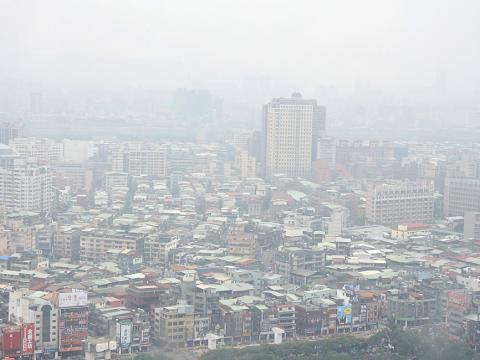
Photo: Lai Hsiao-tung, Taipei Times
The EPA reiterated its advice that the elderly and those with chronic lung problems or heart disease should avoid prolonged outdoor activity while the PM2.5 index is so high, and that everyone should wear facial masks outside.
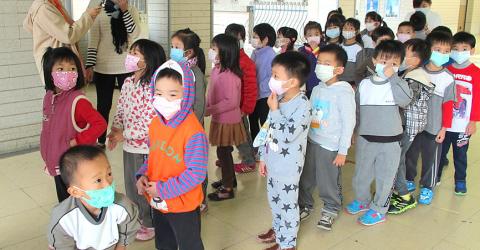
Photo: CNA
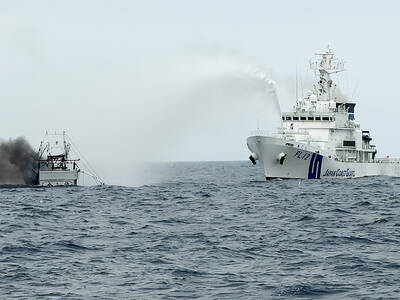
CREDIT-GRABBER: China said its coast guard rescued the crew of a fishing vessel that caught fire, who were actually rescued by a nearby Taiwanese boat and the CGA Maritime search and rescue operations do not have borders, and China should not use a shipwreck to infringe upon Taiwanese sovereignty, the Coast Guard Administration (CGA) said yesterday. The coast guard made the statement in response to the China Coast Guard (CCG) saying it saved a Taiwanese fishing boat. The Chuan Yu No. 6 (全漁6號), a fishing vessel registered in Keelung, on Thursday caught fire and sank in waters northeast of Diaoyutai Islands (釣魚台). The vessel left Keelung’s Badouzih Fishing Harbor (八斗子漁港) at 3:35pm on Sunday last week, with seven people on board — a 62-year-old Taiwanese captain surnamed Chang (張) and six

The Legislative Yuan’s Finance Committee yesterday approved proposed amendments to the Amusement Tax Act (娛樂稅法) that would abolish taxes on films, cultural activities and competitive sporting events, retaining the fee only for dance halls and golf courses. The proposed changes would set the maximum tax rate for dance halls and golf courses at 50 and 20 percent respectively, with local governments authorized to suspend the levies. Article 2 of the act says that “amusement tax shall be levied on tickets sold or fees charged by amusement places, facilities or activities” in six categories: “Cinema; professional singing, story-telling, dancing, circus, magic show, acrobatics

RISKY BUSINESS: The ‘incentives’ include initiatives that get suspended for no reason, creating uncertainty and resulting in considerable losses for Taiwanese, the MAC said China’s “incentives” failed to sway sentiment in Taiwan, as willingness to work in China hit a record low of 1.6 percent, a Ministry of Labor survey showed. The Directorate-General of Budget, Accounting and Statistics (DGBAS) also reported that the number of Taiwanese workers in China has nearly halved from a peak of 430,000 in 2012 to an estimated 231,000 in 2024. That marked a new low in the proportion of Taiwanese going abroad to work. The ministry’s annual survey on “Labor Life and Employment Status” includes questions respondents’ willingness to seek employment overseas. Willingness to work in China has steadily declined from

Tainan, Taipei and New Taipei City recorded the highest fines nationwide for illegal accommodations in the first quarter of this year, with fines issued in the three cities each exceeding NT$7 million (US$220,639), Tourism Administration data showed. Among them, Taipei had the highest number of illegal short-term rental units, with 410. There were 3,280 legally registered hotels nationwide in the first quarter, down by 14 properties, or 0.43 percent, from a year earlier, likely indicating operators exiting the market, the agency said. However, the number of unregistered properties rose to 1,174, including 314 illegal hotels and 860 illegal short-term rental


 RSS
RSS