


Chinese Nationalist Party (KMT) vice presidential candidate Jennifer Wang (王如玄) yesterday pledged to donate all profits she has made from sales of military housing units, amid mounting pressure for her to provide the public with a clear explanation of the controversy.
Against the background of two large boards covered with property declaration documents that she and her husband have filed since 1993, Wang said she decided to hold a press conference in Taipei to clear up the matter after seeing KMT supporters confused or misled by “unsubstantiated allegations” leveled by the Democratic Progressive Party (DPP).
“Even now, some people still mistakenly believe that I own 19 military apartments, or that I have made NT$300 million [US$9.08 million] in profits from selling military apartments,” Wang said.
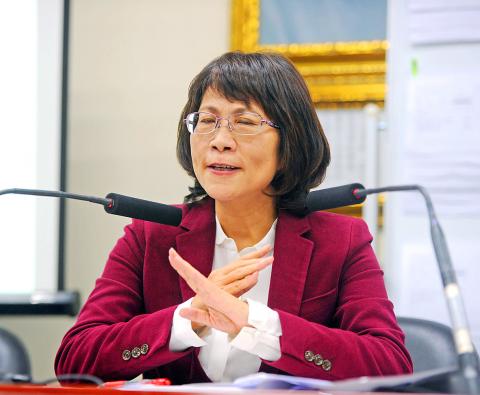
Photo: CNA
She said her family currently owns only three military housing units, with one each registered under the names of her husband, mother and sister.
However, she added that she had purchased a total of nine military apartments between 1995 and 2003, seven of which were bought for investment purposes and two for self-occupation.
“All the property transactions were reported to relevant authorities in accordance with sunshine laws,” Wang said, adding that she was willing to subject herself to public scrutiny.
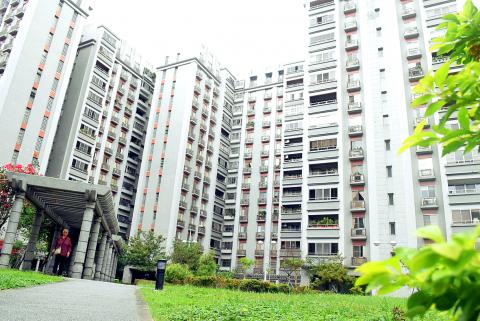
Photo: Chen Wei-tsung, Taipei Times
According to information provided by Wang, the seven investment properties included two units in the Ren Ai Xin Cheng (仁愛新城) residential complex in Taipei’s Zhongzheng District (中正), which were sold in 1997 and 2000, and generated a profit of NT$660,000 and NT$6.31 million respectively; and one unit in the Shi Mao Xin Cheng (世貿新城) complex in Taipei’s Xinyi District (信義), sold in 2003 for a profit of NT$700,000.
They also included one unit in the Jian Jun Xin Cheng (健軍新城) complex in Taipei’s Zhongzheng District, sold in 2002 for a NT$1.5 million profit; one unit in the Dun Hua Xin Cheng (敦化新城) complex in Taipei’s Songshan District (松山), sold in 2003 for a NT$3.63 million profit; and two units in the Da Peng Xin Cheng (大鵬新城) complex in New Taipei City’s Sindian District (新店), both sold in 2000 for a profit of NT$600,000 and NT$400,000 respectively.
The two self-occupied units were part of the Da Peng Xin Cheng complex, which were combined into a single unit and where Wang and her husband had lived for six years since their respective acquisitions in 1998 and 2000. The properties were resold in 2007 for a profit of NT$7.4 million.
Wang said she would donate the combined profit of NT$13.8 million she made from sales of the seven investment properties.
However, since the money she gained from the two self-occupied apartments were later used to purchase a military housing unit in the Jian Hua Xin Cheng (健華新城) complex in New Taipei City’s Banciao District (板橋) — which is currently registered under the name of Wang’s husband and meant to serve as their home after retirement — the NT$7.4 million profit was not an investment gain and would not be given away, Wang said.
Wang, who served as minister of the Council of Labor Affairs from May 2008 to September 2012, previously only acknowledged having bought five government-subsidized military apartments, including the three units still owned by her family and the two self-occupied Da Peng Xin Cheng houses.
She had been reluctant to hold a press conference to answer reporters’ questions on the matter, until KMT presidential campaign manager Jason Hu (胡志強) said on Monday that the controversy had taken a toll on the KMT’s election prospects.
At the press conference, Wang, a lawyer, denied that some owners of the military apartments might have been forced to sell her their properties.
“None of them were coerced or deceived... If there are any military housing owners who have been tricked or bulldozed into selling their houses, or seen their rights and interests encroached upon, I am willing to offer my legal assistance,” Wang said.
Wang said she has been under tremendous pressure due to fears that her real-estate dealings might affect the KMT’s campaign, adding that she joined the election to help the disadvantaged and never thought she would be subjected to sustained mudslinging and character assassination.
She was overwhelmed with emotion as she talked about how the intense media coverage has caused her mother to suffer heart problems and depression.
“My mother and sister are afraid of going home because of the reporters stationed outside. Sometimes they just wander around outside for an entire day,” Wang said, begging the public to leave her family alone.
Wang reiterated that all her property dealings were legal, but apologized for causing an outcry and letting the presidential campaign drift away from what was really important.
Television show host and political commentator Cheng Hung-yi (鄭弘儀) raised four questions regarding Wang’s explanation later yesterday.
“First, Wang said before that the property deals involved only five military apartments. Why it is 12 units now?” Cheng asked.
“Second, who can prove that she only made NT$13.8 million in profits from the sales of the [seven] military houses?” Cheng asked.
“Third, is it difficult to visit a local tax bureau and apply for copies of the tax returns she filed [for public scrutiny]?” he said.
“Fourth, Wang was appointed a member of the Ministry of National Defense’s Legal Rights Protection Commission of the Republic of China Military Forces in 2005, but she still purchased a military housing unit that year. Did she feather her own nest? Or did she exploit her position for profits?” Cheng said.

‘NO SECURITY RISK’: The Railway Bureau reassured the public that the technicians’ activities were limited to technical guidance and did not involve sensitive systems The Railway Bureau yesterday said it had invited eight Chinese technicians to assist with an airport MRT construction project. The bureau issued the confirmation after an Internet user said Chinese nationals had entered the construction zone of Taiwan Taoyuan International Airport’s Terminal 3 project. They asked why “individuals from an enemy state” were allowed access to such a major national infrastructure project, which raised serious concerns over Taiwan’s industrial safety, sensitive systems and information security. The bureau’s Northern Region Engineering Branch Office said subcontractor Taiwan Handle Industrial Co (台灣手把工業) of the Taoyuan airport MRT’s “Contract No. CU05 Project A14 Station Civil, MEP &

A US uncrewed surface vessel (USV) encountered multiple Chinese warships during an autonomous transit of the Taiwan Strait, US defense company Seasats said in a statement on Wednesday. Seasats announced that a Lightfish USV had completed the first autonomous transit of the Taiwan Strait. Over five days, the USV traversed the entire length of the Strait while constantly monitoring surface vessel traffic, the company said. The Lightfish encountered multiple Chinese warships, one of which was a Chinese People’s Liberation Army Navy (PLAN) Type 056 corvette, it said. The Chinese vessels were operating “well within Taiwan’s exclusive economic zone without transmitting their identity via the
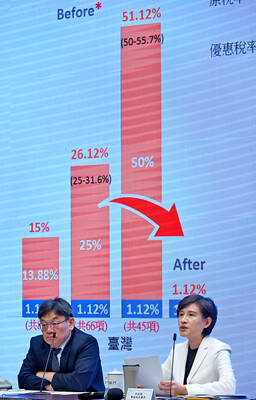
GREATER REACH? Auto parts and wood products would face tariffs of up to 15%, matching those targeting the EU, Japan and South Korea, Vice Premier said The US has announced that preferential tariff treatment for Taiwan’s non-semiconductor Section 232 goods would take effect retroactively from May 1, the Executive Yuan said yesterday. The US government yesterday posted a notice on the Federal Register’s public inspection Web site previewing tariff concessions for Taiwan under a memorandum of understanding (MOU) on Taiwan-US investment after two months of negotiations. The MOU signed on Jan. 15 stipulated three major preferential tariff arrangements: a 15 percent “reciprocal” tariff rate for Taiwan without stacking most-favored nation (MFN) rates; preferential Section 232 treatment for semiconductors and related products; and preferential Section 232 treatment for non-semiconductor

The National Chungshan Institute of Science and Technology yesterday showcased its locally developed variants of the Vision 60 robotic patrol dog, which it plans to deploy on the nation’s outlying territories in the South China Sea. The variants were produced under the Joint Lab project — created by the institute and domestic companies — and assembled with domestically produced motors, lenses and artificial intelligence (AI) systems alongside licensed tech from the US, Missile and Rocket Systems Research Division deputy director Jen Kuo-kang (任國光) told the media event at a military base in Taipei’s Dazhi (大直) area. Taiwan has built up its strengths


 RSS
RSS