


Ministry of National Defense Political Warfare Bureau Director Wen Chen-kuo (聞振國) yesterday pledged to review all dealings involving military housing units to ascertain whether any of them were sold during the five-year prohibition period.
Wen was responding to a request made by Democratic Progressive Party (DPP) Legislator Chiu Chih-wei (邱志偉) at a question-and-answer session at a meeting of the legislature’s Foreign and National Defense Committee in Taipei yesterday, during which Chiu urged the ministry to take a stance against real-estate agents’ blatant promotion of military apartment sales.
“Since the promulgation of the Act for Rebuilding Old Quarters for Military Dependents (國軍老舊眷村改建條例) in 1996, [owners of military houses] are barred from transferring the units to another person within five years of the registration of the property,” Wen said.

Photo: CNA
The ministry is entitled to repossess units sold or transferred during the five-year prohibition period, Wen said, adding that the ministry is not aware of any owner who has broken the law.
“Prearranged sales agreements do not show up in land administration records. They can only be detected by reviewing tax returns or property declaration documents,” Wen said, vowing to launch a thorough investigation.
Wen made the remarks amid the controversy surrounding Chinese Nationalist Party (KMT) vice presidential candidate Jennifer Wang’s (王如玄) alleged speculative sales of several military housing units.
DPP Legislator Tuan Yi-kang (段宜康) has alleged that Wang purchased at least 19 military housing units, which were subsidized and converted by the government from old housing for military dependents for the sole purpose of improving their living conditions and providing housing for military veterans.
Tuan has also accused Wang of dodging the five-year ban by brokering transactions in which the buyer makes a cash payment or provides a promissory note in exchange for the future ownership of the property after the five-year prohibition period.
Wang retaliated by filing a slander lawsuit against Tuan on Wednesday.
On the sidelines of the meeting, Minister of National Defense Kao Kuang-chi (高廣圻) also promised to re-evaluate the Act for Rebuilding Old Quarters for Military Dependents and to lay down further restrictions.
“The ministry has been reviewing the law and working to devise ways to prevent prearranged sales since the Control Yuan pointed out the issue in 2013,” Kao said.
Kao said he had no comment about Wang’s personal conduct, but said that the intention of the act is to take care of residents of old military dependents’ villages, military veterans and active military personnel.
Separately yesterday, KMT presidential candidate Eric Chu (朱立倫) defended his selection of Wang as his running mate, saying that what the public cares about are Wang’s long-term efforts on the rights of women and disadvantaged people, as well as improving workers’ rights.
“The DPP’s negative campaign tactics are detrimental to Taiwanese democracy,” Chu said.

LEVERAGE: China did not ‘need to fire a shot’ to deny Taiwan airspace over Africa when it owns ‘half the continent’s debt,’ a US official said, calling it economic warfare The EU has raised concerns about overflight rights following the delay of President William Lai’s (賴清德) planned state visit to the Kingdom of Eswatini after three African nations denied overflight clearance for his charter at the last minute. Taiwanese allies Paraguay and Saint Kitts and Nevis, as well as several US lawmakers and the Inter-Parliamentary Alliance on China (IPAC) condemned China for allegedly pressuring the countries. Lai was scheduled to fly directly to Taiwan’s only African ally from yesterday to Sunday to celebrate the 40th anniversary of King Mswati III’s accession and his 58th birthday, but Seychelles, Mauritius and Madagascar suddenly revoked
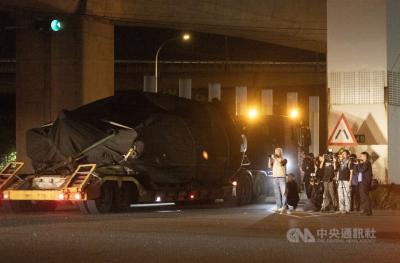
The final batch of 28 M1A2T Abrams tanks purchased from the US arrived at Taipei Port last night and were transported to the Armor Training Command in Hsinchu County’s Hukou Township (湖口), completing the military’s multi-year procurement of 108 of the tanks. Starting at 12:10am today, reporters observed more than a dozen civilian flatbed trailers departing from Taipei Port, each carrying an M1A2T tank covered with black waterproof tarps. Escorted by military vehicles, the convoy traveled via the West Coast Expressway to the Armor Training Command, with police implementing traffic control. The army operates about 1,000 tanks, including CM-11 Brave Tiger
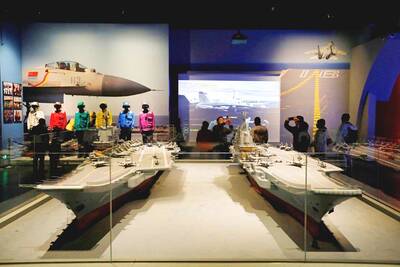
China on Wednesday teased in a video an aircraft carrier that could be its fourth, and the first using nuclear power, while making an allusion to Taiwan and vowing to further build up its islands, as it looks to boost maritime power, secure resources and bolster territorial claims. The video, issued on the eve of the 77th founding anniversary of the Chinese People’s Liberation Army Navy, featured fictional officers with names that are homophones of three commissioned aircraft carriers, the Liaoning (遼寧), Shandong (山東) and Fujian (福建). Titled Into the Deep, it showed a 19-year-old named “Hejian” (何劍) joining the group, sparking
BIG YEAR: The company said it would also release its A12 chip the same year to keep a ‘reliable stream of new silicon technologies’ flowing to its customers Taiwan Semiconductor Manufacturing Co (TSMC, 台積電) yesterday said its newest A13 chip is to enter volume production in 2029 as the chipmaker seeks to hold onto its tech leadership and demand for next-generation chips used in artificial intelligence (AI), high-performance-computing (HPC) and mobile applications. TSMC, the world’s biggest contract chipmaker, also unveiled its A12 chip at its annual technology symposium in Santa Clara, California. The A12 chip, which features TSMC’s super-power-rail technology to provide backside power delivery for AI and HPC applications, is also to enter volume production in 2029, a year after the scheduled release of the A14 chip. The technology moves


 RSS
RSS