


Memorychip packager and tester Powertech Technology Inc (力成科技) yesterday said it would sell a 25 percent stake to China’s Tsinghua Unigroup Ltd (清華紫光) for NT$19.4 billion (US$591 million) to expand its presence in China.
“Tsinghua is actively expanding its partnerships with big global semiconductor firms, most of which are our customers. We hope to safeguard our market position and fend off growing competition through this strategic cooperation with Tsinghua,” Powertech chairman and chief executive officer Tsai Duh-kung (蔡篤恭) told a media briefing.
“We also hope to provide our services to Tsinghua’s subsidiaries or partners,” he said.
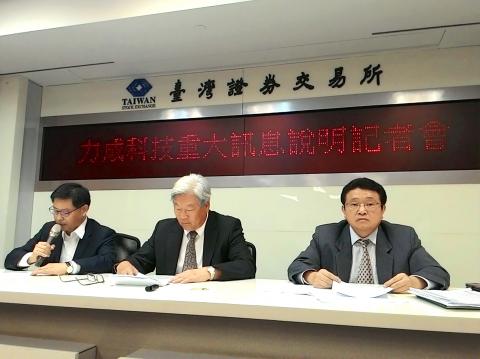
Photo: CNA
The Powertech deal follows Tsinghua’s efforts to expand its presence in the global semiconductor industry. It acquired RDA Microelectronics Inc (銳迪科技) two years ago after taking over Chinese handset chipmaker Spreadtrum Communications Inc (展訊).
In July, Tsinghua proposed buying Micron Technology Inc for US$23 billion, but the US memorychip giant rejected the offer.
Earlier this month, the Chinese firm reportedly poached Charles Kau (高啟全), former president of local DRAM chipmaker Nanya Technology Corp (南亞科技), to take charge of its memory business.
The latest deal, once it receives approval from the government, would make Powertech the first Chinese-invested Taiwanese chip packaging and testing service provider.
“Tsinghua aims to acquire key memorychip packaging and testing technologies,” market researcher TrendForce Corp (集邦科技) said.
“Tsinghua’s aggressive expansion plan will have a great impact on the landscape of the world’s DRAM industry,” it added.
Under an agreement signed yesterday, Powertech is to sell new shares via a private placement at NT$75 per share to the Chinese firm. The offer represents a 4.17 percent premium to Powertech’s closing price of NT$72 yesterday.
Tsinghua will become the biggest shareholder of Powertech after the transaction, which is expected to be completed by June next year.
Powertech plans to use most of the proceeds to build a new factory to provide 3D chip packaging services, Tsai said.
The company plans to start with an initial investment of NT$4 billion next year and is scouting land in Hukou Township (湖口), Hsinchu County, for the plant, he said.
Under the agreement, Tsinghua is to hold one seat on Powertech’s nine-seat board, which includes three independent directors.
The Chinese firm will not be involved in management and personnel decisions, and will be considered a pure equity investor, it said.
Powertech plans to hold an extraordinary shareholders’ meeting on Jan. 15 next year to discuss the share sale and its strategic partnership with Tsinghua.
The Investment Commission yesterday said it has not received Tsinghua’s application for the planned investment in Powertech.
“Once we receive it, we will transfer the application to a task force under the Industrial Development Bureau to see if there is any risk of Powertech’s critical technologies being leaked to the Chinese firm,” Investment Commission Executive Secretary Emile Chang (張銘斌) said by telephone.
The case will also be referred to the National Security Bureau for further evaluation, he said.
Current regulations cap Chinese companies’ investments in Taiwanese chip testing and packaging firms at 50 percent.
“But what is important is that Tsinghua will not have majority control of Powertech,” Chang said.
Additional reporting by Lauly Li
Taiwan Semiconductor Manufacturing Co (TSMC, 台積電), the world’s largest foundry service provider, yesterday said that global semiconductor revenue is projected to hit US$1.5 trillion in 2030, after the figure exceeds US$1 trillion this year, as artificial intelligence (AI) demand boosts consumption of token and compute power. “We are still at the beginning of the AI revolution, but we already see a significant impact across the whole semiconductor ecosystem,” TSMC deputy cochief operating officer Kevin Zhang (張曉強) said at the company’s annual technology symposium in Hsinchu City. “It is fair to say that in the past decade, smartphones and other mobile devices were
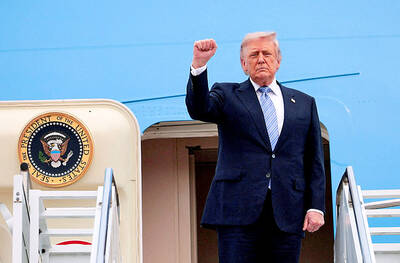
US-CHINA SUMMIT: MOFA welcomed US reassurance of no change in its Taiwan policy; Trump said he did not comment when Xi talked of opposing independence US President Donald Trump yesterday said he has not made a decision on whether to move forward with a major arms package for Taiwan after hearing concerns about it from Chinese President Xi Jinping (習近平). Trump’s comments on Taiwan came as he flew back to Washington after wrapping up critical talks in which both leaders said important progress was made in stabilizing US-China relations even as deep differences persist between the world’s two biggest powers on Iran and Taiwan. “I will make a determination,” Trump said, adding: “I’ll be making decisions. But, you know, I think the last thing we need right
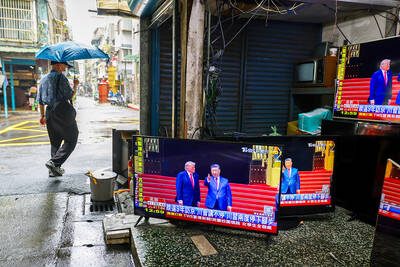
TAIWAN ISSUE: US treasury secretary Scott Bessent said on the first day of meetings that ‘it wouldn’t be a US-China summit without the Taiwan issue coming up’ There were no surprises on the first day of the summit between US President Donald Trump and Chinese President Xi Jinping (習近平), the Mainland Affairs Council (MAC) said yesterday, as the government reiterated that cross-strait stability is crucial to the Asia-Pacific region, as well as the world. As the two presidents met for a highly anticipated summit yesterday, Chinese state media reported that Xi warned Trump that missteps regarding Taiwan could push their two countries into “conflict.” Trump arrived in China with accolades for his host, calling Xi a “great leader” and “friend,” and extending an invitation to visit the White House
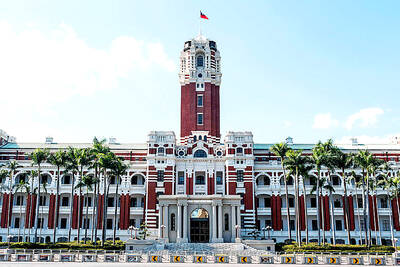
SECURITY: Taipei presses the US for arms supplies, saying the arms sales are not only a reflection of the US security commitment to Taiwan but also serve as a mutual deterrent against regional threats Taiwan is committed to preserving the cross-strait “status quo” and contributing to regional peace and stability, the Presidential Office said yesterday. “It is an undeniable fact that the Republic of China is a sovereign and independent democratic nation,” Presidential Office spokeswoman Karen Kuo (郭雅慧) reiterated, adding that Beijing has no right to claim sovereignty over Taiwan. The statements came after US President Donald Trump warned against Taiwanese independence. Trump wrapped up a state visit to Beijing on Friday, during which Chinese President Xi Jinping (習近平) had pressed him not to support Taiwan. Taiwan depends heavily on US security backing to deter China from carrying


 RSS
RSS