


Chinese Nationalist Party (KMT) presidential candidate Eric Chu (朱立倫) yesterday said that the 1945 “retrocession of Taiwan to the Republic of China (ROC)” is a historical fact that should be recognized by both the ruling and opposition parties.
“Seventy years ago today, the ROC’s military forces defeated Imperial Japan to secure victory in the eight-year War of Resistance Against Japan, allowing Taiwan to return to its embrace,” Chu said in an address at a commemorative event held in New Taipei City to mark the 70th anniversary of Japan’s surrender of Taiwan.
Urging the public to maintain a “thankful heart,” Chu said he would like to express his sincerest gratitude to all the heroes who fought in the war against Japan, the forebears of the ROC and each individual who dedicated their service to Taiwan over the past seven decades.
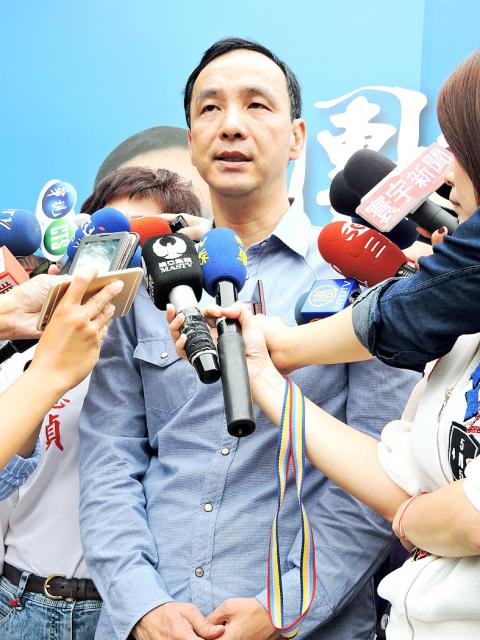
Photo: Lai Hsiao-tung, Taipei Times
On the sidelines of the event, Chu said he was concerned about what the Democratic Progressive Party’s (DPP) stance and views were on the “historical fact” that Taiwan was “recovered by the ROC.”
“The period between the Japanese colonization and the ROC’s recovery of Taiwan was a piece of history jointly faced by the people of Taiwan that should be respected,” Chu said, expressing his hope that no more controversies would be stirred up by political parties’ divided views on the matter.
Many Taiwanese historians and academics have taken issue with the KMT over its long-standing claims that Chiang Kai-shek’s (蔣介石) troops were the ones who liberated Taiwan and returned it to China’s control following Japan’s defeat in World War II.
Some have argued that Taiwan was liberated by the US, as the defeat of Japan was the result of a US offensive in the Pacific.
Others dismiss the notion that Japan’s renouncement of sovereignty over Taiwan meant the island returned to China’s control, saying that neither the 1951 Treaty of San Francisco nor the 1952 Treaty of Taipei, between the KMT and Japan, designated a specific country to assume sovereignty over Taiwan.
When asked by reporters about Chu’s call for her to recognize the “historical fact” that the ROC reclaimed Taiwan after the end of the war, DPP presidential candidate Tsai Ing-wen (蔡英文) played down the issue, saying that she already made her views about the ROC abundantly clear at the Double Ten National Day celebrations earlier this month and declined to elaborate.
Chu also dodged questions about the likelihood of him pairing up with Legislative Speaker Wang Jin-pyng (王金平) for the presidential election.
“Most [KMT] lawmakers want Wang to remain in the Legislative Yuan because of his substantial experience leading the legislature. I respect their opinions,” Chu said, adding that Wang would also respect the party’s decisionmaking mechanism.
Chu then reiterated the KMT’s plan to revise its regulations to lift a self-imposed three-term limit on the legislative speaker’s legislator-at-large seat, a move Chu said the party hopes will promote neutrality and objectivity in the speakership.
Regarding former New Party legislator Chao Shao-kang’s (趙少康) recent calls for Chu to distance himself from President Ma Ying-jeou (馬英九) to bolster his campaign, Chu said there should be no question about disassociation from the president.
“Instead, I intend to do better than the current administration in aspects where it has already performed satisfactorily, such as cross-strait policies, and to reflect on where its performance has been lackluster, such as the planned 12-year national education system, and push for improvements,” Chu said.
Additional reporting by Loa Iok-sin
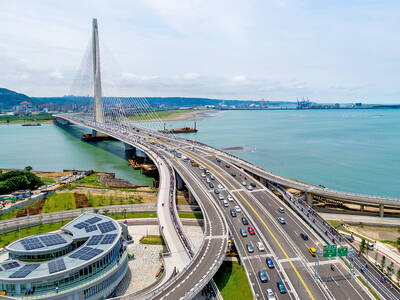
The Ministry of Transportation and Communications yesterday inaugurated the Danjiang Bridge across the Tamsui River in New Taipei City, saying that the structure would be an architectural icon and traffic artery for Taiwan. Feted as a major engineering achievement, the Danjiang Bridge is 920m long, 211m tall at the top of its pylon, and is the longest single-pylon asymmetric cable-stayed bridge in the world, the government’s Web site for the structure said. It was designed by late Iraqi-British architect Zaha Hadid. The structure, with a maximum deck of 70m, accommodates road and light rail traffic, and affords a 200m navigation channel for boats,
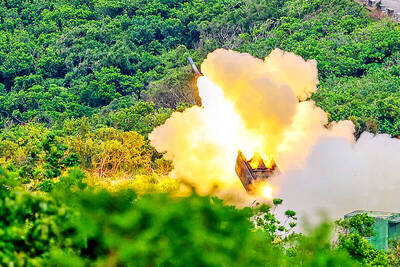
PRECISION STRIKES: The most significant reason to deploy HIMARS to outlying islands is to establish a ‘dead zone’ that the PLA would not dare enter, a source said A High Mobility Artillery Rocket System (HIMARS) would be deployed to Penghu County and Dongyin Island (東引) in Lienchiang County (Matsu) to force the Chinese military to retreat at least 100km from the coastline, a military source said yesterday. Taiwan has been procuring HIMARS and Army Tactical Missile Systems (ATACMS) from the US in batches. Once all batches have been delivered, Taiwan would possess 111 HIMARS units and 504 ATACMS, which have a range of 300km. Considering that “offense is the best defense,” the military plans to forward-deploy the systems to outlying islands such as Penghu and Dongyin so that
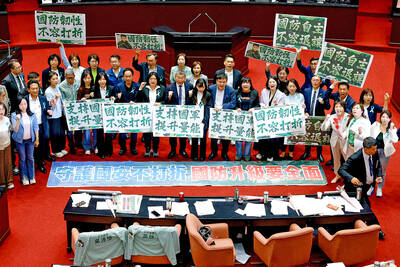
WHAT WAS ALL THAT FOR? Jaw Shaw-kong said that Cheng Li-wen had pushed for more drastic cuts and attacked him, just for the outcome to be nearly identical to his bill The legislature yesterday passed a supplementary budget bill to fund the purchase of separate packages of US military equipment, with the combined amount of spending capped at NT$780 billion (US$24.8 billion). The Chinese Nationalist Party (KMT) and Taiwan People’s Party (TPP) used their legislative majority to pass the bill, which runs until 2033 and has two main funding provisions. One was for NT$300 billion of arms sales already approved by the US for Taiwan on Dec. 17 last year, the other was for NT$480 billion for another arms package expected to be announced by Washington. The bill, which fell short of the NT$1.25
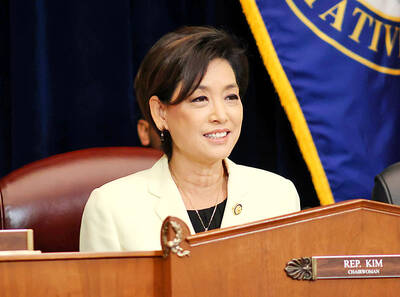
‘CLEAR MESSAGE’: The bill would set up an interagency ‘tiger team’ to review sanctions tools and other economic options to help deter any Chinese aggression toward Taiwan US Representative Young Kim has introduced a bill to deter Chinese aggression against Taiwan, calling for an interagency “tiger team” to preplan coordinated sanctions and economic measures in response to possible Chinese military or political action against Taiwan. “[Chinese President] Xi Jinping [習近平] has directed the People’s Liberation Army to be ready to invade Taiwan by 2027. China has a plan. America should have one too,” Kim said in a news release on Thursday last week. She introduced the “Deter PRC [People’s Republic of China] aggression against Taiwan act” to “ensure the US has a coordinated sanctions strategy ready should


 RSS
RSS