


While the call to replace Hung Hsiu-chu (洪秀柱) as the Chinese Nationalist Party (KMT) presidential candidate was voiced loudly at the party’s Central Standing Committee meeting yesterday, angry Hung supporters gathered outside KMT headquarters in Taipei to protest a plan to replace Hung, demanding that KMT Chairman Eric Chu (朱立倫) resign.
More than a hundred supporters, many clad in red and blue, rallied yesterday afternoon outside the building, behind a line of police officers and blockades set up in front.
At least five groups, including the White Justice Alliance, had rallied Hung’s supporters on Facebook before yesterday’s protest as the party’s Central Standing Committee mulled calling an extempore party congress to pass a resolution to replace the deputy legislative speaker as the KMT’s presidential candidate.

Photo: Chien Jung-fong, Taipei Times
The crowd raised various banners rooting for Hung, castigating Chu and calling on the KMT to stay true to its principles.
“Our opponent is [Democratic Progressive Party (DPP) presidential candidate] Tsai [Ing-wen (蔡英文)]” and “The 100-year-old party is depending on Hung for change” were among the slogans.
The supporters were predominantly elderly, with just a few young people spotted among the crowd.
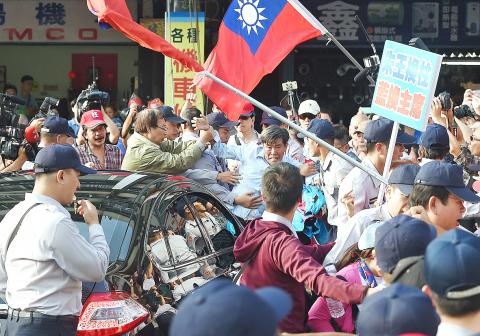
Photo: Liao Chen-huei, Taipei Times
China Unification Promotion Party Chairman Chang An-le (張安樂), also known as the “White Wolf,” appeared for a short period of time, shouting his opposition to the KMT’s plan to remove Hung from the race.
“What is wrong with calling for an ultimate unification [between Taiwan and China]?” Chang asked. “If you are called the Chinese Nationalist Party, you should not object to unification.”
“The KMT has ended up in this mess because it does not dare admit that it is Chinese,” he said, asking why none of the KMT heavyweights had borne the responsibility of running for president in May and had to let “Hung, a little girl” do so.
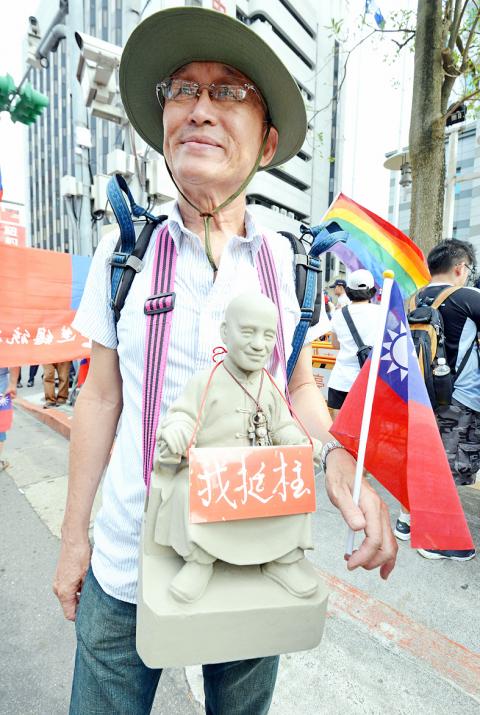
Photo: Sam Yeh. AFP
There were also some unexpected protesters in the crowd.
A group of former freeway toll collectors, accompanied by labor activists, were there to accuse both the KMT and the DPP of failing to propose a solution for workers laid off when the nation switched to an electronic toll collection system in January last year.
They were criticized by Hung’s supporters, who questioned “their intentions and why they were not busy looking for jobs.”
“The workers’ stance is that whoever takes care of the workers will get our vote,” the former toll collectors said.
Gay rights activist Chi Chia-wei (祁家威), holding a rainbow-colored flag and claiming to represent pan-blue gays, said he had joined the protest because he believes Hung would be supportive of the marriage equality campaign.
“I know that quite a few members of her campaign team are gay, meaning that Hung is actually supporting us in a substantive way,” Chi said.
When asked about the fact that Hung had not openly voiced her support for same-sex marriage, Chi said that what he cares about is the concrete assistance that politicians provide, citing former KMT Taipei City councilor — and current KMT spokesperson — Lin Yi-hua (林奕華), who Chi said had helped the gay community many times during her term as a councilor.
He said he did not think Tsai would push for same-sex marriage “because, unlike Hung, she has been accused of being gay, and like [President] Ma [Ying-jeou (馬英九)], she would not proactively push the passage of a bill for fear of being labeled.”
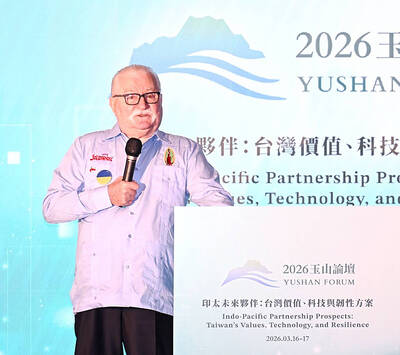
RECOGNITION: Former Fijian prime minister Mahendra Chaudhry said that Taiwan’s New Southbound Policy serves as a stabilizing force in the Indo-Pacific region Taiwan can lead the unification of the Chinese people, Nobel Peace Prize laureate and former Polish president Lech Walesa said in Taipei yesterday, adding that as the world order is changing, peaceful discussion would find good solutions, and that the use of force and coercion would always fail. Walesa made the remarks during his keynote address at a luncheon of the Yushan Forum in Taipei, titled “Indo-Pacific Partnership Prospects: Taiwan’s Values, Technology and Resilience,” organized by the Taiwan-Asia Exchange Foundation with the Ministry of Foreign Affairs. Walesa said that he had been at the forefront of a big peaceful revolution and “if
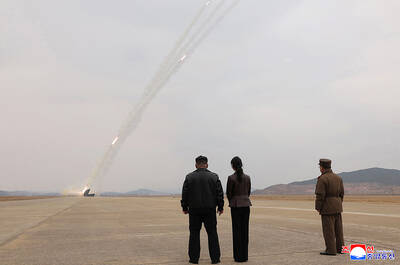
North Korea tested nuclear-capable rocket launchers, state media reported yesterday, a day after Seoul detected the launch of about 10 ballistic missiles. The test comes after South Korean and US forces launched their springtime military drills, due to run until Thursday. North Korean leader Kim Jong-un on Saturday oversaw the testing of the multiple rocket launcher system (MRLS), the Korean Central News Agency (KCNA) said. The test involved 12 600mm-caliber ultra-precision multiple rocket launchers and two artillery companies, it said. Kim said the drill gave Pyongyang’s enemies, within the 420km striking range, a sense of “uneasiness” and “a deep understanding

North Korea yesterday fired about 10 ballistic missiles to the sea toward Japan, the South Korean Joint Chiefs of Staff (JCS) said, days after Pyongyang warned of “terrible consequences” over ongoing South Korea-US military drills. Pyongyang recently dashed hopes of a diplomatic thaw with Seoul, Washington’s security ally, describing its latest peace efforts as a “clumsy, deceptive farce.” Seoul’s military detected “around 10 ballistic missiles launched from the Sunan area in North Korea toward the East Sea [Sea of Japan] at around 1:20pm,” JCS said in a statement, referring to South Korea’s name for the body of water. The missiles

‘UNWAVERING FRIENDSHIP’: A representative of a Japanese group that co-organized a memorial, said he hopes Japanese never forget Taiwan’s kindness President William Lai (賴清德) yesterday marked the 15th anniversary of the Tohoku earthquake and tsunami, urging continued cooperation between Taiwan and Japan on disaster prevention and humanitarian assistance. Lai wrote on social media that Taiwan and Japan have always helped each other in the aftermath of major disasters. The magnitude 9 earthquake struck northeastern Japan on March 11, 2011, triggering a massive tsunami that claimed more than 19,000 lives, according to data from Japanese authorities. Following the disaster, Taiwan donated more than US$240 million in aid, making it one of the largest contributors of financial assistance to Japan. In addition to cash donations and


 RSS
RSS