


The Chinese Nationalist Party’s (KMT) Central Standing Committee yesterday passed a motion to hold an extempore party congress, with the apparent aim of removing Deputy Legislative Speaker Hung Hsiu-chu (洪秀柱) as the KMT’s presidential candidate and nominating KMT Chairman Eric Chu (朱立倫) instead.
The motion filed by KMT Central Standing Committee member Chiang Shuo-ping (江碩平) was passed unanimously without being put to a vote at an afternoon meeting, after it secured the signatures of 28 of the 39 members.
“If party representatives find it difficult to campaign for and boost the momentum of the party’s candidates, [the KMT leadership] is urged — for the sake of salvaging the party and its legislative election prospects — to change its current presidential candidate and let Chairman Chu shoulder the responsibility,” the motion read.
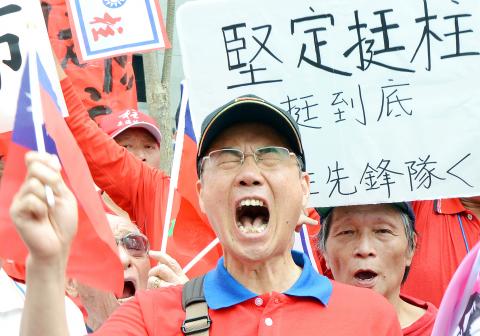
Photo: Sam Yeh, AFP
At a press conference held following the meeting, KMT Culture and Communications Committee director-general Lin Yi-hua (林奕華) said the date and location of the party congress is to be determined by KMT headquarters as soon as possible, hopefully before the end of this month.
Lin said Chu’s goal for the congress is to “consolidate a consensus and secure victory with party solidarity,” adding that the agenda of the congress was not discussed at the meeting.
Chiang said Chu reminded the committee members during the meeting that the KMT’s real enemies lie outside the party and called for concerted efforts between party headquarters and its members to continue active communication with Hung.
“Almost every committee member expressed their opinions at the meeting and they all acknowledged the arduous efforts the deputy legislative speaker has made in the past months,” Chiang said.
“Some members advised KMT headquarters to explore a more well-rounded way to persuade Hung to accept the voices and concerns of her peers, given that she has been a loyal party comrade,” he said.
Hung later issued a strongly worded press release expressing her “deep regret” over the committee’s decision, which she said would only plunge the KMT deeper into crisis.
“The party … does not belong to any individuals, party staff or its members, but rather to whoever cares about it. Without public support, the party cannot survive, and will even lose its meaning and reason for being,” Hung said.
While saying she respected the committee’s right to call an extempore party congress, Hung said the motives behind the passage of the motion were paradoxical and unjust.
Despite its disastrous defeat in last year’s nine-in-one elections, the KMT has yet to seriously reflect on its mistakes, and has continued to wallow in failure and shirk its responsibility, she said.
“It will be impractical for the KMT to refuse to undergo comprehensive self-reflection or acknowledge its own problems, while continuing to paper over the cracks. The party will subject itself to total collapse if it resorts to unjust measures and depends on misjudgement,” Hung said.
Hung said she believes society knows what is fair and just, and that history would eventually be her judge.
“I also believe that at such a critical time, the party representatives attending the congress will safeguard the integrity of the party, and the sense of right and wrong that the party is supposed to possess,” she said.
At an impromptu press conference about an hour later, Hung said she could not agree with Chu’s remarks that her cross-strait policies deviated from those of both the party and mainstream public opinion.
“If the party has concerns about my cross-strait policies, we could probably hold a debate or a forum to openly discuss the issue,” Hung said.
She said she has not considered withdrawing from the presidential race, adding that all she ever cared about was the future of the country and the younger generations, rather than fame or status.

National Taiwan University (NTU) yesterday said it disqualified a person from an entrance examination for using AI smart glasses to cheat, along with two others for making untruthful statements in their curriculum vitae. The three applicants were given null scores, Taiwan’s highest-ranked university said, calling on prospective students to be honest in the admissions process. NTU registrar Lee Hung-sen (李宏森) said that the cheating applicant wore a hat and thick-rimmed glasses to the second written exam for medical school, claiming that they felt cold. Suspicions were aroused when the applicant stared oddly at the test for long stretches while steadily bringing the paper

MILITARY ISSUES: A partisan divide between the Cabinet and the legislature ‘raised questions about Taiwan’s ability to adequately fund its defense,’ the report said Taiwan’s defense budget, military personnel numbers and resilience are challenges to its ability to meet national defense goals, the US Naval Institute said in a report published on Tuesday. In response to the perception of a growing military threat posed by China, Taiwan has embarked on an effort to enhance the capabilities needed to deter an attempt by Beijing to annex the nation by force, the institute said in the US Congressional Research Service report, titled Taiwan: Defense and Military Issues, which was filed on Thursday last week. Taiwan’s defense budget increased by about 7.5 percent from 2024 to last year, it

66 FIGHTER JETS: The aircraft is likely undergoing preparations for its transfer to Taiwan — a significant step forward in the nation’s modernization program, a lawmaker said The first of Taiwan’s order of F-16V Block 70 aircraft has been sighted in Texas ahead of delivery, Democratic Progressive Party (DPP) Legislator Wang Ting-yu (王定宇) said. Taiwan’s first F-16V Block 70 two-seat aircraft, tail number 6831, was seen flying from Lockheed Martin’s production facility in Greenville, South Carolina, to Naval Air Station Joint Reserve Base Fort Worth in Texas, Wang wrote on Facebook yesterday. The plane is likely undergoing preparations for its transfer to Taiwan, marking a significant step forward in the Republic of China Air Force’s modernization program, Wang said, citing military analysts. The F-16V Block 70 is a new-build version
NOT JUST NUMBERS: What matters to intelligence work is crucial, reliable information, so even a few credible leads can be highly valuable to national security, a legislator said The National Security Bureau (NSB) yesterday said it has finished the establishment of an information-reporting channel for Chinese nationals, the aim of which is to broaden intelligence gathering on China’s political, military, economic and social developments. Chinese nationals can submit information on the Web page, https://report.nsb.gov.tw, the NSB said in a statement. The move aims to expand the bureau’s diverse intelligence sources and is pursuant to the National Intelligence Services Act (國家情報工作法), it said, adding that it referenced practices adopted by intelligence agencies in the US, the UK and Israel. An increasing number of people are approaching Taiwanese agencies to provide information, as


 RSS
RSS